


Noah was six months old, though most strangers guessed younger. Illness had thinned him down to wide eyes, pale skin, and fists that opened and closed as if searching for something familiar. A ventilator tube taped at his mouth rose and dipped with the rhythm of the machine. Clear lines ran from a pole to his arm. A feeding tube disappeared beneath the blanket printed with blue whales, the one Claire had bought before she knew hospital blankets would become a permanent part of his life.
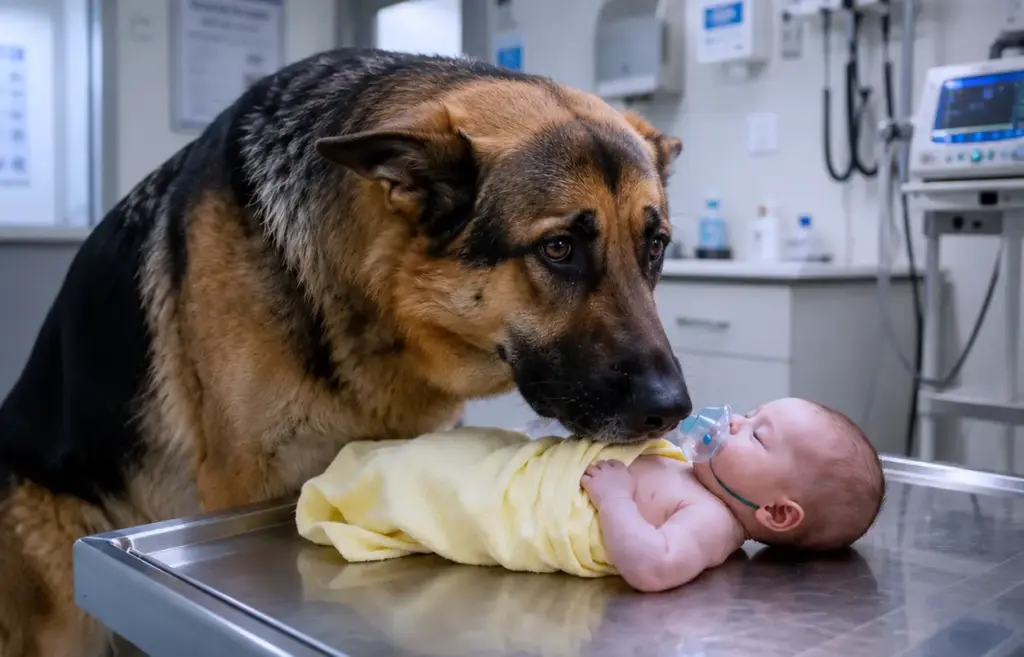
She rested two fingers lightly on his foot.
By the time Claire Bennett learned how to sleep sitting upright, the nurses on the fourth floor had stopped pretending the pediatric ICU was temporary. Her purse lived under the vinyl recliner. Her toothbrush sat in a paper cup beside the sink. There was a sweatshirt folded beneath Noah’s crib that still smelled faintly like home, though Claire could no longer remember when she had last been there long enough for anything to feel like hers. For ninety-three days, the world had been reduced to one glass-walled room, three humming machines, and the small boy inside the crib who had forgotten how to cry with any strength.
“Hey, little man,” she whispered. “It’s morning. You made it to morning.”
Noah did not open his eyes, but the monitor above him gave one steady beep, then another. Claire had learned to take comfort where she could find it. A normal number. A hand that felt warmer than yesterday. The way his lashes fluttered when she sang the first line of “You Are My Sunshine,” even if he never made it all the way back to her.
He had been admitted after a fever spiked so fast the ER nurse stopped asking routine questions and started shouting for respiratory support. At first, everyone had spoken in hard, hopeful verbs. Treat. Fight. Stabilize. Improve. Then the words began to change. Monitor. Manage. Support. Wait.
A week ago, the doctors had stopped saying when he gets better.
The door opened quietly behind her, and Ruth Alvarez stepped in carrying a medication tray against her hip. Ruth had worked nights at Briarwood Regional Medical Center for nearly thirty years. She wore her gray hair in a tight bun, kept peppermint candies in her scrub pockets, and had a way of touching Noah’s blanket as if she were straightening it for her own grandson.
“You eat anything yet?” Ruth asked.
Claire gave a tired little laugh. “You always start with the hard questions.”
“I start with the ones nobody else asks.” Ruth checked the IV pump, then leaned close enough to read the tiny numbers on the ventilator screen. “Dr. Patel’s on his way up. He wants to talk to you.”
Claire’s fingers tightened around Noah’s foot. “Is it bad?”
Ruth did not answer too quickly. That was how Claire knew.
The older nurse adjusted the blanket at Noah’s chest, smoothing one corner with the flat of her hand. “He’ll explain everything.”
“That’s not what I asked.”
Ruth looked at her then, and the soft pity in her face made Claire wish she had not pressed. “I know, honey.”
After Ruth left, Claire sat very still, listening to the machines fill the space where courage was supposed to be. She had become fluent in hospital silence. The quiet before bad news had a texture to it. Doctors stopped making eye contact. Nurses lingered near the door. Specialists used careful phrases that had been polished smooth by repetition.
Noah’s chest rose beneath the blanket. Fell. Rose again.
Claire bent over him and pressed her mouth close to his damp forehead without disturbing the tape on his cheeks. “Whatever he says,” she whispered, “you and me are still us. Okay? Nobody gets to change that.”
Dr. Aaron Patel arrived ten minutes later with a tablet tucked under one arm and no residents trailing behind him. That was another sign. He was a kind man in his early forties, with tired eyes and a habit of removing his glasses when he had to say something difficult. He did that now before he pulled the second chair close to Claire’s.
She hated the chair before he even sat down.
“Claire,” he began, “Noah’s infection is no longer responding the way we need it to. We’ve used the strongest medication combinations we can safely give him. We’ve consulted with the infectious disease team in Chicago and the pediatric specialists downtown.”
Claire nodded, though she understood less from the words than from the pace of his voice. He was slowing down for her. Giving her time to catch up to something she did not want to know.
“What does that mean?” she asked.
Dr. Patel looked at Noah before he looked back at her. “His kidneys and liver are under serious strain. His labs show his body is working too hard just to maintain basic function. I wish I had another treatment to recommend today, but right now our focus needs to shift.”
“No.”
The word came out before he finished. It was small, not dramatic, but it was the strongest thing Claire had left.
Dr. Patel folded his hands. “I’m so sorry.”
“No,” she said again, because the first time had not changed anything. “He’s six months old. He hasn’t even sat up by himself yet. You don’t get to tell me we’re out of things.”
“I know this feels impossible.”
“It doesn’t feel impossible. It is impossible.” Claire stood because sitting made her feel trapped. “There are trials. There are hospitals. There are doctors who spend their whole lives figuring out the thing nobody else figured out.”
“We’ve looked,” he said gently. “I promise you, we’ve looked.”
Claire wanted to be furious at him. It would have been easier if he had sounded dismissive, if he had hidden behind policy or ego. But his grief was real, and that made the conversation worse. The people trying to save Noah were tired too.
Dr. Patel let her stand there for a moment. Then he said, “I think we need to discuss comfort-focused care.”
Claire turned back toward the crib. Noah’s mouth was slack around the tube. One soft brown curl stuck to his forehead, the same color as the man who had stopped coming after the first month, when hope started costing more than he could bear.
Comfort-focused care.
The phrase moved through Claire’s mind like a locked door.
She reached into the crib opening and stroked Noah’s hair with the back of one finger. For an instant, she did not see the tube or the bruised skin around his IV site. She saw him at three months, awake and round-cheeked, staring with solemn wonder at the enormous dog beside his crib.
Ranger.
The memory struck so suddenly that she turned back to Dr. Patel.
“What about Ranger?” she asked.
Dr. Patel blinked. “The therapy dog?”
“He helped him.” Claire heard urgency rising in her own voice and did not care. “You saw it. Everyone saw it. Noah’s heart rate would settle when Ranger came in. He opened his eyes. He smiled at him.”
Dr. Patel’s expression changed. Not hope exactly, but recognition.
“Claire…”
“Please,” she said. “I’m not asking you for a miracle drug. I’m asking for a dog. One visit. Ten minutes.”
“The animal-assisted therapy program was suspended last month.”
“Because of money,” Claire said. “Because some administrator decided it wasn’t worth funding.”
Dr. Patel exhaled through his nose. “There were budget decisions, yes. There were also infection-control concerns.”
“Ranger was cleaner than half the people walking in here with visitor badges.” Her voice cracked on the last word. She hated that, hated sounding as desperate as she was. “He’s certified. He wore the hospital vest. He knew how to be near the equipment.”
“I can ask,” Dr. Patel said.
Claire stepped closer to him. “Don’t ask like it’s paperwork. Ask like it matters.”
Something tightened in his face. “It does matter.”
“Then make them hear that.”
He nodded once, quietly. “I’ll speak to Dr. Calder.”
The name made Claire’s stomach pull inward. Dr. Vivian Calder was Briarwood’s chief administrator and the person whose framed photograph appeared in glossy donor brochures all over the hospital. Claire had seen her twice in three months, both times surrounded by people in suits. Calder never looked at rooms like Noah’s as if children lived inside them. She looked at them the way real estate agents looked at kitchens—evaluating light, angles, and what could be improved before a showing.
For the next four hours, Claire waited.
She sang when Noah’s oxygen dipped. She counted the squares in the ceiling tile. She answered a call from the billing office with a voice so flat the woman on the other end softened and said she could call back another time. Claire almost laughed. Another time had become the cruelest phrase in the English language.
Ruth came in just after lunch with fresh linens and a cup of coffee Claire had not asked for.
“You’ll burn a hole in that floor with all the pacing,” Ruth said.
Claire stopped moving. “Did you hear anything?”
Ruth’s mouth tightened. “Dr. Patel went up to administration.”
“That’s not an answer.”
“No,” Ruth said softly. “It’s not.”
A little after two, the hallway changed. Claire noticed it before the door opened. The unit secretary straightened at her desk. A resident stepped out of the way. The steady sound of expensive heels came down the corridor, too sharp and confident for a place where families walked like they were afraid of waking fate.
Dr. Vivian Calder entered without knocking.
She was tall, immaculately dressed, and composed in the manner of someone who had never once been forced to sleep in a chair beside a dying child. Her cream blazer was tailored perfectly. Her hair was smooth, her nails pale and glossy, her hospital badge clipped to a silk blouse instead of scrubs. Dr. Patel followed half a step behind her, his jaw set.
“Ms. Bennett,” Calder said. “Dr. Patel tells me you’ve made a request regarding a former therapy animal.”
Claire kept one hand on Noah’s crib rail. “His name is Ranger.”
Calder’s smile was professional and empty. “Yes. Ranger. Unfortunately, that won’t be possible.”
Claire felt the denial land before the words finished. “Why?”
“Our animal-assisted care program is no longer active, and the pediatric intensive care unit is under heightened protocol restrictions this week.”
“Because of the donor event?”
Calder’s eyes flickered, just once. “Because this hospital is responsible for maintaining the safest possible environment for every child on this floor.”
“Ranger came here for months.”
“Under a program that no longer exists.”
“He made my son calmer.”
“I understand that you believe that.”
Claire stared at her. The sentence was so carefully built that it almost hid the insult inside it.
Dr. Patel shifted. “Vivian, given Noah’s current status, I do think there’s room for a compassionate exception.”
Calder did not look at him. “The answer remains no.”
Claire’s throat worked. “He’s dying.”
For the first time, Calder’s expression changed. Not with compassion. With irritation at having the word spoken plainly.
“My understanding,” she said, “is that Noah remains under active medical supervision.”
“You know exactly what I mean.”
“I know that grief can make families cling to familiar comforts,” Calder replied. “But I cannot compromise hospital policy because a parent is emotional.”
Ruth, standing near the medication cabinet, went very still.
Claire stepped away from the crib rail. “A parent is emotional? That’s what you see when you look at me?”
Calder’s voice lowered. “Ms. Bennett, next week the Blackwell Family Foundation will tour this unit. Their continued support is essential to our pediatric expansion, including equipment that benefits children like your son. We cannot have unsanctioned animals in restricted clinical areas while we are under review.”
“There it is,” Claire said.
“Excuse me?”
“My baby gets ten minutes of comfort only if it doesn’t mess with your rich-people tour.”
Calder’s mouth flattened. “I’m going to give you grace because of your circumstances.”
“I don’t want your grace.”
“Then I’ll give you clarity.” Calder took one step closer, her heels silent now on the polished floor. “No unauthorized animals will enter this unit. If you attempt to violate that policy, security will be involved. I am sorry your son is ill, but my responsibility is to the entire hospital.”
Claire looked at Noah, at the tube taped to his mouth, at the tiny fingers curled loosely against the blanket. The rage inside her was not loud. It was cold and clean and so focused it steadied her hands.
“Your responsibility,” she said, “is to the children in these rooms. You keep forgetting that.”
Calder gave a brief nod, the kind powerful people used when they had already stopped listening. “Dr. Patel will continue to keep you informed.”
She left with the same crisp steps, taking the air with her.
No one spoke for several seconds. Dr. Patel looked ashamed. Ruth looked furious. Claire looked at the doorway until it blurred.
“I’m sorry,” Dr. Patel said.
Claire sat down slowly. The chair creaked beneath her. “Don’t say that unless it changes something.”
He had no answer for that.
That evening, the lights over Noah’s bed were dimmed, and the whole unit settled into its night rhythm. Machines beeped softly behind closed doors. Nurses murmured at the central station. Somewhere down the hall, a baby let out one thin cry, and Claire’s body responded before her mind did, tensing with the animal fear that belonged only to mothers in hospitals.
Ruth came in near nine with Noah’s medication. She checked the pump, adjusted his blanket, and pretended not to notice that Claire had been crying.
“I remember the first day Ranger came up here,” Ruth said quietly. “Big old dog walked in like he owned the place. Scared Dr. Levin half to death.”
Despite herself, Claire smiled. “Noah grabbed his ear.”
“Ranger let him.”
“He always did.”
Ruth glanced toward the door, then lowered her voice. “His handler was Jack Mercer. Retired fire captain, search-and-rescue background. He loved this program.”
Claire’s pulse changed. “You know him?”
“I know of him.”
“Ruth.”
The nurse busied herself with the tubing, though there was nothing left to adjust. “There are rules about giving out personal information.”
“I’m not asking you to break the rules.”
Ruth looked at her over the top of her glasses. “No. You’re asking me to be human, which administration considers much worse.”
Claire pressed her lips together.
Ruth reached into her scrub pocket and removed her phone. She tapped the screen a few times, then laid it faceup on the narrow counter beside the sink. “I’m getting old,” she said in a perfectly ordinary voice. “Sometimes I set things down and forget them. Sometimes I leave a screen open while I go check on another patient. It’s embarrassing.”
Claire’s eyes stung. “Ruth…”
“I’ll be back in ten minutes.” Ruth walked to the door, then paused. “And Claire? Whatever you decide to do, think like a mother, not like a cornered woman. There’s a difference.”
After she left, Claire stood frozen beside the sink.
The phone screen glowed. A contact card was open.
Jack Mercer — Ranger K-9 Services.
Claire copied the number onto the back of an old parking receipt with a hand that shook so badly she nearly tore the paper. Then she stood over Noah’s crib, looking at the child who had survived every prediction except the last one.
“I’m going to try,” she whispered. “I don’t know if trying is enough, but I’m going to do it anyway.”
Noah’s fingers twitched against the blanket.
Claire took that as permission.
Jack Mercer answered on the fourth ring.
Claire had expected voicemail. She had prepared for it, rehearsed what to say in a whisper while standing in the dim family bathroom with the faucet running so no one would hear her. Instead, a man’s voice came through the line, rough with sleep and caution…
To read the rest of the story – CLICK the NEXT button 👇👇👇