


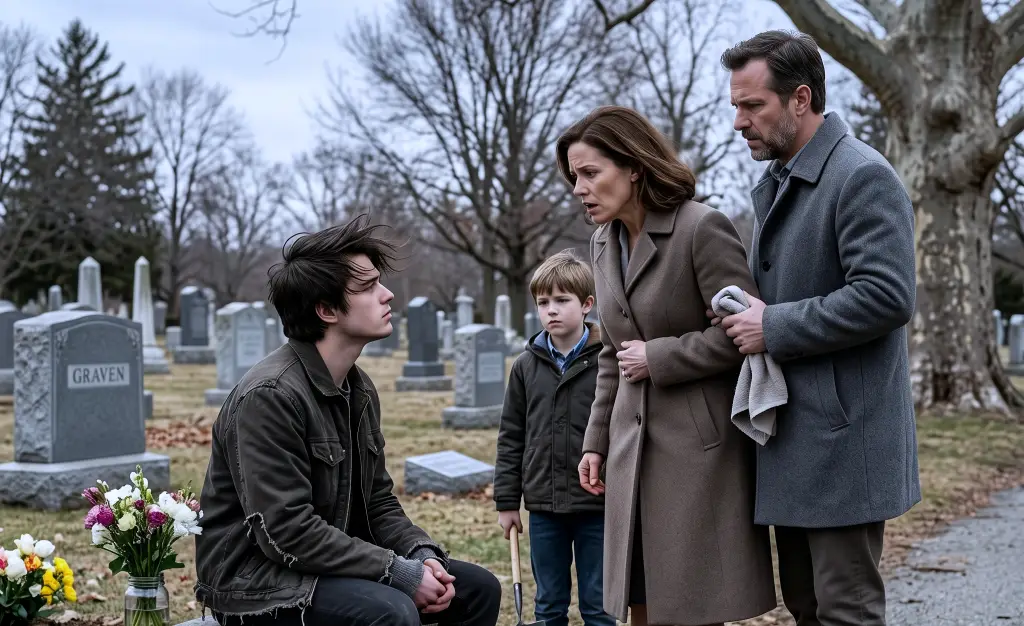
Grace Parker saw her son at Maple Ridge Cemetery on a windy Saturday in March, standing beside a grave that did not belong to anyone in their family. At first, she thought the Navy had sent Ethan home early and he had decided, in that strange quiet way of his, to surprise them. The young man was sitting on a stone bench near the old sycamore tree, elbows on his knees, hands folded loosely between them. His dark hair lifted in the cold breeze. His shoulders had the same shape Grace had memorized from every photograph Ethan had texted from base, every video call, every doorway he had walked through and then left again.
For one foolish, impossible second, her body believed before her mind could object.
“Ethan?” she called.
The young man looked up.
Grace stopped so suddenly that her younger son, Caleb, bumped into her from behind with the small rake he had been using to clear leaves from his grandmother’s grave.
The face was Ethan’s.
Not almost. Not vaguely. Ethan’s straight nose, Ethan’s jaw, Ethan’s guarded eyes, even the small crease between the brows that appeared whenever he was trying to decide whether to answer honestly or politely. But this young man’s hair was a little longer. His jacket was worn at the cuffs. His expression did not soften when he saw her.
It closed.
“Ma’am,” he said carefully, “I think you’ve got the wrong person.”
Grace heard Daniel’s footsteps behind her on the gravel path. He had been kneeling by her mother’s headstone a moment earlier, brushing dirt from the carved letters with a towel he kept in the trunk for that purpose. When he reached her side, he followed her gaze and went completely still.
The young man noticed. His eyes moved from Grace to Daniel, then down to Caleb, who had frozen with the rake in both hands.
“I’m sorry,” the young man said, rising from the bench. “Do I know you?”
Grace opened her mouth. No sound came out.
Daniel was the one who answered, though his voice had lost the calm weight it usually carried. “What’s your name?”
The young man’s posture changed. Not dramatically. Just enough that Grace saw him prepare to leave.
“Lucas,” he said. “Lucas Bennett.”
Bennett.
The name meant nothing to her. It should have meant nothing. But the sound of it landed inside her with a coldness she could not explain.
Daniel took a step closer, then seemed to think better of it. “Do you live around here, Lucas?”
“Near downtown.” Lucas looked past them toward the cemetery road, where a few cars sat under bare trees. “Look, I don’t mean to be rude, but I came here to visit my mother. I don’t know what this is.”
His mother.
Grace’s eyes moved to the grave behind him. Fresh flowers leaned in a mason jar against a modest stone. The grass there had not fully settled yet, and the dirt was still darker than the ground around it.
Elaine Bennett
Beloved Mother
1974–2026
The dates blurred.
Grace pressed a hand to her mouth. Daniel saw the motion and reached for her, but she barely felt his touch.
Lucas followed her gaze, and something sharp crossed his face. “Did you know her?”
Daniel’s fingers tightened around Grace’s elbow. She knew he was trying to hold her steady, but he was shaking too.
“Twenty years ago,” he said slowly, “our newborn son was taken from St. Anne’s Regional Medical Center.”
Lucas stared at him.
Grace heard the wind scraping dry leaves along the path. She heard Caleb whisper, “Mom?” from behind her. She heard her own breathing, thin and uneven, as if the air had become too narrow to pull into her lungs.
Daniel reached into his coat pocket with the stiff, careful motion of a man afraid sudden movement might frighten away a wounded animal. He took out his wallet and removed a business card from the small construction company he owned.
“I’m not saying you have to believe us,” Daniel said. “You shouldn’t, not standing here with strangers. But please take this. Our address is on the back. My number too.”
Lucas did not reach for it.
His eyes had gone hard now, but not because he felt nothing. Grace recognized that look from Ethan. It was what men in their family did when feeling too much would cost them more than they could afford in public.
“You think I’m your missing kid?” Lucas asked.
Daniel swallowed. “I think you need to hear the whole story.”
Lucas gave a short, humorless laugh. “No. I think you saw somebody who looks like your son, and now you’re standing over my mother’s grave telling me something insane.”
Grace flinched at the word mother. Lucas saw it. For a second, something like regret passed through his expression, but it vanished before it could become kindness.
“I’m sorry for whatever happened to you,” he said. “I really am. But I can’t do this.”
He stepped around Daniel and started down the path.
Grace moved before she knew she had decided to move. “Please.”
The word stopped him, though he did not turn around.
She had imagined this moment for twenty years in a thousand impossible forms. A phone call. A detective at the door. A grown man knocking after midnight. A hospital record discovered by accident. A stranger in a grocery store. She had prepared speeches in the shower, in the car, in the dark beside Daniel while he pretended to sleep.
Now all she had was one word.
“Please,” she said again, softer.
Lucas turned just enough to look back.
Daniel held out the card.
After a long moment, Lucas took it between two fingers, as if it might burn him. He did not look at the address. He put it in his jacket pocket and walked away.
Grace watched until he passed through the iron gate and disappeared behind a row of parked cars. Then her knees weakened. Daniel caught her before she could fall, and Caleb dropped the rake with a clatter that sounded far too loud among the graves.
“Was that Ethan?” Caleb asked, frightened now. “Dad, who was that?”
Daniel did not answer right away. He looked at Grace with a terror she had not seen in his face since the morning everything began.
“No,” Grace whispered, though she was not answering Caleb anymore. “Not Ethan.”
Twenty years earlier, Grace Parker had left for the hospital with a packed bag by the front door, two car seats in the back seat of Daniel’s truck, and one hand pressed to the side of her belly where one of the babies had been pushing hard against her ribs since dawn.
They had waited seven years to become parents.
Seven years of polite smiles at baby showers. Seven years of doctors’ offices and blood tests, of calendars marked in pencil, of hope rising and collapsing so often that Grace had begun to distrust happiness whenever it came too close. Daniel never said he was tired of hoping. He just learned to cook dinner quietly on the bad days and to keep his disappointment folded small enough that she would not blame herself for carrying both of theirs.
When the ultrasound technician finally turned the screen and said, “There are two heartbeats,” Grace laughed because she thought she had misheard.
Daniel cried.
He tried to hide it by taking off his glasses and wiping them on his shirt, but the nurse saw, and Grace saw, and neither of them said anything because there are moments too tender to touch with teasing.
They painted the nursery a pale green because Grace refused to make the room too certain before the babies arrived. Daniel assembled one crib, then stood in the doorway staring at the empty space beside it until he drove back to the store and bought another one. By the eighth month, the room smelled faintly of fresh paint, baby detergent, and the cedar chest where Grace had stored tiny sleepers she still felt afraid to remove from their tags.
At St. Anne’s, the delivery was long but ordinary, which later became its own kind of cruelty. No storm. No fire. No dramatic warning. Just fluorescent lights, nurses changing shifts, Daniel counting breaths because the childbirth class had told him to do that, and Grace crushing his hand while insisting she was not crushing it.
The first baby came just after 3:00 a.m.
“A boy,” the doctor said.
Daniel bent over Grace’s shoulder, laughing and crying at once. “Grace. Grace, look at him.”
The second arrived seventeen minutes later, smaller but louder, furious at the cold and the brightness. The nurse wrapped both babies in blue-striped blankets and placed them near Grace’s face. One opened his mouth in a silent yawn. The other curled a fist around Daniel’s finger with astonishing strength.
They named the first Ethan Daniel Parker.
They named the second Noah James Parker.
Grace repeated the names under her breath all morning, afraid that if she stopped saying them, the miracle might become too large and disappear.
For two days, their room filled with soft congratulations. Grace’s mother came with soup no one ate. Daniel’s brother brought balloons that bumped against the ceiling. Nurses came and went, checking bracelets, taking temperatures, adjusting blankets. The boys slept in bassinets side by side, two small bundled proofs that suffering could lead somewhere other than more suffering.
On the second morning, Daniel left to get coffee from the cafeteria and call his mother. Grace was half asleep, one hand resting near Ethan’s bassinet, when a nurse came to take Noah for a routine check.
Grace remembered the nurse’s badge later, or thought she did. She remembered dark hair pulled back. She remembered a soft voice. She remembered being told, “We’ll bring him right back.”
For years, she hated herself most for that.
She had nodded.
She had let go.
Daniel returned with two coffees and a blueberry muffin he had bought because Grace had asked for one the day before. He found three hospital employees in the room and no baby in Noah’s bassinet.
At first, Grace thought there had been a mistake. A paperwork issue. A room change. Something irritating but fixable. Then a security officer appeared in the doorway, followed by a man in a gray suit who introduced himself as Detective Warren Hale from the Cedar Falls Police Department.
No one said kidnapped.
Not at first.
They said “unaccounted for.” They said “we’re checking every exit.” They said “we need you to remain calm.” They said “there may have been a mix-up.”
Grace kept asking for Noah until the words no longer sounded like language.
Daniel stood beside the empty bassinet with his coffee still in his hand. It had gone cold by the time someone gently took it from him.
The hospital locked down the maternity floor. Officers reviewed camera footage. Nurses gave statements. Administrators moved through the hallways with pale faces and clipped voices. A woman with a clipboard asked Grace questions she could not answer: Had anyone unusual visited? Had anyone asked about the twins? Had she noticed a staff member she did not recognize?
Grace stared at the second bassinet, where Ethan slept through the beginning of his family’s ruin.
By evening, the story had spread through local news. Newborn Missing from St. Anne’s. Police Seek Information. Hospital Cooperating with Investigation. Daniel drove home once to pick up clothes and came back with the tiny blue hat Noah had worn the first morning, because Grace had become convinced the baby would need it when they found him.
They did not find him.
A week later, Grace was discharged with Ethan in her arms and Noah’s empty car seat still strapped into the back of Daniel’s truck. No one had known what to do with it. Daniel had tried to remove it before bringing them home, but he had stood in the driveway with both hands on the handle and could not make himself unclick the base.
So Ethan rode home beside absence.
At the house, the nursery waited exactly as they had left it. Two cribs. Two mobiles. Two stacks of folded blankets. Daniel carried Ethan inside while Grace stood in the doorway, staring at the crib against the far wall.
“Should I—” Daniel began.
“No,” she said.
He did not ask again.
For the first year, every phone call made Grace’s body tighten. Every unknown number became a door opening. Every news story about a found child made her sit down before she could read it. Detective Hale came by often in those early months. He was kind and tired, with a notebook full of leads that bent into nothing. A woman in a gas station thought she had seen a baby matching Noah’s description. A clerk remembered someone buying formula. A camera caught a partial image of a person leaving a side exit, but the angle was bad and the face was turned away.
The hospital settled into legal language. The police department moved the case into colder files. Friends stopped asking because they did not know how to survive the answers.
Grace did not move Noah’s crib.
On the boys’ first birthday, she baked one cake and placed two candles on it. Daniel stood behind her in the kitchen with Ethan on his hip. Their surviving son reached for the flames, delighted by the light, and Grace smiled for him because he deserved every smile she could give.
After he went to bed, she sat on the nursery floor and held Noah’s unworn birthday outfit in her lap.
Ethan grew into a bright, serious child who learned early that birthdays made his mother careful.
When he was little, he did not understand why there were always two candles in the first picture and one child in the high chair. He loved the extra cupcake Grace placed on the counter every year, the one no one touched until late evening, when Daniel quietly wrapped it and threw it away. At five, Ethan asked whether the second cupcake was for God. At seven, he asked whether Noah was dead…
To read the rest of the story – CLICK the NEXT button 👇👇👇