


Nathan Whitaker had not meant to shout. That was what he told himself later, though it was not exactly true. He had meant to sound sharp. He had meant for the security guard outside Ridge Club to hear him, and for the woman standing in the private parking lane to understand that she did not belong there. The old anger had come up too quickly, the kind that felt cleaner than fear because it moved outward instead of in.
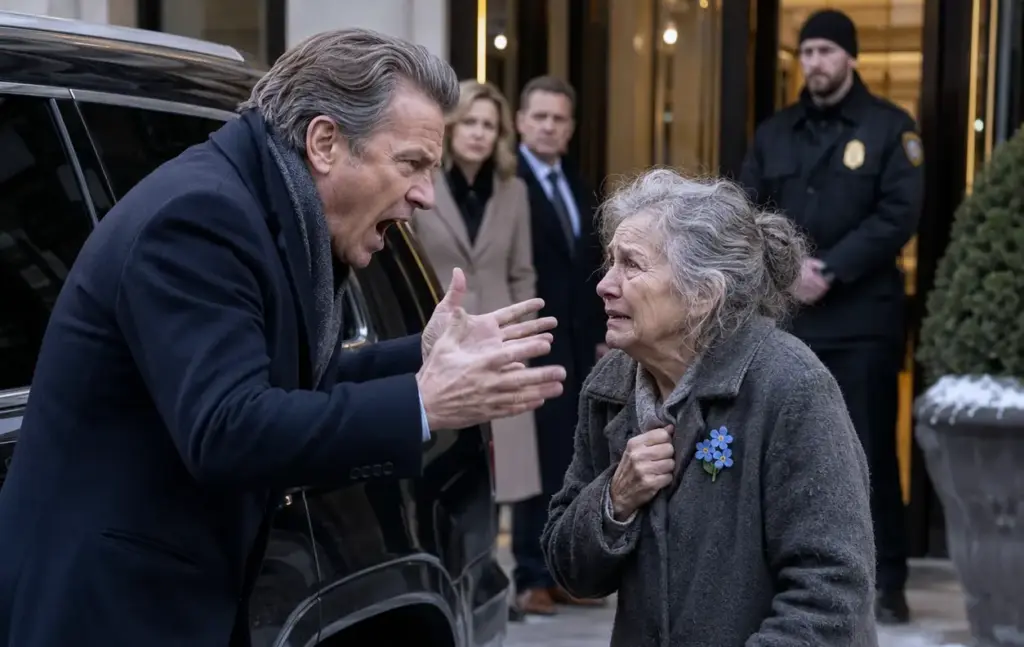
“Get her out of here,” he snapped, one hand still on the door of his black Range Rover. “This is a members’ lot. Why is there a woman begging outside the entrance?”
The security guard straightened at once. A few people near the glass doors turned, pretending not to look while looking anyway. The woman in the worn gray coat flinched, but she did not move away. She stood beside the painted curb with both hands wrapped around the handle of a cane, her shoulders hunched against the January wind.
“Nathan,” the guard said carefully, because everyone at the club knew who he was. “I’ll handle it.”
Nathan hated that tone almost as much as he hated the scene itself. It was the soft voice people used when they wanted his money, his approval, or his patience. He had built Whitaker Market Group from three failing neighborhood grocery stores into a chain that covered half the Midwest, and somewhere along the way strangers had decided he owed them kindness on command.
The old woman looked at him with pale, watery eyes. “Sir,” she said, her voice barely carrying over the wind. “I’m sorry to bother you. I just need a little help. There’s a child at home, and we’re down to almost nothing.”
Nathan pulled his gym bag from the back seat and shut the door harder than necessary. The car gave a soft, expensive chirp as it locked behind him.
“There are shelters,” he said. “Churches. Food banks. You can’t just walk up to people in a private parking lot.”
“I know,” she whispered. “I wouldn’t have, but your car looked—” She stopped, embarrassed by the honesty of it. “I thought maybe you could spare a few dollars. Or food. Anything you don’t need.”
Her coat was old but clean. Her shoes were cracked at the seams, not filthy. She did not smell of alcohol or neglect, and there was something in the way she held herself—ashamed, yes, but not practiced—that made Nathan’s irritation snag on something he did not want to examine.
Then she shifted, pulling the lapel of her coat tighter around her throat, and a small flash of blue caught the winter light.
Nathan’s breath left him.
Three forget-me-nots rested against her sweater, their petals made from pale blue enamel, each tiny center set with a sapphire no larger than a tear. The flowers were gathered into a single gold stem, delicate enough that most people would have missed the workmanship. Nathan did not. He knew every curve of that brooch. He knew the custom setting, the almost invisible engraving on the back, the way the jeweler had complained that the petals were too small for stones that expensive.
He knew because he had ordered it eleven years earlier for the only woman he had ever loved.
The old woman saw his face change. Her hand rose quickly, closing over the brooch.
“Where did you get that?” Nathan asked.
She took half a step back. “It’s mine.”
“No, it isn’t.” His voice lowered, but the sharpness remained. “Where did you get it?”
“I said it’s mine.”
Nathan reached out before he could think better of it and caught her wrist. Not hard enough to hurt her, but firmly enough that she could not hide the pin. The guard started toward them, uncertain now which person needed protecting.
The woman’s eyes widened. “Please don’t.”
“Tell me the truth,” Nathan said. “Right now.”
Her lips trembled, and for a moment she looked so tired that he felt the first clean stab of shame. He released her wrist. The cold had reddened her knuckles. One finger was wrapped with a bandage that had been used too long.
“Sir,” she said, swallowing. “I didn’t steal it.”
“I didn’t ask what you didn’t do.”
She looked past him, toward the shining glass doors of the club, toward the people in sleek coats and expensive sneakers who had slowed down to watch. Then she looked back at him, and whatever she saw in his face made her shoulders sink.
“It belonged to my girl,” she said.
The words landed wrong.
Nathan’s chest tightened. “Your girl?”
“My neighbor,” she said quickly. “But she’s like my daughter to me. Her name is Claire.”
The gym bag slipped from Nathan’s hand and hit the pavement with a dull thud.
For eleven years, that name had belonged to a locked room inside him. He had gone into that room at first every hour, then every day, then every few months when he was tired or drunk or driving past a hospital without warning. He had spent years pretending he had sealed it off for good. But a name did not need permission to reopen a door.
“Claire Bennett,” he said.
The old woman stared at him.
Nathan took one step closer. “Is her name Claire Bennett?”
Her face changed. Not fear this time. Recognition, maybe. Or suspicion.
“How do you know Claire?”
Nathan did not answer at once. He looked at the brooch again, and the years folded backward with such force that the private lot, the glass doors, the guard, even the cold seemed to move far away. He saw a young woman in scrubs laughing quietly in a hospital hallway. He saw pale pink tulips in January. He saw a small apartment full of grocery bags and textbooks and light. He saw a bedroom door opening on the worst morning of his life.
When he finally spoke, his voice no longer sounded like the voice he used in boardrooms.
“I was going to marry her.”
The old woman pressed her palm more tightly over the brooch. “Then you’re Nathan.”
It had been a long time since anyone said his name like an accusation that had waited patiently for a decade.
He bent, picked up his bag, and turned to the guard. “She’s with me.”
The guard blinked. “Mr. Whitaker?”
“She’s with me,” Nathan repeated. Then, more gently, to the woman, “Come sit in the car. You’re freezing.”
She did not move. “I’m not getting in a stranger’s car.”
“That’s probably the first sensible thing anyone has said to me today.” He reached into his coat pocket and pulled out a business card, then his driver’s license. He handed both to her. “Nathan Whitaker. Whitaker Market Group. You can keep those in your hand. The guard knows me. The cameras are pointed right at us. I’m not going to hurt you.”
She studied the cards, then studied him longer than the cards. “You hurt her.”
Nathan had no answer for that.
The woman nodded once, as if his silence confirmed what she already knew. “My name is Evelyn Price,” she said. “Most people call me Mrs. Price.”
“Mrs. Price,” he said. “Please. Sit in the car and tell me where Claire is.”
Her eyes filled before she could stop them. “You really don’t know?”
“No.”
She looked down at the brooch, her thumb moving over the little blue petals. “Then maybe you better hear it sitting down, too.”
He opened the passenger door, and the warm air rolled out into the cold. Mrs. Price lowered herself carefully into the seat, as if she expected the leather to reject her. Nathan put his gym bag in the back, walked around the car, and got behind the wheel.
For several seconds neither of them spoke. The engine hummed softly. Beyond the windshield, the Ridge Club entrance gleamed with heat and money and the easy confidence of people whose problems had never followed them into a parking lot.
Nathan looked at Mrs. Price. “Is Claire alive?”
She turned her face toward the window, and in that small hesitation he felt his whole body go still.
“Yes,” she said. “But she’s in prison.”
Nathan had broken his wrist the winter he met Claire Bennett. That was how ordinary the beginning had been: a patch of black ice outside a pharmacy, a bad fall, and a furious drive to Riverside Regional because he refused to call an ambulance for what he insisted was “probably a sprain.”
He had been thirty-one, already rich enough to be arrogant about pain. Back then Whitaker Market Group was still just Whitaker Foods, three grocery stores, two of them profitable, one of them held together by debt and stubbornness. Nathan wore tailored coats before he could comfortably afford them and drove a car chosen mainly because it made other men turn their heads…
To read the rest of the story – CLICK the NEXT button 👇👇👇