


By the time Caleb Ward turned off the county road and onto the rutted lane to his farmhouse, the old Ford sounded like it was grinding a handful of nails under the hood. The heater blew lukewarm air through cracked vents, the steering wheel trembled in his hands, and every few minutes the temperature needle made a nervous climb before dropping back down as if ashamed of itself. In the back seat, stretched across an old moving blanket, lay the reason he had come home without the part he’d driven forty-seven miles to buy.
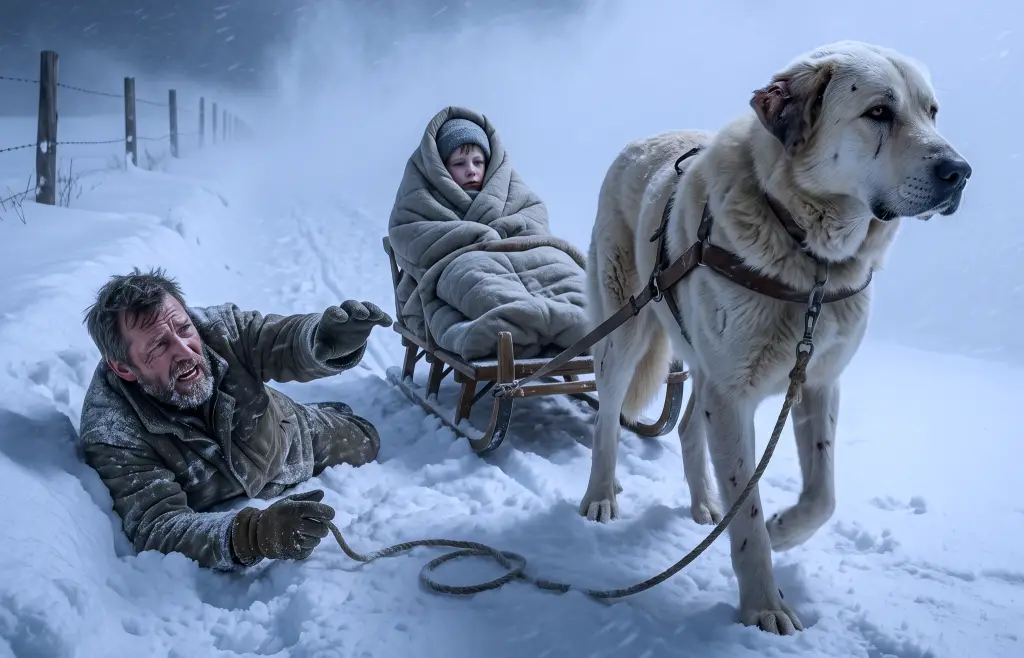
The dog was enormous, though hunger had carved him down to bone and shadow. His coat, once probably cream-colored, was filthy and matted into ropes. One ear had been torn nearly in half. Old scars showed beneath the fur when he breathed, pale marks against raw-looking skin. He did not lift his head when the truck bounced over the frozen ruts. Only one cloudy eye opened, following Caleb’s reflection in the rearview mirror.
Caleb kept one hand on the wheel and the other near the dashboard, as if touching it might coax the Ford a little farther. “Don’t quit now,” he muttered. “We’re close.”
The dog blinked once.
Caleb had gone to the winter swap outside North Platte before daylight, telling himself he would not get pulled into anyone’s story. He had two hundred and ninety dollars folded inside a sandwich bag in his coat pocket, and every dollar already had a job. Two-forty for a used water pump if he could talk the seller down. The rest for gas, cheap groceries, and Eli’s refill at the pharmacy.
There was nothing left over for mercy.
The swap had been spread across the frozen gravel lot behind an auction barn, a place where men came to sell the parts they’d pulled off dead trucks and tractors that had given up ten winters earlier. Tailgates sagged under alternators, belts, hubs, tires, chains, cracked toolboxes, and coffee-stained cardboard signs written in fat black marker. Men in insulated coveralls stood hunched against the wind, talking in short bursts with their shoulders lifted to their ears.
Caleb found the pump near the far end of the lot. Walt Bigelow had it wrapped in a towel, sitting beside a pile of fan belts and a milk crate full of sockets.
“Two hundred and forty,” Walt said, not even pretending there was room to bargain.
Caleb rubbed his thumb over the split skin across his knuckles. “I’ve got two hundred.”
Walt shook his head. “Then you’ve got two hundred dollars and no water pump. I’m not trying to skin you, Caleb. I’m telling you the truth. You won’t find another one before March.”
Caleb knew it. Everyone in that part of Nebraska kept old vehicles alive long past reason because new ones belonged to people with two incomes, paid-off roofs, and luck that had not turned on them. His Ford was ugly and tired, but it was the only thing between his farmhouse and the county hospital. With Eli’s heart the way it was, a bad truck was still better than no truck.
He had the plastic bag halfway out of his pocket when he heard the sound.
At first, he thought it was metal whining in the wind. Then it came again, thin and broken, not quite a whimper and not strong enough to be a cry. Caleb looked past Walt’s shoulder toward the back fence, where snow had drifted up against a row of rusted panels.
A dog lay tied to a fence post with orange baling twine.
For a moment Caleb could not make sense of the size of him. The animal was built like something meant to guard flocks on a mountain, broad-chested and heavy-skulled, but starvation had pulled his body inward. His ribs rose and fell under the filthy coat with a slow, painful effort. His paws were cracked. The rope around his neck had worn the fur away. Beside him, sitting on an overturned bucket, a thick-necked man in a brown canvas jacket smoked a cigarette and watched people pass as if none of it had anything to do with him.
Caleb set the pump down.
Walt saw where he was looking and made a sound under his breath. “Don’t.”
Caleb walked over anyway. The man on the bucket squinted up at him through cigarette smoke.
“That dog yours?” Caleb asked.
The man shrugged. “Today he is.”
“What happened to him?”
“Got old. Got useless. Pick one.” He flicked ash into the snow. “You buying or just making conversation?”
Caleb crouched a few feet away. The dog’s eye opened, flat and cloudy with exhaustion. There was no hope in it, no pleading. Caleb had seen dogs beg at diners and feed stores, all wagging tails and careful eyes. This one had moved past asking.
“How much?” Caleb asked before he could stop himself.
Behind him, Walt said, “Caleb, you’ve got to be kidding me.”
The man on the bucket smiled around the cigarette. “Hundred bucks. He’s some kind of imported shepherd. Alabai, Anatolian, whatever they call them. Big money once, before he decided he didn’t have the stomach for work.”
The way he said work made Caleb’s shoulders tighten. He had heard enough stories about the abandoned stockyard out past Dry Creek, enough half-sentences dropped at the feed store when people thought children and decent women were not listening. Dogs in plywood boxes. Men with cash. Trucks with plates from three counties. Nobody liked to talk about it because talking meant knowing, and knowing meant deciding what kind of person you were.
The dog’s gaze shifted toward Caleb’s bare hand.
Not toward the bills in his pocket. Not toward the pump on Walt’s towel. Just toward his open hand, red from the cold.
Caleb thought of Eli asleep in the room at the end of the hall, a little boy with a body too fragile for winter and a voice he had not used since his mother’s funeral. He thought of the prescription bottle on the kitchen windowsill, the overdue electric notice tucked under a magnet, the water pump he needed if he was going to keep getting to work and doctors and town.
Then he laid five twenties on the bucket.
The man took them so quickly the cigarette nearly fell out of his mouth. “Your problem now.”
“Leave the rope,” Caleb said.
Walt swore softly. “You’re out of your mind.”
Maybe he was. Caleb did not have an answer then, and he did not have one when the men near the trucks began laughing as he gathered the dog into his arms. The animal should have weighed twice what he did. Instead, Caleb lifted him like a wet sack of feed, too large and too light, all bone beneath fur.
Someone called, “Ward, you go for a water pump and buy a dead dog?”
Another man laughed. “Truck won’t run, but at least you’ll have something to bury.”
Caleb kept walking. He laid the dog across the back seat, covered him with the moving blanket, and started the Ford. The engine coughed, the bad pump shrieked, and for one sharp second he thought God Himself might be laughing too.
Now, with the farmhouse in view and the Ford still running, Caleb let out a breath he hadn’t realized he was holding.
Mae Dobbs came out onto her porch before he had the driver’s door open. She had been watching Eli since seven that morning, the same way she did whenever Caleb had to take extra shifts or chase parts. Mae was seventy-one, a widow, and built out of plain talk. She wore a faded blue cardigan under a barn coat, and her gray braid had come loose over one shoulder.
She took one look at the back seat and stopped on the porch steps. “Caleb Ward.”
“I know.”
“No, I don’t think you do.” She came closer, boots crunching over hard snow. “What in the Lord’s name is that?”
“A dog.”
“That is not a dog. That is trouble with a pulse.”
Before Caleb could answer, a pickup slowed on the road. Tom Pritchard leaned out the window, one elbow hooked over the door. Tom owned the biggest hay rake in the township and had never met an opinion he couldn’t throw at somebody else.
“You fix that water pump?” he called.
Caleb opened the rear door and slid his arms carefully beneath the dog. “Not today.”
Tom’s eyes moved from Caleb to the animal in his arms. His mouth tilted. “You’ve got a sick kid, a broken truck, and half a paycheck to your name, and you bring home that?”
A couple of men in the cab laughed. Mae did not, but her silence was worse. It had worry in it.
Caleb carried the dog around back to the shed where his father’s tools still hung on pegboard above a cracked workbench. The place smelled like straw, old oil, cold dirt, and mice. He made a bed in the corner with clean straw and the moving blanket, then filled a dented bowl with warm water from the kitchen.
The dog did not drink. Caleb dipped two fingers in the bowl and touched them to the dog’s mouth. A drop slid between the cracked lips. After a moment, the dog swallowed.
“All right,” Caleb whispered. “That’s something.”
He stayed there until the light thinned and the cold began settling into the walls. Every few minutes he offered water. Every few minutes the dog swallowed. His breathing remained harsh, but it kept coming, one stubborn pull after another.
Inside, Eli sat at the kitchen table in a gray sweatshirt with sleeves too long for his wrists. He was six years old and small even for six, with dark hair that fell into his eyes and his mother’s delicate mouth. Caleb warmed canned chicken noodle soup and cut toast into careful squares. Eli ate slowly, his spoon moving as if he had to remember each step.
“I brought something home,” Caleb said.
Eli’s spoon paused.
“He’s in the shed. He’s hurt pretty bad.” Caleb kept his voice even. He had learned that too much hope could scare a child as much as bad news. “I thought he needed a warm place.”
Eli did not look up, but his eyes shifted toward the kitchen window, toward the yard beyond it.
Before Mara died, Eli had talked from the moment he opened his eyes until sleep stole the words out of his mouth. He talked to birds, tractors, rain puddles, cereal boxes, his mother’s houseplants, the moon. After the funeral, the words stopped. Not all at once, exactly. They retreated day by day until there was nothing left but nods, pointed fingers, and the flat quiet of a child who had decided language could not bring back what mattered.
Doctors called it trauma. Complicated grief. Selective mutism. Caleb called it coming home every night to a house where his son’s voice had become another thing buried with Mara.
At 2:13 a.m., the dog howled.
The sound cut through the farmhouse like a saw. Caleb came awake already reaching for his boots. By the time he grabbed his coat from the chair, the howl had ended, leaving the house so quiet he could hear the refrigerator hum.
He turned toward Eli’s room out of habit.
The bed was empty.
For a second his mind refused to take in what his eyes had already seen: the kicked-back quilt, the small pillow, the bare floorboards. Then he was running through the mudroom and across the yard in unlaced boots, cold biting through his socks.
The shed door stood open.
Moonlight lay across the straw. Eli sat in his pajamas beside the huge dog, barefoot and shivering, with one hand buried in the matted fur behind the animal’s torn ear. The dog’s head rested across Eli’s lap. His breathing, which had rasped all afternoon, had softened into a deep, uneven sigh.
Caleb stopped in the doorway.
“Eli,” he said, barely above a whisper.
His son’s lips were moving.
No sound came out. The words formed and broke apart, formed again, as if the boy had found an old locked room inside himself and was trying every key with shaking hands. He stroked the dog’s forehead with the solemn care of someone tending a wound no one else could see.
Caleb should have picked him up. He should have carried him back to bed, scolded him about frostbite, wrapped his feet in towels, checked his breathing. Instead, he gripped the doorframe and stood still, afraid that even love, if it moved too quickly, might frighten away whatever had come into that shed.
By morning, Eli had a cough and a mild fever, and Mae called him a fool in three different ways while making pancakes. But she brought warm towels to the shed anyway, and when Caleb asked if she knew whether Dr. June Talley still made farm calls, Mae had already picked up the phone.
June arrived a little after noon in a mud-splattered Subaru with a veterinary bag on the passenger seat and a face that looked as if it had weathered every kind of rancher nonsense. She had treated calves for Caleb’s father, stitched up Mae’s barn cat, and once delivered a foal in an ice storm while cussing quietly enough that the horse would not take offense.
She stepped into the shed, saw the dog, and did not waste a single breath on surprise.
“Light,” she said.
Caleb brought the work lamp. June knelt in the straw and began examining the dog with hands that were gentle because they were not uncertain. She checked his gums, eyes, ribs, teeth, paws, joints, ears, and the raw ring around his neck. The dog flinched twice but never snapped. When she pressed along his side, a tiny sound came out of him, so worn down it was almost polite.
Eli stood just inside the doorway, wrapped in his coat, watching every movement.
June glanced at him, then looked at Mae. “Sweetheart, I need a bowl of warm water and the cleanest towels in this house. Think you can be my helper?”
Eli did not answer. He looked at the dog first, then followed Mae.
Only after his footsteps faded did June sit back on her heels. “Where did you find him?”
“Swap meet.”
“Who had him?”
“Man I don’t know.”
June gave him a look that said she did not believe ignorance was always accidental. “This dog has been starved nearly to death. He’s dehydrated, infected in two places, and those ribs healed wrong months ago. His teeth are damaged from chewing at metal. Paw pads are torn up. The ear’s old trauma. The scars…” She stopped, jaw tightening, and looked down at the dog. “You know what the scars are.”
Caleb did.
“Can he make it?” he asked.
June’s answer came slowly. “He shouldn’t have made it this long.”
Caleb closed his eyes.
“But he did,” she added. “That matters. Some animals are already gone before their bodies quit. This one isn’t gone. Tired, yes. Angry, maybe. But not gone.”
She left antibiotics, salve, instructions for broth, and warnings about feeding too much too fast. When Caleb reached for his wallet, she snapped her bag shut.
“Put that away.”
“June—”
“My north fence is down. You can fix it when the ground isn’t iron.”
“I don’t know when I can—”
“I didn’t ask for your calendar.” She stood, brushing straw from her knees. “You naming him?”
Caleb looked toward the house. Eli stood behind the kitchen glass with Mae’s hands resting on his shoulders. His eyes were fixed on the shed, unblinking.
“Boone,” Caleb said.
June considered it, then nodded. “Sturdy name. He’ll need one.”
For the first few days, Boone did not respond to anything. He slept, swallowed broth, endured ointment and bandages, and opened his eyes whenever Eli entered the shed. On the fourth morning, Caleb set down a bowl and said, “Here you go, Boone.”
The dog lifted his head.
It was not much. Not to anyone else. But Caleb stood there in the cold shed with broth steam rising between his hands and felt, for the first time in longer than he cared to measure, that something in his life had moved toward living instead of away from it.
Winter narrowed their world to three places: the house, the shed, and whatever job Caleb could reach before his truck gave out completely. He learned to move through the dark without thinking. Oatmeal for Eli before sunrise. Broth for Boone. Bandages checked. Pills counted. Notes left for Mae in block letters because exhaustion made his handwriting useless…
To read the rest of the story – CLICK the NEXT button 👇👇👇