


Maya Brooks stepped into Graham Ellison’s path before he reached the first stone step. She was twelve, maybe thirteen, with dust on the knees of her jeans and one hand clamped around an old phone that was not hers. Graham knew her mostly as a quiet blur at the edge of the property: Calvin’s daughter, the girl who did homework on the low wall by the rose garden while her father trimmed hedges, hauled mulch, and kept the Ellison estate looking effortless.
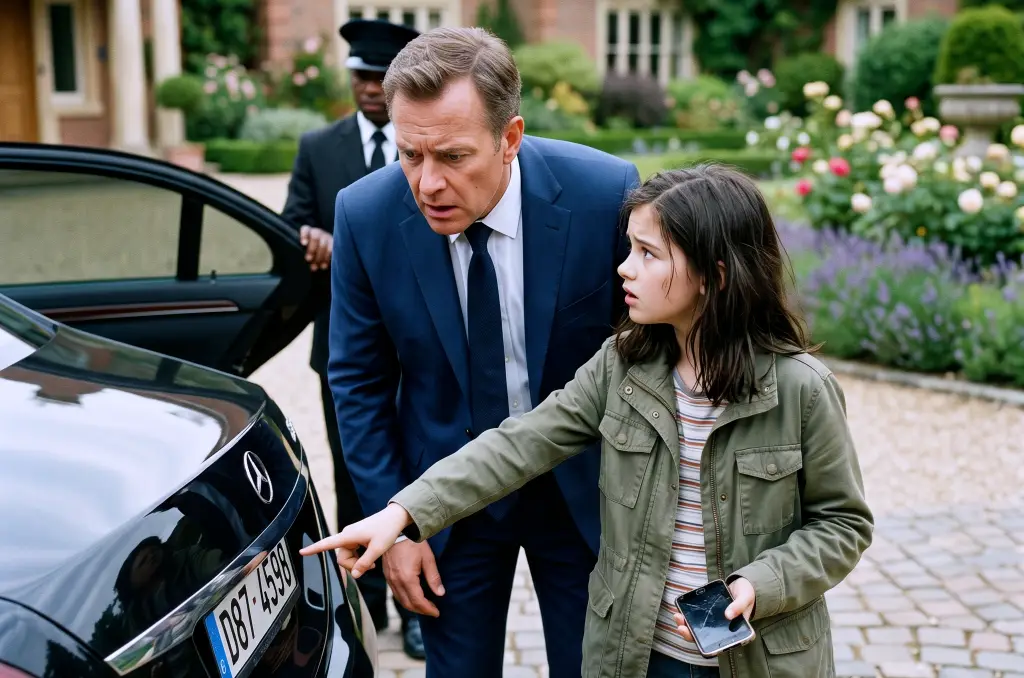
That morning she looked as if she had been running.
“Mr. Ellison,” she whispered. “Please don’t go to the car.”
Graham was already late. His watch showed 8:47 a.m., and his plane for Dallas would not wait because a child had appeared on his front walk with fear in her eyes. In one hand he held his phone, his passport, and the key fob to the sedan waiting beyond the iron gate. In the other, he carried a slim leather briefcase with two contracts inside that half his executive team had spent three months preparing.
“Maya, what is it?” he asked, keeping his voice low because something in her face made irritation feel out of place.
She glanced past him toward the driveway. “Don’t let him see you talking to me.”
“Who?”
“The driver.”
Graham almost looked toward the gate, but Maya caught his sleeve with a quick, urgent hand. It was not rude. It was desperate.
“Please,” she said. “Walk with me. Act like you forgot something.”
He stared at her for a second. Graham Ellison had built one of the largest private technology firms in the country by asking questions, demanding proof, and never moving because someone else panicked. But there was a kind of fear adults learned to perform and another kind children had no way to fake. Maya’s face held the second kind.
So he turned slightly, as if remembering an errand, and followed her off the walkway toward the side garden.
The front of the house sat open to the long, curving driveway, but along the side there were thick hydrangeas, tall planters, and a low brick wall that hid part of the lawn from the gate. Maya slipped behind the planters and crouched. Graham stayed standing until she looked up at him with such plain disbelief that he lowered himself beside her, his suit jacket brushing damp leaves.
“This is ridiculous,” he said under his breath, though he no longer quite believed it.
Maya pointed through a gap between two ceramic pots. “Look at the car.”
The black sedan waited at the gate, polished and quiet, the kind of vehicle that had carried Graham through most of his adult life. The driver stood beside it in a dark jacket, one hand resting on the open rear door. From where Graham crouched, the car looked exactly right.
“That’s the company car,” he said.
“No, sir.”
“Maya, I know my own car.”
“You know what it’s supposed to look like,” she said. “That’s not the same thing.”
It was a sentence Graham would remember later, not because it was clever, but because it landed with uncomfortable precision. He looked again. Black sedan. Tinted rear windows. Clean wheels. Familiar shape. Nothing obvious.
“What am I supposed to see?”
“The plate,” she said. “The last two numbers are wrong. Your regular car ends in four-seven. This one ends in seven-four.”
Graham narrowed his eyes. The distance made it hard, but not impossible. He shifted to see around the planter and felt the first small tightening in his chest.
She was right.
He had taken that car hundreds of times and never once memorized the plate on purpose. He only knew it the way a man knows the pattern of his front steps, by seeing it often enough that the wrongness announces itself before the mind catches up. Four-seven. Not seven-four.
Maya kept watching him. “And that man isn’t Mr. Denning.”
Graham’s regular driver, Paul Denning, had been with him for years. Paul had a square jaw, a stiff walk from an old knee injury, and a habit of opening the back door with his right hand while keeping the keys in his left. The man at the gate was similar in height and dressed the same way, but now that Graham really looked, the shoulders were wrong. The stance was wrong. The hairline was wrong.
“Where’s Paul?” Graham murmured.
“I don’t know.”
He turned to Maya. “How did you notice all that?”
“My dad says if you work around rich people, you better notice things before they notice you.” She swallowed, then added, “And Mr. Denning always says good morning to the front camera. Every time. Like a little salute. That man didn’t.”
Graham looked back toward the gate. His phone vibrated in his hand. Meredith.
He silenced it.
Maya’s fingers tightened around the old phone. The screen was cracked in one corner, and the case had a landscaping company sticker peeling off the back. Calvin’s phone, Graham realized. Not hers.
“What’s really going on?” he asked.
Maya’s eyes lifted to his. “Yesterday afternoon, I was behind the greenhouse waiting for my dad. Mrs. Ellison was inside with a man.”
Graham felt his face change before he could stop it.
“A man?”
“I didn’t know him. I couldn’t see him good at first. They thought nobody was there.” Maya looked toward the driveway again, then lowered her voice. “They were talking about you.”
“In what way?”
She hesitated, and the hesitation was worse than an answer. She looked like a child deciding how much adult darkness she could safely put into words.
“They said you were going to get in the car this morning,” she said. “They said you’d be looking at your phone and you wouldn’t notice the driver was different. They said once the gate closed, he wouldn’t take you to the airport.”
Graham did not move. The hydrangea leaves brushed his shoulder, cool from last night’s sprinkler cycle. Somewhere beyond the gate, the sedan idled so quietly he could barely hear it.
“Where was he supposed to take me?”
“I don’t know the name of the place. They just said it was far enough. Somewhere nobody would hear.”
The words were simple. Too simple. Graham almost stood up then, not because he disbelieved her entirely, but because there are certain sentences the mind refuses at first contact. His wife. His car. A child’s warning. A quiet place where nobody would hear.
“No,” he said, more to himself than to Maya. “That doesn’t make sense.”
“I recorded them.”
The world seemed to shrink to the phone in her hand.
Maya held it out, but before Graham could take it, his own phone vibrated again. Meredith’s name filled the screen, bright and clean and familiar. He looked at it a moment too long.
“Answer it,” Maya whispered. “But don’t tell her where you are.”
Graham glanced at the girl, then accepted the call.
“Graham?” Meredith’s voice came through soft and controlled. “Where are you? The driver says you’re not in the car.”
He watched the man by the gate through the leaves. “I had to grab something from the study.”
“You’re cutting it close.”
“I know.”
“This meeting matters. You said so yourself.”
“I’ll be there in a minute,” he said.
There was the slightest pause on the line. Meredith had always been gifted at hearing what people left out.
“Are you all right?” she asked.
“Fine.”
“All right. Hurry, please.”
The call ended. Graham kept the phone in his hand, staring at the dark screen. He had heard that voice across breakfast tables, hotel rooms, hospital waiting areas, charity events, and midnight calls from different time zones. He had trusted that voice longer than he had trusted most of his own instincts.
Maya held out Calvin’s phone again. “Please listen.”
He took it.
The recording began badly, with wind scraping across the microphone and the distant clatter of garden tools. At first there was only static and leaves. Then Meredith’s voice emerged, not loud, but unmistakable.
“He’ll be in the car by nine. He never looks up until they’re halfway down the drive.”
A man answered. Calm. Close to the phone, or maybe close to the open greenhouse vent. “The driver knows the route. After that, he follows the instructions.”
Graham’s grip tightened around the phone.
Meredith again. “No airport. No hotel cameras. No mistakes.”
The man said, “He’ll be out of sight before anyone starts asking.”
A rustle, then Meredith’s voice, lower. “And the policy?”
“Clean,” the man replied. “You’re named first. The increase went through months ago. You just have to let time do its work.”
Maya had gone completely still beside him. Graham listened until the recording broke into wind again, then stopped. He did not speak. He could not, not right away. The mind, when struck hard enough, often reaches for practical things. Dates. Documents. Signatures. Insurance. He tried to remember what he had signed six months ago and saw only a blur of papers, conference rooms, airports, and assistants marking tabs with red stickers.
“This could be misunderstood,” he said, though he hated himself for saying it.
Maya looked at him with a child’s grave patience. “There’s more.”
Before he could ask what she meant, she pulled lightly at his sleeve and nodded toward the back garden. “Come see. But you have to be quiet.”
They moved along the side of the house, past the service entrance and the row of clipped boxwoods Meredith insisted made the property look “settled.” Graham had walked those paths for years without seeing them. Today he noticed every wet leaf, every reflection in every window, every place a person could stand and watch without being seen.
Near the greenhouse, Maya slowed. The old glass structure sat behind a line of cypress and roses, bright in the morning sun. It had been Meredith’s idea ten years earlier, an elegant little building imported from some specialist company in Vermont, too expensive for the tomatoes Calvin later coaxed from its raised beds.
Maya held up one finger, then guided Graham behind a hedge.
Voices came from the gravel path.
Meredith was walking beside a man Graham did not know. He was tall, sandy-haired, younger than Graham by maybe ten years, in a linen jacket too casual for a workday. His hand rested lightly at the small of Meredith’s back, familiar in a way Graham could not mistake. They stopped near the greenhouse door.
The man said something too low to catch. Meredith laughed under her breath, then touched his face.
Graham did not step forward. He did not call her name. He stood behind the hedge, half hidden by leaves, and watched his wife kiss another man in the garden he had paid for and never tended.
When they drew apart, Meredith rested her forehead briefly against his. Her voice carried this time.
“After today, Evan, we can stop pretending.”
The man smiled faintly. “You’re sure you’re ready?”
“I’ve been ready for years,” she said. “I love you. I’m tired of hiding it.”
Graham’s hand dropped slowly to his side. The phone in his palm felt heavy, almost warm. He heard Maya breathe beside him, small and careful, as if she were trying not to exist inside his humiliation.
Meredith and the man—Evan—walked away in opposite directions. Meredith returned toward the house, smooth and composed, a woman who knew how to cross a lawn without letting the damp grass touch the hem of her dress. Evan took the service path toward the far gate, hands in his pockets.
Only after they were gone did Graham realize he had been holding his breath.
Maya said nothing. She had already given him the truth. There was nothing left for her to explain.
Graham looked at the greenhouse, at the flash of sunlight on its glass walls, and understood that his life had just split in two. There was the life he had been walking through that morning, late for a meeting, irritated by delay, certain of the basic facts around him. Then there was this one, where his wife had spoken of policies and disappearances, where a strange man knew his schedule, where a child had known enough to hide him behind flowers.
He handed Calvin’s phone back to Maya very carefully, as if sudden movement might crack something more than the screen.
“Did they see you recording?” he asked.
“No.”
“You’re sure?”
“I was behind the north wall. The vent was open, and I was waiting for Dad to finish by the irrigation line. I heard Mrs. Ellison say your name, so I listened.”
Graham nodded slowly. “Why didn’t you tell your father first?”
Maya looked down at the phone. “Because if I was wrong, he’d be in trouble. If I was right, I didn’t know who else might be part of it.”
It was a hard kind of intelligence, the kind people learn when the world has made them careful. Graham had spent his life surrounded by adults with degrees, titles, and polished shoes. None of them had shown half the judgment of the girl standing beside him in muddy sneakers.
“You did the right thing,” he said.
Her face changed, just slightly, as if she had expected anger, disbelief, or dismissal, but not gratitude.
“You believe me now?” she asked.
Graham looked toward the front of the property. The black sedan was still waiting beyond the gate, and so was the man pretending to be Paul Denning.
“Yes,” he said. “I believe you.”
The words cost him something. Saying them made the morning real.
He took out his own phone and looked at the missed calls, the emails, the meeting reminders, the machinery of his life still running as if nothing had happened. For years he had believed power meant access, speed, control. People answered when he called. Planes waited. Doors opened.
That morning, a door had opened for him too.
He almost walked through it.
“Listen to me,” he told Maya. “You don’t talk about this to anyone yet. Not anyone in the house. Not your father until I’m with you. Not the staff. Not a friend. Nobody.”
She nodded.
“And you stay close to your dad today. If anyone asks why you were near the front walk, you tell them you were looking for him.”
“Yes, sir.”
Graham paused. “Do you know where your father is right now?”
“By the south beds.”
“Go to him. I’ll come find you both.”
She started to leave, then stopped. “Are you going to the police?”
Graham looked back at the house. Every window seemed suddenly occupied, whether anyone stood behind it or not. “Yes,” he said. “But not before I understand how far this goes.”
Maya’s mouth tightened, as if she did not like that answer.
“My dad says waiting can be smart,” she said. “But not if the snake is already close.”
Graham almost smiled. It came out as a tired breath instead.
“Your dad sounds like a practical man.”
“He is.”
“Then stay with him.”
Maya slipped away through the garden, small and quick, Calvin’s phone held tight in both hands. Graham watched until she reached the far beds and Calvin Brooks looked up from a row of ornamental grasses, his brow furrowing as his daughter came to his side.
Only then did Graham turn back toward the house.
He entered through the side door, not the front. The hallway smelled faintly of lemon polish and Meredith’s jasmine perfume. The marble floor reflected the morning light exactly as it had every other day, but nothing felt luxurious now. The house had become evidence. Every corridor held possibility. Every staff member might have seen something, missed something, hidden something, or simply been trained by years of wealth not to ask questions.
In his office, Graham closed the door and stood behind his desk without sitting down. A framed photograph sat on the shelf to his left. He and Meredith in San Francisco, fifteen years younger, standing in front of a cramped apartment building with peeling blue paint. Before the money. Before the estate. Before the private planes and security gates and charity committees.
They had been happy in that picture. Or he had believed they were.
His phone buzzed again. This time it was his executive assistant, asking whether he was en route to the airport.
Graham typed one sentence: Cancel Dallas. Family emergency.
Then he scrolled to a number he had not called directly in months.
Owen Maddox answered on the third ring. “Aren’t you supposed to be somewhere over the Midwest by now?”
“Owen,” Graham said, “I need you to listen carefully and not interrupt.”
The joking tone disappeared. Owen had been Graham’s attorney for twelve years and his friend for nearly twenty. Before private practice, he had worked in the district attorney’s office, long enough to understand what people sounded like when they were trying not to sound afraid.
“I’m listening,” Owen said.
Graham looked through the office window toward the greenhouse. “I think Meredith and another man arranged for me to be taken this morning. The driver outside my gate is not my driver. The car has a different plate. There’s a recording.”
Owen said nothing for a moment.
Then, quietly, “Are you safe right now?”
“I’m in my office.”
“Is she in the house?”
“Yes.”
“Then don’t confront her. Don’t hint. Don’t test her. Don’t do anything that gives her reason to think you know.”
Graham closed his eyes briefly. “You believe me?”
“I believe you enough to treat it like you’re telling the truth until we prove otherwise,” Owen said. “That’s the only sane approach. What’s on the recording?”
Graham told him. Not everything. Enough.
When he finished, Owen’s voice had gone flat with concentration. “Insurance was mentioned?”
“Yes.”
“I’ll start there. I’ll need access to policy records, office filings, any recent changes, anything your signature touched.”
“I sign too much.”
“I know. That’s part of the problem.”
Graham opened his eyes. The photograph of the younger couple watched him from the shelf.
“There’s another man,” he said. “Meredith called him Evan.”
“I’ll look.”
“Owen?”
“Yes?”
“If a person disappears, not confirmed dead, what happens with life insurance?”
Owen exhaled. “It depends. Usually there are legal time frames, court proceedings, evidence standards. It isn’t instant. But if someone has planned this, they may have planned the paperwork too.”
Graham absorbed that. In business, a structure this careful would have impressed him.
Now it made him cold.
“Don’t stay alone,” Owen said. “And don’t eat or drink anything you didn’t see prepared.”
Graham looked at the untouched coffee Mrs. Alvarez had left on his desk before dawn. A ridiculous thought, a paranoid thought, and yet he pushed the cup away.
“I’ll call you when I know more,” Owen said. “Until then, act normal.”
Graham almost laughed. Normal had become the least believable thing in his life.
By noon, the trip to Dallas had been rescheduled, the black sedan at the gate had disappeared, and Meredith had come to Graham’s office twice without knocking.
The first time, she stood in the doorway with her phone in one hand, her expression arranged into mild concern. She wore a pale blue dress and small diamond earrings, the kind she chose when she wanted to appear unstudied. Graham noticed that now too, the work behind the ease. For years he had admired it…
To read the rest of the story – CLICK the NEXT button 👇👇👇