


At Red Cedar K-9 Operations Center, tucked deep in the wet green ridges of West Virginia, most people managed not to see me at all. To them, I was just Mara Wells, the new custodian in a thrift-store parka with a broken zipper and sleeves too long for my arms. I moved through the place with a yellow mop bucket, gray hair pulled back with a drugstore elastic, shoulders rounded in the posture of a woman who had learned not to take up space. On paper, I was forty-two years old, five foot three on a generous day, a former hospital orderly from Biloxi with a quiet voice, no close family, and no reason for anyone to remember my face.
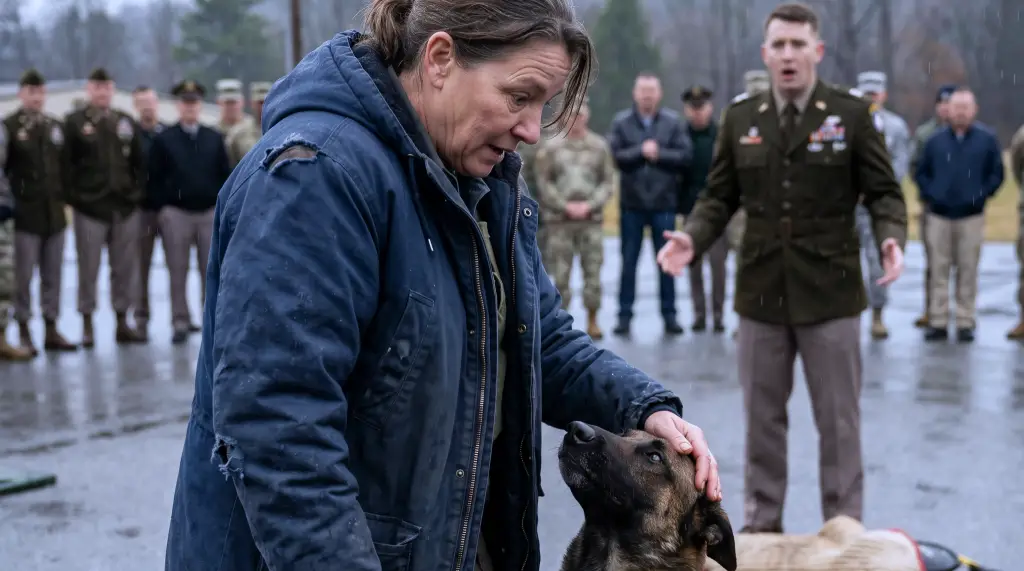
The dogs knew better.
All fifty-two of them knew before a single officer did.
That first morning, a freezing November rain had turned the asphalt black and slick. Pine needles clung to the drains. The kennels steamed faintly in the cold, and the air smelled of disinfectant, wet fur, and the burnt coffee the guards drank out of paper cups at the gate.
I had barely pushed my cart past the security turnstile when the kennel block erupted.
Not barking. Barking is what house dogs do when the mailman comes.
This was deeper than that. It rolled over the compound like weather, vibrating through sheet metal, rattling the latch plates on the kennel doors, making two young MPs near the gate flinch hard enough to reach for weapons they did not need.
Lieutenant Mark Crowe did not flinch. He only looked irritated.
Crowe was tall, square-jawed, and handsome in the clean, hard way young officers sometimes are before the world has done enough damage to soften them. His call sign was Raven, which he wore like a second rank. That morning he had my personnel folder clamped under one arm, and when the dogs’ noise hit us, he turned his annoyance on the easiest target in front of him.
Me.
“Pick that up,” he said.
He had yanked the broom from my cart and tossed it down in front of my shoes. The wooden handle slapped the pavement and rolled until it stopped against the toe of my left boot.
I looked at it. Then I looked at the rainwater gathering in the cracked leather of my boots.
Crowe stepped on the broom before I could bend. The sole of his tactical boot pinned it in a shallow puddle. Behind him, Captain Claire Bennett glanced up from her phone with the bored disgust of a woman who had already decided I was a problem beneath her pay grade. Staff Sergeant Dylan Reeves, young and broad-shouldered and too pleased with himself, had started recording.
“Ma’am,” Crowe said, his voice sharp enough to draw a half circle of handlers from the covered walkway, “I need to know you understand where you are. This is not a school gym. This is not an office building. You will be cleaning around military working dogs trained for building searches, apprehension, explosives detection, and battlefield noise. They bite. They break bone. They do not care that you’re new.”
I lowered my eyes and gave him the small, obedient nod he wanted.
That pleased him less than fear would have.
“Sector Alpha first,” he said. “That row houses our hardest cases. If you quit before lunch, do us all a favor and tell HR before you waste a uniformed escort.”
Dylan laughed under his breath. Claire smiled without looking up again.
The part of me they were speaking to—the thin, bent woman with cheap gloves and a work badge still stiff from the printer—remained silent. She was useful that way. People talk in front of invisible women. They show you who they are.
Crowe lifted his boot. I bent slowly, picked up the broom, and tucked it back into my cart.
At the far end of the covered walkway, Master Sergeant Hank Porter watched without joining in. Everybody at Red Cedar called him Top. He had been training dogs since before most of these handlers had learned to drive, and time had carved his face into something spare and weatherproof. He didn’t laugh. He didn’t look away, either. His eyes stayed on the way I held the broom, not like a cleaning tool, but like something I had measured without meaning to.
“Alpha’s this way,” Crowe said.
He led me across the yard, talking as if I were hard of hearing. The dogs slammed themselves against the reinforced gates as we approached, all teeth and wire and muscle. Belgian Malinois. German shepherds. One Dutch shepherd with a scar through the fur above his left eye. They were leaner than pets, sharper than police dogs, built by discipline and stress into living pressure points.
Dylan jogged behind us, eager for the show.
“Tell her about Atlas,” he said.
Crowe gave him a warning glance, but he could not resist the performance. “Atlas is the end kennel on the left. Do not approach him unless a handler tells you to. Do not put your hands near the gate. Do not make eye contact. His previous handler needed reconstructive surgery after ignoring that advice.”
I looked toward the last kennel.
Atlas had already seen me.
He was bigger than the others, a dark-masked Malinois with a chest like a spring-loaded trap. His front paws hit the gate before I reached him, and the sound cracked through the yard. His lips peeled back. The growl that came out of him was low, almost private, the kind of sound that tells the body to move before the mind can explain why.
Then my shadow crossed his concrete.
Atlas stopped.
The halt was so complete that even Crowe’s boots seemed to quiet on the wet pavement. Atlas dropped from the gate, paws landing with a heavy thud. His ears flattened, not in submission exactly, but in recognition. His head tilted, and his eyes fixed on my face with an intensity that went through the parka, the badge, the gray in my hair, the years I had spent trying to become no one.
His tail moved once.
A slow sweep over the concrete.
I kept walking.
Crowe did not.
“What the hell?” Dylan whispered.
Claire, irritated by anything that interrupted her schedule, strode closer to the gate. “Maybe the dog’s finally aging out.”
Atlas hit the wire so fast she stumbled backward with a strangled cry. His teeth snapped inches from her face, and the gate shook hard enough to make the whole kennel row answer him.
He had not aged out. He simply knew who was his and who wasn’t.
I connected the hose to the hydrant without letting my hands shake. The old body remembered what the new body pretended not to know. Twist. Lock. Test the pressure. Keep your shoulders loose. Never give fear a shape if an animal is close enough to smell it.
The morning crawled forward under a low sky. I cleaned one kennel, then another. The handlers watched from a distance with cigarettes, coffee, and jokes that died a little more each time another dog settled when I stepped inside. Some sat. Some lay down. One old shepherd pressed his forehead to my knee and breathed as if he had been holding something in for months.
Dylan was the first to get angry about it.
By nine, he had lost the grin. He was supposed to be supervising me, but there was nothing to supervise except his own confusion. When I reached the last row of Bravo block, he moved ahead and stood in front of Kennel Seven with his shoulder covering the warning sign.
“Hey, Ms. Wells,” he called, using the name like a joke. “Water bowl in here needs scrubbing. Dog’s sedated. Vet has him on meds. Go in, clean it, come back out.”
I glanced at the red placard half hidden behind his arm.
HAVOC. EXTREME STRESS RESPONSE. TWO-HANDLER ENTRY ONLY.
Dylan’s pulse had picked up. It showed in the side of his throat, in the quick flare of his nostrils, in the sour adrenaline smell that came off him under the soap and coffee. He wanted a reaction. A scream would do. Tears would be better.
I opened the gate.
The latch clicked shut behind me before I had taken two steps.
Havoc was not sedated. He was a black German shepherd with a ruined nervous system and too many bad memories lodged under his skin. His ribs showed beneath a thick coat. He had the fixed, glittering stare of an animal who had stopped sorting the world into friend and stranger. To him, everything was danger now.
He came low and fast.
Dylan stopped breathing outside the gate.
I set the brush down on the concrete. Slowly. Deliberately. Then I lowered myself into a crouch, making my body smaller, letting my hands hang open between my knees. A civilian trainer might have called it foolish. In the places I had learned dogs, rules were not always written in manuals. Sometimes they were written in blood and dust and the last sound a handler made before the ridge went dark.
Havoc skidded to a stop less than a foot from me.
His teeth were out. His body shook with the force of wanting to survive. I did not reach for him. I did not speak at first. I gave him the only thing he could understand in that state: stillness without surrender.
“Easy,” I whispered at last. “I know. It hurts.”
Something changed in his eyes before it changed in his body. The focus broke. His growl thinned into a sound that belonged to a much younger dog, one not yet trained to throw himself at men in padded suits. He pressed his nose into the collar of my parka, breathed once, and folded to the floor as if his bones had finally been given permission to rest.
When Dr. Grace Keaton came running from the veterinary building with her medical case slamming against her thigh, she was prepared for blood.
Instead she found me sitting cross-legged on cold concrete, scratching Havoc behind one ear while he lay with his head across my lap.
Grace stopped so hard her shoes squeaked.
Dylan backed away from the gate. His phone hung useless in his hand.
“How did you get him down?” Grace asked. Her voice was careful, but her face had lost color. “He hasn’t let anyone touch him in four months.”
“He’s not vicious,” I said. “He’s terrified. There’s a difference.”
She looked at me then. Really looked.
Most people, once they see the shape you give them, never look again. Grace Keaton was not most people. She had the calm hands of a surgeon and the tired eyes of someone who had stayed late too many nights because an animal still needed her. Her gaze moved over my face, my knees, my hands resting on Havoc’s neck.
Dylan tried to laugh. It came out wrong.
“Lucky guess,” he said.
Grace turned on him. “You locked her in?”
“I thought he was medicated.”
“No, you didn’t.”
The words landed flat and clean. For the first time since I had arrived, Dylan looked his age.
Grace fumbled for her keys. “I’m writing this up.”
“No,” I said.
Both of them turned.
I stood, easing Havoc’s head gently onto the floor. “No report. No drama. I was told to clean the bowl. I cleaned the bowl.”
Grace stared at me as if I had offered her a language she did not trust. Dylan looked relieved for half a second, then frightened by the relief.
I picked up the brush and bucket and stepped out of the kennel. Havoc lifted his head to follow me with his eyes. He did not bark. None of the dogs did.
By noon, the incident had reached Colonel Warren Clay’s office anyway. I did not hear the conversation then. I learned the shape of it later from a half dozen careful omissions and one ashamed lieutenant who finally stopped thinking silence made him honorable.
Clay had read the report twice before summoning Crowe upstairs.
“Explain to me,” he had said, standing at the window of his second-floor office while rain tracked down the glass, “how a civilian custodian ended up locked inside a restricted kennel with a dog flagged red for handler aggression.”
Crowe took the hit without moving. “My failure, sir. Staff Sergeant Reeves acted like an idiot. I should’ve been closer.”
“An idiot?” Clay turned from the window. “An idiot forgets to sign out a radio. An idiot leaves a coffee cup in a classified room. What happened today could’ve shut this place down.”
“Yes, sir.”
Clay threw my file onto the desk. “Mara Wells. No family. Temporary hire. Clean background. She’s here because no one else wants to scrub kennels for base contractor wages in November. She keeps her head down, does the work, and doesn’t cause trouble. You and your handlers will leave her alone unless she gives you a reason not to. Am I clear?”
Crowe hesitated. “Sir, the dogs are reacting to her.”
“Good. Maybe they have better manners than my people.”
That should have ended it.
It did not.
By the time I finished my shift, Raven Crowe had stopped laughing with the others. He watched me cross the yard with my bucket in one hand and Atlas walking the fence line beside me, separated by chain link and years, and the lieutenant’s face carried the first fine crack of doubt.
The dogs had accepted me.
The men were slower.
The next morning came in pale and cold, with fog tangled in the pines and frost whitening the roofs of the kennel runs. Red Cedar woke before sunrise, as military places do, in layers of habit: boots on stairs, radios chirping, kennel doors clanging open, coffee brewing strong enough to float a wrench…
To read the rest of the story – CLICK the NEXT button 👇👇👇