


By the time the first light touched the storefronts on Main Street, Maggie Ellis had already been awake for nearly three hours. The ovens at The Hearth & Crumb came on at 4:15 every morning, long before Millbrook, Pennsylvania, started pretending it was ready for the day. In those early hours, the bakery felt separate from the rest of town, warm and breathing in the dark. Heat rolled out of the kitchen. Flour softened the air. Butter melted into sugar, sugar into cinnamon, and the old floorboards held the scent as if they had been built for that one purpose.
Maggie liked the bakery best before the customers arrived. Before the bell over the door started ringing. Before anyone asked how she was doing and expected an answer simple enough to fit between a coffee order and a receipt.
She had been working there since August, which in a place like Millbrook still made her new. People knew her name now, but they had not stopped asking where she was from, why she had come, whether she was related to the Ellises who used to own the hardware store on Third. Maggie had become good at smiling through the same version of herself.
Pittsburgh. Needed a change. No, not those Ellises.
The real answer was not something she could hand across the counter with a cranberry scone. The real answer involved a father who had gotten sick quietly, a daughter who had missed more signs than she could forgive herself for, and a house she had emptied one cardboard box at a time after the funeral.
Millbrook had not healed her. She had not expected it to. But it had given her work that began before sunrise, tasks with clear edges, and a place where her hands could stay busy when her mind became too loud.
At 6:47 on a cold Tuesday in November, Maggie slid the first tray of cinnamon rolls into the display case and glanced toward the front window.
She did it without meaning to.
Five minutes later, the cat appeared.
He came from the direction of Maple Avenue, padding along the brick sidewalk with the calm confidence of an animal who had never once doubted his right to enter any room. He was a large orange tabby, broad through the shoulders, with a white chest and white paws that made him look more formal than he had any reason to be. Ben Carter, the assistant baker, had once called him “a loaf with legs,” but Maggie had already named him Muffin, and the name had stuck before anyone could object.
Muffin did not scratch at the door. He did not meow. He did not press his face against the glass with dramatic hunger the way other cats might have done if they had discovered a building full of butter.
He simply sat on the mat beneath the hanging sign and waited.
“There he is,” Ben called from the kitchen doorway. He had icing on his sleeve and the permanent half-awake expression of someone who insisted he was not a morning person despite choosing bakery work. “Six fifty-two. I’m telling you, that cat has a better internal clock than the oven timer.”
Maggie reached for the front-door key. “He also has better attendance than you.”
“That feels personal.”
“It was meant to.”
When she opened the door, cold air slipped around her ankles. Muffin blinked up at her with green eyes, then stepped inside as if she were not allowing him in so much as performing a duty she should have understood weeks ago.
He crossed the bakery without looking at the pastry case, the trash bin, or the rack of cooling rolls behind the counter. He ignored Ben’s soft whistle. He ignored the warmth of the kitchen. He ignored the small dish of water Maggie had begun setting near the window.
His destination was always the same.
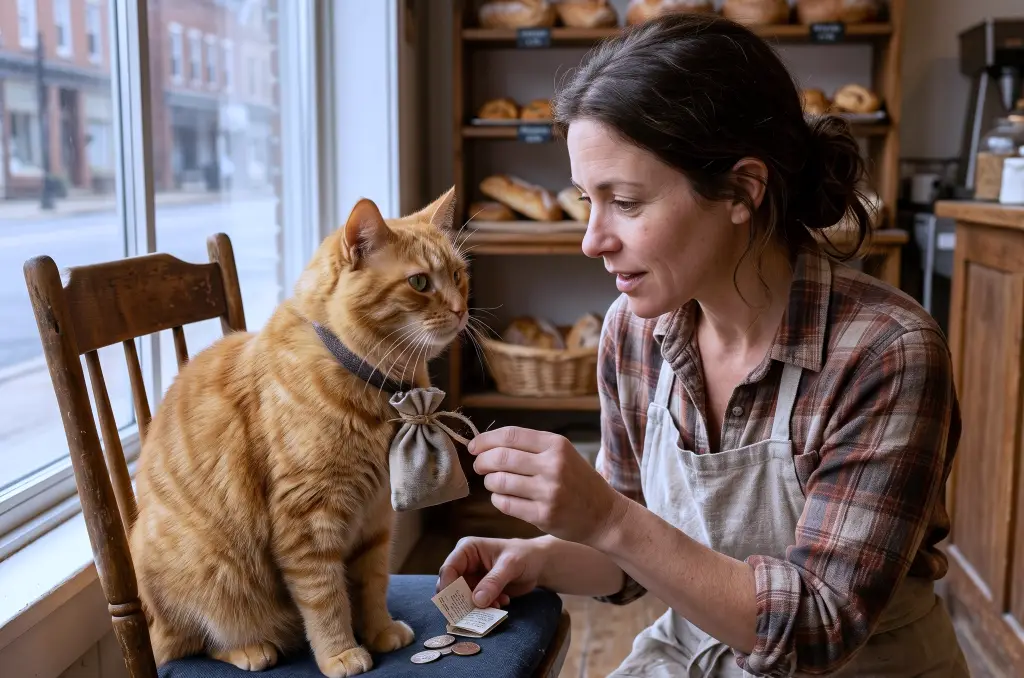
The third chair by the left front window.
It was a wooden chair with a curved back and one uneven leg that Ray Callahan, the manager, had promised to fix at least twelve times before leaving town to help his brother recover from surgery in Maine. The chair sat beside a round table where customers usually placed coffee cups, newspapers, gloves, and the kind of conversations that lasted longer than anyone intended.
Muffin jumped onto it, turned once, tucked his paws beneath him, and faced the street.
For the next twenty minutes, he watched the sidewalk.
At first, Maggie had assumed he belonged to someone in one of the apartments above the shops. Downtown Millbrook was the kind of place where people accepted cats as unofficial citizens. A cat could belong to the florist, the retired dentist, the woman who ran the used bookstore, or nobody in particular.
But Muffin did not behave like a cat looking only for warmth. He arrived at the same time every morning. He sat in the same chair. He stayed for almost exactly the same amount of time, and then he left by the same route. He allowed children to pet him with solemn tolerance. He let Mrs. Alvarez, who came in every morning for tea and a cheese danish, call him “sir.” Once, a contractor slipped him a piece of turkey under the table, and Muffin accepted one bite with such indifference that the man looked personally wounded.
Mostly, Muffin looked out the window.
“What do you see out there?” Maggie asked him one morning while wiping down a nearby table.
The cat’s ears moved at the sound of her voice, but his gaze stayed fixed on Main Street. A pickup rolled past. A woman in a navy coat hurried by with coffee from the shop across the street. Two high school boys cut across the sidewalk, laughing too loudly for the hour.
Muffin watched each person pass with a strange, measuring stillness.
Maggie understood waiting better than she liked to admit. After her father died, she had spent months feeling as if some part of her were still sitting beside his hospital bed, expecting one more conversation. She had been there at the end, but not before it. Not when he first began forgetting appointments. Not when the refrigerator started filling with expired milk and unopened containers. Not when he began answering her texts with a thumbs-up because forming full sentences had become too much effort and too much admission.
By the time she understood how much he had been hiding, the choices had narrowed to hospice forms, pharmacy calls, and the stunned logistics of losing someone who had spent his last year pretending not to need her.
So when Muffin sat in the window each morning with the posture of someone keeping an appointment, it unsettled her.
“He’s waiting for somebody,” she said.
Ben glanced over from the espresso machine. “Or judging traffic.”
“I’m serious.”
“So am I. He has the face of a zoning-board member.”
Maggie smiled despite herself, but the feeling remained. Every morning, Muffin returned to the third chair. Every morning, he watched the street as if someone important had stepped out of the frame and forgotten to come back.
Ray Callahan returned the Monday after Thanksgiving.
He had been gone almost six weeks, and in his absence the bakery had survived on group texts, muscle memory, and Maggie’s growing ability to solve problems before they became disasters. Ray was sixty-four, narrow-shouldered, white-haired, and incapable of entering a room without noticing what had changed. He noticed if a tray sat half an inch out of line. He noticed if Ben forgot to label a container. He noticed if a regular switched from black coffee to chamomile tea and asked if they were feeling all right before they could decide whether to be touched or annoyed.
That morning, Ray came through the side entrance, dropped his duffel in the office, tied on his apron, and walked into the front room just as Muffin settled into the window chair.
Ray stopped so suddenly that Ben nearly ran into him.
For a few seconds, he did not speak. His hand stayed on the edge of the counter, fingers tightening against the wood, while his eyes moved from the cat to the chair and back again. Muffin turned his head, looked at him with mild interest, and blinked.
“Ray?” Maggie asked. “You okay?”
He did not answer right away. The color had gone out of his face in a way that made him look older than he had five minutes earlier.
“That’s not your cat,” he said quietly.
Maggie glanced at Ben. “No. He started coming in while you were gone. We call him Muffin.”
Ray shook his head once, as if the name itself had landed wrong. “His name is Sunny.”
The bakery was nearly empty, just Mrs. Alvarez with her tea and a man in a construction jacket reading the local paper. Even so, Maggie felt the air change. The morning, ordinary a moment before, had developed a crack through the middle.
“You know him?” she asked.
“I know who he came with.” Ray walked slowly toward the chair. The cat watched him approach but did not move. “Walter Bennett. Sat right there every morning for years.”
“The old man who liked extra cinnamon?” Maggie asked.
Ray nodded. “That’s him.”
Ben leaned back against the counter, all humor gone from his face. “I don’t remember him.”
“You started after he stopped coming.” Ray crouched carefully, his knees popping, and held out his hand. Muffin—Sunny, apparently—sniffed his fingers, then allowed Ray to touch the top of his head. “Walter came in at opening. Not seven. Not ten after. Opening. One cinnamon roll, extra cinnamon, black coffee in a mug, third chair by the window.”
“And the cat came with him?” Maggie asked.
“Every day after Ruth died.” Ray’s thumb moved gently between the cat’s ears. “Before that, Walter and his wife came on Saturdays. Ruth was the cinnamon-roll person. Walter was more of a rye toast man, if you can believe anyone could choose such a joyless breakfast.”
Maggie looked at the cat. “What happened to Walter?”
Ray’s hand went still.
Outside, a delivery truck passed, blocking the window for a moment. Sunny’s tail twitched once until the street came back into view.
“I don’t know,” Ray said. “He stopped coming sometime in the spring. Maybe early summer. I remember an ambulance on Maple Avenue around then, but I didn’t know if it had anything to do with him. Then my brother got sick, and I left town, and…”
He did not finish.
No one helped him.
The timer went off in the kitchen. Ben turned it off without looking away from the cat.
Maggie had seen people disappear from daily life before. Not dramatically. Not with sirens loud enough to make everyone look up. A person missed one breakfast, then three, then a week. Someone assumed they had moved in with family. Someone else figured they were in rehab, or visiting a daughter, or simply tired of the same old routine.
The world was good at making explanations when it did not want to feel responsible.
Sunny sat in Walter Bennett’s chair and watched the door as if explanations meant nothing to him.
For the next two weeks, the bakery carried Walter’s absence like a question no one knew how to ask.
Ray made quiet inquiries whenever familiar customers came in. He asked Mrs. Alvarez whether she had seen Walter at the grocery store. He asked the mail carrier, who could not say much but admitted she had not seen him on his porch in months. He asked a retired teacher who lived two blocks from Maple Avenue, and she remembered an ambulance “sometime before the Fourth,” though she could not swear to the date…
To read the rest of the story – CLICK the NEXT button 👇👇👇