


The mud on Tom Brennan’s sleeves had already started to dry when the first supervisor asked him why he had gone into the river. Tom sat at the end of the conference table with a thermal blanket around his shoulders and river sand still inside both boots. Across from him, the deputy director of Red Mesa Wildlife Refuge kept one hand on a yellow legal pad, though she had stopped writing several minutes earlier. Two field officers stood near the wall. A paramedic waited by the door. Nobody seemed ready to raise his voice, which made the room feel worse.
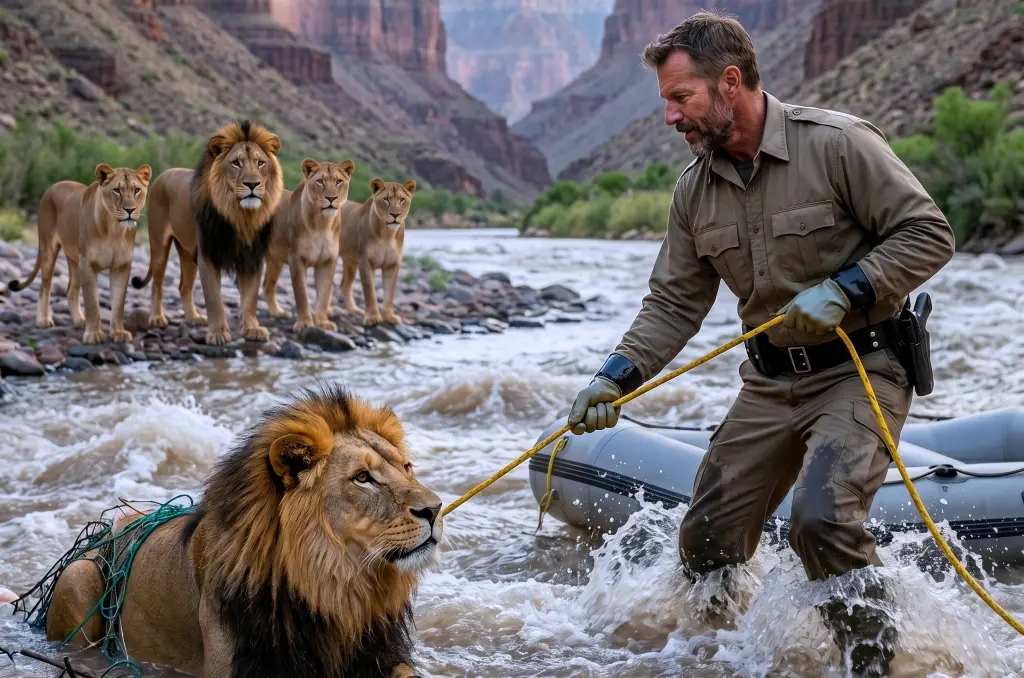
“You heard the order,” the deputy director said carefully. “You were told to maintain distance.”
Tom looked down at his hands. There was a thin red line across his palm where the rescue rope had burned through his glove, and beneath one thumbnail was a dark crescent of river grit. He could still feel the current pulling at his knees, then his waist, then everything he had ever been taught.
“Yes, ma’am,” he said.
“And you entered an active predator habitat anyway.”
He nodded once. Outside the narrow window, the desert evening had gone copper-colored and still. The refuge looked peaceful from headquarters—low hills, dry grass, cottonwoods along the river corridor, miles of high fencing hidden by distance and light. A visitor could stand there and never guess that twelve thousand acres held lions rescued from roadside zoos, illegal breeders, and shuttered private collections, animals given as much wildness as captivity could honor.
Tom did not look toward the river. He had already learned that if he looked that way, he would stop hearing the questions.
The deputy director waited. “Why?”
It should have been an easy thing to answer. Human safety. Animal welfare. Unnatural hazard. Imminent loss. There were official phrases for almost every crisis, language built to hold panic at arm’s length. Tom had used that language his whole career.
But the truth had not come to him in a phrase. It had come in a sound—a young lion trying to breathe through floodwater, and a pride on the far bank going completely still.
So Tom said the only thing that felt honest.
“Because he wasn’t drowning in nature,” he said. “He was drowning in what we left behind.”
The room remained quiet. Not dramatic quiet. Not the kind people later describe as stunned. Just the practical silence of people who know a rule may have been broken for a reason they cannot easily dismiss.
By then the story was already moving through the refuge in low voices. A ranger had disobeyed dispatch. A lion had been pulled from the river. The pride had not attacked.
What nobody knew yet—not in that room, not in the trucks idling outside, not among the staff checking the north range fence line by flashlight—was that the strangest part of the day had not been the rescue.
It had been what the lions did afterward.
That morning had begun with a false calm. Tom had been out before sunrise, driving the east service road with the windows cracked, letting the cool air roll through the cab. In southern New Mexico, summer mornings could start soft enough to make a person forget what the afternoon would bring. The sky was pale gray at the edges, the greasewood damp from night air, the river corridor tucked under a loose veil of mist.
He had been a ranger for twenty-three years, long enough to distrust pretty mornings when the land felt too quiet.
The rain had fallen three nights earlier up in the mountains—hard rain, the kind that dropped out of black clouds and ran downhill with no patience. Flash floods were part of the country. They carved arroyos, moved boulders, pulled entire cottonwoods down by the roots. But as Tom parked near the lower crossing and stepped out, he smelled something that did not belong with rain.
Wet rust. Diesel. Torn plastic.
He stood with one hand on the open truck door and listened. The river sounded wrong. It was not only high; it was pinched, forced into a faster voice, rushing with a sharp metallic clatter beneath the ordinary roll of water. Somewhere upstream, debris was catching and breaking loose, catching again.
Tom took his radio from his belt. The casing was scuffed along one side, the antenna taped where it had cracked the previous winter.
“Unit Three at lower east,” he said. “River’s running hard. I’m going to check the bend before I head north.”
Dispatch answered through a burst of static. “Copy that, Tom. We just got movement alerts near the lion range crossing. North pride is off pattern.”
Tom looked toward the high cottonwoods that marked the far side of the habitat. The north pride usually moved at dawn, but they did not come down to the lower river unless the heat drove them there. The crossing was shallow most of the year, a broad shelf of rock and sand where the lions could wade without trouble. During flood season, staff kept gates locked and patrols light. The animals knew the land better than any person did.
Still, “off pattern” was a phrase that carried weight.
“I’m close,” Tom said. “I’ll take a look.”
He shut the truck door and followed the gravel bank on foot. The river slid in and out of view through the brush, gray in the mist, shouldering branches along as if annoyed by them. Twice Tom saw flashes under the surface—wire, maybe, or sheet metal tumbling in the current. A mile upstream, an old ranch property had been cited for illegal dumping before the refuge bought the adjoining land. Every storm pulled up another piece of somebody’s carelessness.
As he rounded the bend, the sound changed again. It deepened. Broadened.
Then he saw the lion.
At first the animal looked like a dark shape caught in the center of the current, too large to be debris and too low in the water to be standing. Tom stopped so abruptly that gravel shifted under his boots. The lion’s head rose, mane plastered flat against his neck, mouth open as he dragged in air. He was a young male, maybe not fully grown but close, heavy through the shoulders and long-limbed in the awkward way of animals still growing into power.
The current spun him sideways. He fought to correct, front paws striking at water that gave him nothing. His head went under, vanished, then came up again with a rough cough that reached Tom even over the river.
“Damn,” Tom whispered.
He lifted the binoculars from his chest. The lion was not simply tired. Something had him by the rear leg, a dark tangle stretching back into the current and disappearing beneath foam. Each time he tried to angle toward shore, the line snapped tight and dragged his hindquarters downstream.
Tom swung the binoculars upstream and found the cause. A cottonwood had fallen at an angle across a narrow part of the bend. Against it the flood had packed a filthy dam of branches, wire mesh, fence scraps, plastic barrels, and twisted lengths of cable. Water was forcing itself through the gap, faster and meaner than it should have been.
The crossing had become a trap.
On the opposite bank, movement gathered in the mist. One lioness emerged first, tawny body low and tense. Another stepped into view behind her, then a third. Soon the whole pride stood along the far shore in a ragged line, all of them fixed on the young male in the water.
None of them entered past the shallows.
Tom had worked around predators most of his adult life, though he would have been the first to say nobody truly worked “with” lions. You managed distance. You respected patterns. You learned to recognize agitation before it became speed. At Red Mesa, the rule was simple enough to keep people alive: no direct contact inside an active habitat unless the animal was sedated or contained, and no intervention in natural predator incidents without authorization from veterinary command.
The rule existed for good reasons. A drowning lion was still a lion. A frightened pride could turn a rescue into a fatality before anyone reached the gate.
Tom keyed the radio. “Dispatch, I have visual on a young male in the lower bend. He’s in the current and appears entangled. North pride is present on the far bank.”
A pause, then dispatch came back flatter than before. “Copy. Stand by.”
The lion slipped under again. This time only his nose broke the surface at first, then his whole head jerked up as he fought the current.
Tom’s hand tightened around the radio.
A second voice came on, Mark Ellis from operations. “Tom, maintain distance. Do not enter the habitat corridor. Vet team is being notified.”
“Vet team’s at least forty minutes out,” Tom said.
“Understood. Maintain distance.”
Tom stared across the water at the pride. One lioness had moved to the very edge, her front paws in the wash, body trembling as though every muscle wanted to leap and every instinct knew she would lose. Behind her, the others shifted but did not scatter. Their focus was total.
Then the older male came into view.
He was broader than the rest, mane dark across the chest, face marked by old scars. He did not pace. He did not call. He walked to the edge of the bank and stopped, planting himself where the pride could see both the river and Tom.
The young lion cried out once, a short, ragged sound stripped of force. It was not a roar. It carried no claim, no challenge, no warning. It was simply the sound a body makes when strength is running out.
The pride answered—not loudly, not in a frenzy. A low pulse of sound moved through them, deep enough that Tom felt it more than heard it. The older male remained still.
Tom had seen animals panic. He had seen them flee from sirens, bolt from smoke, charge fences during lightning storms, turn on one another under stress. This was not panic. The pride had gathered around helplessness and made a shape out of waiting.
The radio crackled. “Tom, confirm your position.”
He did not answer right away. Through the binoculars, he watched the wire bite into the young lion’s rear leg. It looked like old livestock fencing, maybe reinforced mesh, braided by floodwater into something that tightened whenever the river pulled.
Human material. Human mess. Human consequence.
“Lower bend, east bank,” he said finally. “I’m staying with visual.”
“Observation only,” Mark replied. “No approach.”
Tom closed his eyes for one beat, then opened them. The lion’s head sank again.
Years earlier, long before Red Mesa, Tom had stood on another bank and obeyed every rule given to him.
That animal had not been a lion. It had been a black bear caught in a collapsed culvert after a spring storm in Colorado, wedged deep where the banks were too unstable for a safe approach. Tom had been thirty-four then, new enough to still believe that if a policy was clear, his conscience would follow it. The senior officer had told him they would monitor until the animal freed itself or stopped struggling. The ground was unsafe. Sedation was impossible. Intervention risked human life…
To read the rest of the story – CLICK the NEXT button 👇👇👇