


The first time the white tiger saw Nora Wells again, he hit the viewing glass hard enough to make thirty sophomores stumble backward. A keeper shouted from the far end of the observation deck. Someone screamed. A boy near Nora dropped his phone, and it skidded across the concrete with a bright plastic clatter. For a second, everyone moved at once except the girl in the wheelchair parked closest to the glass.
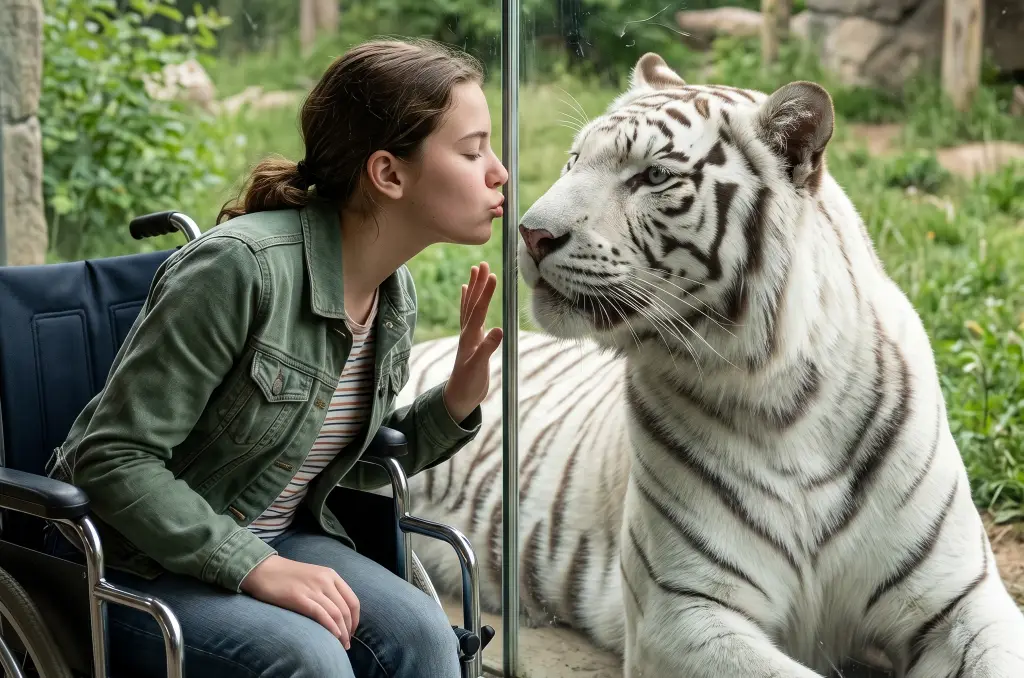
Nora did not flinch.
On the other side of the barrier, the tiger stood with both front paws pressed against the thick pane, his breath spreading white across the glass. He was enormous now, all muscle and winter-colored fur, with pale blue eyes that seemed too familiar to belong to something so wild. His black-striped face lowered until it was level with hers.
“Nora,” her teacher said carefully from behind her. “Back away.”
But Nora’s hands had already gone still on her wheel rims. She was sixteen years old, old enough to know better than to romanticize a wild animal, and still young enough for her heart to forget every rule at once.
“Ghost?” she whispered.
Two years earlier, the same tiger had fit inside a bath towel.
Back then, Nora had been fourteen and still small enough that adults sometimes talked over her head as if her wheelchair had lowered her into another species of person. She had learned to notice things because people rarely noticed her first: loose gravel near curb cuts, doors that claimed to be accessible but opened the wrong way, teachers who said “be patient” when what they meant was “don’t make this difficult.”
The service road behind Cedar Ridge Zoo was one of the few places in town where nobody tried to help her unless she asked. Most visitors never went back there. They stayed on the bright side of the zoo, where the snack carts smelled like pretzels and sunscreen, and kids pressed sticky hands against the railings around the giraffe yard. Behind the public exhibits, the pavement narrowed beside chain-link fencing, loading docks, staff parking, and low brick buildings with signs that said Authorized Personnel Only.
Nora liked it better there.
Every Saturday afternoon, she cut behind the zoo on her way to her grandfather’s veterinary clinic, partly because it was quieter and partly because she could pause by the fence and sketch whatever she could see through the gaps. Her sketchbook was always wedged between her hip and the side of her chair, its pages swollen from colored pencils and Ohio humidity. That day, she had been drawing the back of a snow leopard’s ear from memory when a metal door slammed somewhere ahead of her.
A man in a dark green work shirt came out of the restricted breeding annex carrying two canvas laundry bags and a bundle wrapped in a gray towel. He moved fast, his shoulders tight, one hand pressed to his phone as if he was listening to someone curse in his ear. A woman’s voice called from inside the building, sharp and hurried.
“Just get rid of it before Bennett sees.”
Nora slowed.
The man shoved one laundry bag into a rolling bin by the service gate. The towel bundle slipped from under his arm and fell beside the fence, half in the dirt and half against the concrete curb. Nora saw it clearly. The man did not. He swore at whoever was on the phone, yanked the bin toward the door, and disappeared inside as the steel door clanged shut behind him.
“Hey,” Nora called. “You dropped something.”
The door had already locked.
She rolled closer, frowning. For a moment she told herself it was only laundry, maybe a towel with medical waste or something she should not touch. Her grandfather, Dr. Samuel Wells, had taught her enough about animals and clinics to respect anything wrapped, sealed, or left near a staff-only building. But then the bundle moved.
Not much. Just a small tightening beneath the towel, followed by a sound so thin she almost missed it.
A squeak.
Nora’s hands went cold around the rims. She looked toward the loading dock, then back at the towel. No one came. No one even glanced through the small square window in the steel door.
“Okay,” she said under her breath. “Okay, I hear you.”
There was a shallow drainage rut between the pavement and the fence, dried hard from old rain. Nora angled her chair carefully, but the front caster dropped into it and stopped with a jolt that pitched her forward. Pain flashed up her wrists. She sucked in a breath and pushed back, but the wheel only spun against packed mud.
“Seriously?” she muttered.
The squeak came again, weaker this time.
Nora stopped worrying about the chair. She twisted, unzipped the side pocket of her backpack, and pulled out the aluminum reacher tool she used for high shelves, fallen pencils, and the occasional cafeteria napkin that slipped under a table. The rubber claws shook as she stretched it through a gap beneath the fence.
The towel was heavier than it looked. It dragged through dust, caught on a bent wire, and nearly slipped free twice before she got it close enough to grab with her hands. When she pulled it into her lap, the fabric was damp and cool. Something inside it gave one tiny, exhausted kick.
Nora peeled back the towel.
At first she could not make sense of what she was seeing. The creature was small, no bigger than a house cat, with sealed eyes, a pink nose, and fur so pale it looked almost silver where it was wet. Black stripes ran across its little head and down its folded shoulders. Its paws were oversized for its body, soft and helpless, with claws no bigger than thorns.
A tiger cub.
A white tiger cub, newborn and cold, lying in a dirty towel beside a staff gate as if he had been trash.
“Oh, no,” Nora breathed. “No, no, you’re alive.”
She pressed two fingers lightly against his chest, just where her grandfather had shown her on a kitten once. For one terrifying moment she felt nothing. Then, beneath skin and damp fur, there was a flutter, faint as a moth’s wing.
Nora tucked the towel inside her jacket and leaned back hard, rocking the chair. The front caster stayed trapped. She shoved at the rims again, this time with everything in her shoulders, and the chair lurched backward an inch. The cub made no sound. She pushed again, teeth clenched, and the wheel popped free so suddenly she almost tipped.
“Stay with me,” she told the bundle in her lap. “Please. I’m going to get you help.”
Her grandfather’s clinic was eight blocks away if she took the sidewalk along Mason Street, six if she cut through the alley behind the hardware store and ignored the curb cut that always filled with gravel. Nora chose the six-block route. Her gloves slipped against the rims. Cars hissed by on wet pavement. Once, at a crosswalk, the light changed too fast and a truck driver honked while she was still halfway across, but she kept moving with the cub pressed to her stomach beneath her jacket.
By the time she hit the automatic door button at Wells Veterinary Clinic, her arms were burning.
The lobby smelled like disinfectant, dog treats, and old coffee. Mrs. Alvarez from the bakery was at the counter with a nervous dachshund in a sweater, and the dachshund started barking before Nora was fully inside. Nora ignored it.
“Grandpa!” she called.
Dr. Samuel Wells came out from the exam hallway with his glasses pushed up on his forehead and a stethoscope hanging around his neck. He was seventy-one, broad-shouldered, white-haired, and gentle in the deliberate way of men who had stitched up too many frightened animals to make sudden moves. The look on Nora’s face erased every ordinary question from his.
“What happened?”
Nora pulled open her jacket.
For half a second, her grandfather did not move. Then the veterinarian in him took over.
“Treatment room. Now.”
He cleared the counter with one arm, told Mrs. Alvarez they would reschedule at no charge, and carried the towel bundle down the hall. Nora followed so fast one wheel clipped the doorframe. Her grandfather laid the cub on a heated pad, snapped on gloves, and began issuing short instructions.
“Small oxygen mask. Top shelf. Warm saline. The blue bottle warmer. Nora, look at me.”
She had been staring at the cub’s chest, willing it to rise.
“Nora.”
She looked up.
“Breathe first. Then help me.”
She nodded and grabbed what he needed. Her hands shook, but they worked. Oxygen mask. Towels. Syringe. Thermometer. Her grandfather spoke softly to the cub as he worked, not baby talk, just the steady murmur he used with terrified animals.
“There you are. Come on, little one. Let’s get you warm.”
“Is he going to die?” Nora asked.
Dr. Wells did not lie to her. He never had.
“He’s very cold,” he said. “But he’s here.”
The cub’s mouth opened. Nothing came out. Nora put one hand against the edge of the table because she suddenly felt as if the room had tilted.
“Why would somebody do that?” she asked.
Her grandfather’s jaw tightened. “I don’t know yet.”
He worked for another twenty minutes. The cub’s temperature inched upward. His breathing deepened, then faltered, then steadied again. At last, while Nora was holding a towel around him, the cub gave a tiny wet sneeze and bumped his blind face against her thumb.
Nora laughed once, but it came out too close to a sob.
“He sneezed,” she said.
“I noticed.”
“That means he’s mad, right?”
“It means his body is trying.” Dr. Wells checked the cub’s chest again, and for the first time since she had burst through the door, his face softened. “That’s a good sign.”
Nora looked down at the little white body in the towel. He was still trembling, still far too quiet, but his paw had found the seam of her sleeve and curled there as if holding on.
“He needs a name,” she said.
Her grandfather gave her the look he saved for moments when she had jumped three steps ahead of safety, law, and common sense. “Nora.”
“He can’t just be ‘the cub.’”
“He may already have a name.”
“Not from the people who left him by the fence.”
Dr. Wells removed his glasses and rubbed the bridge of his nose. “We don’t know what happened.”
Nora did not argue. She only looked at the cub, at the pale fur and the thin ribs and the way he seemed barely attached to the world.
“Ghost,” she said quietly.
Her grandfather stopped cleaning the thermometer. “Ghost?”
“He was almost gone.” She stroked one finger over the cub’s damp head. “But he’s not gone now.”
Dr. Wells sighed, the kind of sigh that meant he had already lost the argument and was mostly disappointed that she knew it. “All right,” he said. “For now, he’s Ghost.”
The cub sneezed again, softer this time.
Nora smiled. “See? He likes it.”
Her grandfather did not smile back, not quite. He looked toward the hallway, toward the front door and the town beyond it, and Nora saw worry settle into the lines around his eyes.
“For now,” he repeated.
Ghost survived the first night in a laundry basket lined with heated towels and a fleece blanket Nora refused to admit she had stolen from her own bed.
She slept in her chair beside the treatment table until her grandfather rolled in an old cot and told her she could either lie down or be sent home. Even then, she slept badly, waking every time the cub twitched or made the faintest sound. Dr. Wells fed him with a bottle every few hours, weighed him on a digital scale, checked his temperature, and wrote everything down in the careful block letters he used for medical charts…
To read the rest of the story – CLICK the NEXT button 👇👇👇