


Milo did it for the third night in a row, and this time Emily Carter stayed awake long enough to see where he went. The little orange cat slipped off the armchair without a sound, crossed the dim living room, and hopped onto the edge of the pullout sofa where Daniel Whitaker was sleeping under an old blue quilt. Daniel had stayed late after dinner because freezing rain had coated the sidewalks outside, and Emily had insisted he not try to get his wheelchair down the ramp behind her building until the maintenance crew salted it in the morning. He had argued, of course. Daniel argued with kindness, which somehow made it harder to win against him.
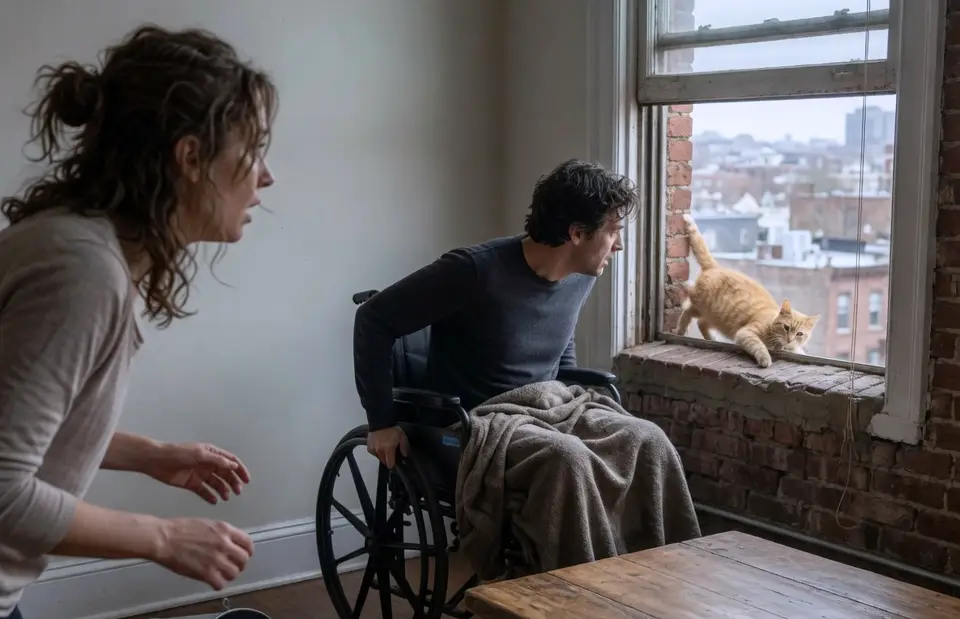
Now he slept on his side, one arm folded beneath his pillow, his chair parked within reach beside the sofa. Milo stood over him like a creature with a secret mission, sniffed the quilt once, then nosed his way beneath it. A minute later the blanket began to move in small, steady pulses near Daniel’s legs.
Emily sat very still in the chair across the room. The only light came from the stove clock in the kitchen and the pale orange glow of the streetlamp outside her apartment window. At first she thought Milo was just burrowing for warmth, the way he did with laundry fresh from the dryer. Then she heard the purring—deep, determined, almost mechanical—and saw the rhythm of his front paws pressing into the quilt.
Kneading. Over and over, right against Daniel’s calves.
Daniel did not stir.
Emily knew he would not feel it. At least, that was what he had told her the first time she had accidentally brushed his leg while moving around him in the kitchen. “You don’t have to apologize,” he had said lightly, as if he were talking about a spilled glass of water and not the invisible border his body had drawn after the accident. “I barely feel anything below the knees.”
Milo didn’t seem to know that, or maybe he didn’t care. He kept pressing his tiny paws into the same place, purring as if he could reach something Daniel himself had stopped believing was there.
Emily pulled the quilt tighter around her own shoulders and looked at Daniel’s sleeping face. Without his usual careful smile, he looked younger. Not young exactly, because time had put its marks on him the way it did on everyone, but younger in the way memory sometimes stepped through a person when they were too tired to guard the door.
For a moment, she saw him at eleven years old again, sitting beside her at a scratched-up table in Mrs. Palmer’s fifth-grade classroom, his pencil moving faster than anyone else’s during a science quiz.
It had been raining that day too. Emily remembered that because the whole room had smelled like wet jackets and pencil shavings, and the windows had fogged at the edges. Daniel had finished the quiz early and turned his paper facedown with the satisfied calm of someone who trusted every answer he had written.
Emily, who had been stuck on a question about the water cycle, leaned close and whispered, “Do you believe in miracles?”
Daniel looked at her as if she had asked whether he believed the moon was made of cake. “During a science quiz?”
“I’m serious.”
He glanced toward Mrs. Palmer, then back at Emily. “No. I believe in things people don’t understand yet.”
“That’s not the same.”
“It’s better,” he whispered. “It means there’s an explanation.”
Emily had smiled, partly because he sounded so certain and partly because she liked how certainty looked on him. Then she wrote three words in the margin of her notebook where he could see them.
Leave room anyway.
He rolled his eyes, but he had smiled too.
From that year on, Daniel Whitaker became the person Emily measured nearly everything against. They grew up in Riverton, Ohio, a town large enough to have two high schools and small enough for everybody to know which grocery store had the good bakery counter. Their teachers kept seating them near each other by accident or habit, and by high school it felt strange to sit anywhere else. Daniel helped Emily through chemistry. Emily proofread his English essays, which were always brilliant and somehow allergic to commas. He wanted to become a surgeon. She wanted to become an attorney, though she was not yet sure whether that was because she loved justice or because she loved winning arguments.
She never told him she loved him.
At graduation, standing in the school parking lot with her cap bobby-pinned too tightly to her hair, Emily nearly did. Daniel was leaving for a state university in Columbus on a pre-med scholarship, and she was staying closer to home. He talked about anatomy labs and hospital rotations and how he would probably not sleep for the next twelve years. She smiled and made jokes because that was easier than asking him not to disappear into the future without her.
For a while, he didn’t. They called each other from dorm rooms and library stairwells. He told her about organic chemistry and a roommate who microwaved fish at midnight. She told him about her political science professor, who threw chalk when students made lazy arguments. Then the calls became texts, and the texts became birthday messages, and the birthday messages became something she wrote and deleted because too much time had passed.
Years folded themselves into other years. Emily finished college, then law school, then found a job at a small but respected firm in downtown Riverton, where she learned how to sound calm in conference rooms even when men twice her age tried to interrupt her. She moved into a first-floor apartment in a renovated brick building near the river. She dated, but never for long. Men called her accomplished, intimidating, beautiful, impossible to read. None of them knew that every February she still remembered Daniel’s birthday before she remembered to pay her electric bill.
She assumed he had become the surgeon he always said he would be. She imagined him in some bright operating room in Columbus or Chicago, wearing blue scrubs, steady hands, steady voice. She imagined him married sometimes, because that was the sensible thing to imagine if she wanted to stop waiting for a person who had never asked her to.
Then, on a bitter January night, she found the kitten.
It was almost nine o’clock, and Emily had stayed at the office too late preparing documents for a custody case that had left her throat tight and her patience thin. The sidewalks glittered with old snow, and the air had that hard Midwestern cold that made every breath feel metallic. She was cutting through the alley behind the firm’s building when she heard a sound so small she almost mistook it for the squeak of her own boots.
The kitten was wedged beside a cardboard box near the dumpster, no bigger than both her hands, his fur crusted with ice at the tips. He lifted his head when she crouched, but only barely. One eye was sealed shut. His mouth opened around another silent cry.
“Oh, sweetheart,” Emily whispered.
She took off her scarf, wrapped him in it, and tucked him inside her coat against her sweater. His body was frighteningly light. For a second she stood there with her hand over him, feeling for a heartbeat, and panic moved through her so fast that she forgot the cold entirely.
She called the nearest emergency veterinary clinic from the back of a rideshare. The driver, a gray-haired man with a thermos in the cup holder, kept glancing at her in the rearview mirror while she held the scarf bundle against her chest.
“Cat?” he asked.
“Kitten.”
“He alive?”
Emily looked down at the tiny rise and fall under the wool. “He’s trying to be.”
The clinic sat in a strip mall between a pharmacy and a closed nail salon, its windows still bright against the dark parking lot. A vet tech took the kitten from Emily the moment she came in, and Emily was left in the waiting room with wet boots, an empty scarf, and a pulse that would not slow down. A television mounted in the corner played a cooking show no one was watching.
After twenty minutes, a woman in lavender scrubs came out. “He’s cold and dehydrated, but he’s tougher than he looks. The doctor wants to talk to you.”
Emily followed her down a short hallway that smelled like antiseptic, dog shampoo, and coffee. In the exam room, the kitten lay on a warming pad inside a small plastic tub, wrapped in a towel, looking both miserable and offended. A man in a surgical mask sat at the desk, writing on a chart.
“He’ll need antibiotics for that eye, and you’ll have to keep him warm tonight,” the veterinarian said without looking up. “Small meals. Not too much at once. Kittens this cold can crash if you push too fast.”
Emily went still.
It was not the words. It was the voice beneath them. Calm, precise, a little dry around the edges, as if every sentence had been checked for structural integrity before being released into the world.
She gripped the back of the chair. “Daniel?”
The pen stopped moving.
The doctor turned slowly. Above the mask, his eyes narrowed, then widened. For a second neither of them spoke. Then he pulled the mask down, and Emily found herself staring at a face she had carried in memory for more than a decade, older now, leaner, with faint lines at the corners of his eyes and a short scar near his jaw that had not been there when he was eighteen.
“Emily Carter,” he said, almost laughing. “No way.”
She did laugh then, because the alternative was something too close to crying. “You’re here.”
“So are you.”
“I live here.”
“I gathered that from the freezing kitten delivery.”
The absurdity of it loosened something in her chest. They talked too fast at first, both of them stepping over the obvious questions with safer ones. She told him she worked downtown. He told her he had joined the clinic six months earlier. She said the kitten had been in the alley behind her office. He said the kitten had excellent timing and terrible judgment.
Then he gathered the prescriptions, tucked them into a folder, and pushed back from the desk.
Not stood. Pushed.
The wheelchair appeared from behind the exam table as he rolled around it, the folder resting across his lap. It took Emily half a second too long to understand what she was seeing, and she hated herself for that half second immediately. Daniel saw it anyway. Of course he did. He had always noticed the things people tried to hide.
His smile changed, not disappearing but becoming practiced. “Yeah,” he said gently. “That part’s new.”
Emily forced her eyes back to his face. “Daniel, I—”
“It’s okay.”
“It’s not that. I just didn’t know.”
“I didn’t exactly send out announcements.” He handed her the folder. “Life got creative.”
The old Daniel would have said it with a sharper edge. This Daniel said it quietly, as if he had learned how to make pain sound like weather.
Emily looked down at the kitten, who had managed to free one paw from the towel and was kneading weakly at the air. “Does he have a chance?”
Daniel’s face softened in a way that made her chest ache. “A good one, if you’re willing to lose sleep.”
“I can do that.”
“Then he’s lucky.”
She wanted to say, So am I, but the words felt too large for a room with fluorescent lights and a half-frozen cat between them. Instead she nodded, held the folder tight, and listened while Daniel explained every medication twice.
At the door, he said, “Text the clinic number if anything changes. Or call.”
“Even if I have a stupid question?”
“Especially then.”
Emily stepped out into the cold with the kitten tucked against her heart, his tiny claws snagging her sweater through the scarf. She sat in the back of another rideshare and looked at the phone number printed on the discharge sheet.
Daniel Whitaker, DVM.
For the first time in years, his name was not something she remembered alone.
Emily named the kitten Milo because by the third morning he had recovered enough strength to climb into a cereal box and refuse to come out, and the name sounded like someone who would do that. His eye improved first. Then his appetite. Then his personality arrived all at once, as if it had been waiting behind the fever for permission to take over her apartment. He attacked shoelaces, dragged socks under the couch, and developed a particular hatred for Emily’s printer. Twice he walked across her laptop during a work email and sent messages that made one senior partner reply, “Did you mean to include sixteen semicolons?”…
To read the rest of the story – CLICK the NEXT button 👇👇👇