


By the third morning after the hurricane, the water had learned the shape of every road in Cypress Parish. It moved where pickup trucks used to pass, where children had ridden bikes to school, where mailboxes now poked up like little metal crosses. It carried porch chairs, gas cans, pieces of fencing, and the pale splintered ribs of old barns. Every so often, something struck the side of the rescue boat with a hollow thump, and Staff Sergeant Caleb Hayes would look down before he could stop himself.
He had been doing that for two days.
“Log,” Earl Bennett called from the back of the boat.
Caleb leaned over the bow, hooked the drifting branch with the aluminum pole, and shoved it away before it could foul the motor. His gloves were soaked through. Mud had dried in gray-brown bands across the knees of his uniform, and the skin beneath his eyes felt tight from too little sleep.
Behind him, Earl eased the throttle forward again. Earl was not military, but the parish emergency office had assigned him to the Guard team because he knew the bayou roads even when they were underwater. He was sixty-two, narrow as a fence rail, with a tobacco-rough voice and the calm of a man who had spent more of his life in boats than in houses.
“You keep staring at everything that bumps us, Sergeant,” Earl said.
Caleb kept his eyes on the flooded road ahead. “Part of the job.”
“Some parts you can set down when they’re over.”
Caleb did not answer. Earl had known him for only forty-eight hours, but old boatmen noticed things. They noticed currents, weather, weak boards, bad lies, and men who went quiet whenever water rose above the window lines of abandoned cars.
The radio crackled near Caleb’s shoulder. A dispatcher’s voice cut through static and wind.
“Rescue Team Three, be advised. We still have two civilians reported near Miller Cutoff, possibly on the second floor of a residence. Also receiving unconfirmed reports from the north end of the parish regarding escaped exotic animals. Repeat, unconfirmed. Use caution.”
Earl glanced at Caleb. “Exotic animals?”
Caleb pressed the talk button. “Dispatch, Rescue Three. Define exotic.”
A pause followed, broken by a burst of static. “Caller said big cats. Source is a neighbor near Dobbins Wildlife Park. We do not have confirmation. Sheriff’s office is prioritizing human rescues.”
Earl gave a dry, humorless laugh. “Ray Dobbins and his circus.”
“You know the place?” Caleb asked.
“Everybody knows it. Half zoo, half roadside attraction. Kids got their pictures taken there with baby animals back when that was still allowed. Folks stopped going after the place got sad.”
Caleb looked toward the north, where the water widened into a brown sheet between broken tree lines. “Any chance the report is real?”
“Dobbins had tigers years ago. Maybe still does. Hard to know what a man keeps when nobody wants to look too close.”
The boat pushed on, past a church sign with only the top line visible above the floodwater. Caleb forced himself to focus on the address they had been given. Two civilians, possibly trapped. That was the order. That was the mission.
But the word tiger stayed in his mind.
It was not because he had any soft, romantic idea about wild animals. Caleb had grown up in western Kentucky around horses, cattle, hunting dogs, and men who respected animals enough not to pretend they were harmless. A tiger loose in floodwater was not a symbol. It was four hundred pounds of muscle, fear, and teeth where no one expected it to be.
Still, once he imagined it, he could not put the image away: an animal built to command a cage, a clearing, a strip of jungle it had never seen, being dragged through dirty Louisiana floodwater like any broken thing.
They found the two civilians on the upper floor of a white farmhouse with a green roof. An elderly man refused to leave until Caleb promised to come back for the photograph albums stacked on the dining room table. His wife kept apologizing for being heavy as Caleb and another Guardsman helped her into the boat.
“You boys should be home with your families,” she said, clutching a plastic grocery bag of pill bottles to her chest.
“Yes, ma’am,” Caleb said. “We’ll get there.”
He had been saying versions of that for years. Yes, ma’am. Hold on. Step here. Take my hand. Keep your eyes on me. He knew the lines. He knew how to make his voice steady when someone else’s fear needed a place to rest.
What he did not know was how to stop hearing the voice of Private First Class Luis Marin under a different flood, in a different county, eleven months earlier.
Sarge, I’m slipping.
Caleb tightened his grip on the bow rail until his knuckles ached. He had gone over the accident in his head so many times that the memory had lost its edges and become something worse than a picture. A hand in his. A rope gone slack. Rain on his face. The weight leaving all at once.
Earl steered around a half-submerged pickup. “You good?”
Caleb looked back at the rescued couple huddled under ponchos, then toward the next line of roofs. “Yeah.”
Earl studied him for half a second and let the lie pass.
By late afternoon, the sky had dropped low and yellow over the parish. Helicopters moved in the distance like dark insects. The main levee had held, but two smaller flood barriers had failed, and the water coming through the low country had too much force to be called standing water. It ran in channels where streets dipped, dragging debris through intersections and into yards.
They were crossing what had been a service road near the old wildlife park when Earl cut the motor so sharply that Caleb nearly lost his footing.
“What?” Caleb asked.
Earl raised one hand, listening.
At first Caleb heard only rain ticking against the water and the distant buzz of a chainsaw. Then came another sound, low and raw, almost swallowed by the rivering current.
Not a dog. Not cattle.
The sound came again, longer this time.
Earl’s face changed. “Lord have mercy.”
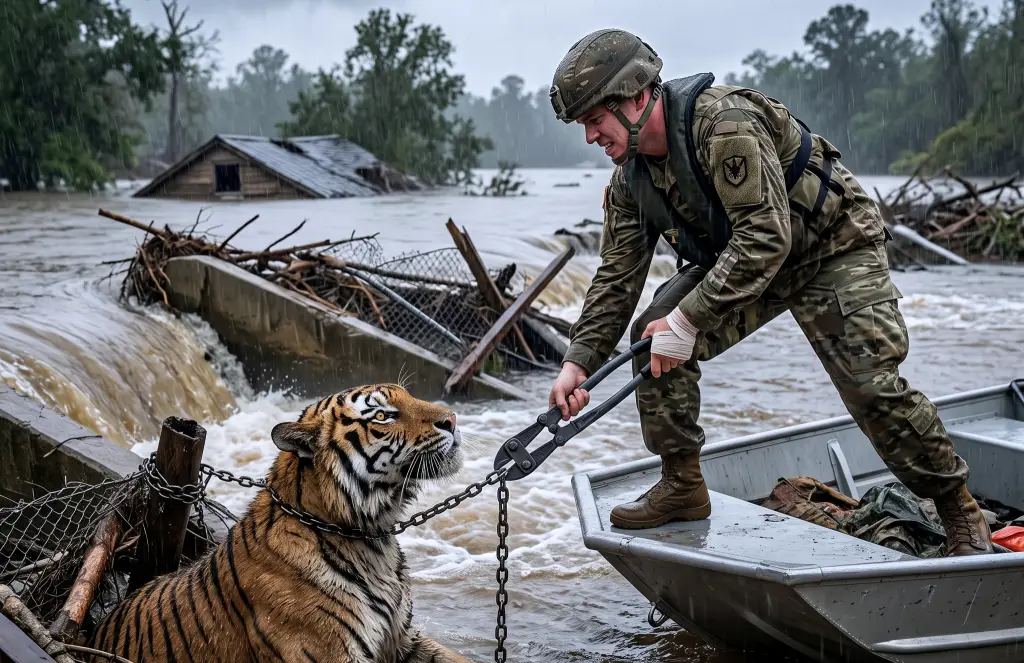
Caleb turned slowly toward the remains of a concrete spillway beside the flooded road. A broken utility pole had wedged against it, collecting branches, fencing, and pieces of corrugated metal. Something orange moved among the debris.
For a moment, Caleb’s mind refused to name it.
Then the animal lifted its head.
The tiger’s face was streaked with mud and blood, but the white marks around its eyes were clear even through the rain. Its front paws clung to the slick lip of the concrete, claws scraping for purchase. The rest of its body was in the rushing water, pulled sideways by the current every few seconds as if the river were trying to peel it away.
The elderly woman behind Caleb whispered, “Is that real?”
No one answered.
The tiger tried to shift its weight. Its back end swung out, slammed against the debris jam, and vanished under the water for one terrible second before it surfaced again. A torn length of chain trailed from something around its neck or shoulder, catching and releasing against the floating wreckage.
Earl reached for the radio. “Rescue Three to Dispatch. We have visual confirmation on one tiger in active floodwater near the north service road by Dobbins Wildlife Park. Animal is alive, distressed, partially trapped.”
Static answered first. Then the dispatcher came back, sharper now. “Rescue Three, maintain distance. Do not engage. Sheriff’s office and wildlife personnel are being notified.”
Caleb stared at the tiger’s paws. They were enormous, each claw cutting pale lines against the concrete before slipping again.
“Copy,” Earl said, but his voice had thinned.
The tiger made another effort to climb. It failed. The current yanked hard enough to slam its shoulder against a jagged piece of metal, and Caleb saw the animal’s mouth open, not in a roar this time, but in a silent, exhausted grimace.
Earl lowered the radio. “We’ve got civilians on board.”
“I know.”
“We also have a boat that wasn’t built for a tiger.”
“I know that too.”
The tiger’s eyes found them then. Caleb did not see gratitude there. He saw panic, pain, and the bright, focused fury of something that had not agreed to die.
The dispatcher’s voice returned. “Rescue Three, county wildlife vet is en route but delayed. Estimated arrival unknown due to road closures. Sheriff’s instruction is to keep clear until trained personnel arrive.”
Earl looked at the water around the concrete spillway. A whole section of roof drifted past, turning slowly. “By then he’ll be gone.”
Caleb said nothing for a moment. Rainwater ran from the edge of his helmet down his jaw. Behind him, the rescued couple sat very still, as if any movement might draw the animal’s attention.
“You thinking what I think you’re thinking?” Earl asked.
Caleb watched the chain snag again. This time, when the current pulled, the tiger’s head jerked sideways. The animal’s grip slipped lower.
“I’m thinking we don’t have time to wait.”
The first voice to tell Caleb no belonged to the sheriff.
Sheriff Tessa Miller came over the radio from a command post somewhere on higher ground, her words clipped by interference but clear enough. She had already lost two roads, one deputy cruiser, and most of a volunteer fire station to the flood. She did not sound like a woman in the mood for heroics…
To read the rest of the story – CLICK the NEXT button 👇👇👇