


The first thing I remember is the sound of the zebras hitting the fence. Not the alarm. Not the screaming. The fence. It was just after noon at Cedar Bend Wildlife Park, the kind of July heat that made the service roads shimmer and turned the keeper uniforms damp before breakfast rounds were done. A false fire alarm had gone off near the old primate building ten minutes earlier, and I was behind the maintenance shed resetting a breaker box, irritated more than worried. False alarms were annoying, but we drilled for them. Gates locked. Guests moved. Staff checked sectors. Everyone complained afterward and went back to work.
Then the zebra herd in the adjoining paddock bolted so hard the whole run of steel mesh shuddered.
They weren’t startled by a dropped bucket or a backfiring truck. I had worked hoofstock long enough before moving to carnivores to know the difference. This was deeper than fear. It was the ancient panic prey animals carry in their bones, the kind that hits before the thinking part of the brain can name what’s wrong.
A woman screamed somewhere beyond the concession plaza.
I left the breaker panel open and ran.
The keeper path curved behind the snack stand and came out near the main fountain, where families usually gathered with strollers and souvenir cups. That morning, the plaza had already broken apart into chaos. Parents were dragging children behind concrete planters. A teenage boy had fallen and was being yanked up by his backpack. Someone had abandoned a stroller sideways in front of the gift shop doors, one wheel still spinning.
And in the middle of the walkway, moving as calmly as if the entire park belonged to him, was Atlas.
Our twelve-year-old male African lion crossed the hot pavement without hurry. Outside the walls and moats and artificial rockwork of his habitat, he seemed impossibly large, larger than any guest ever understood from the safe side of the glass. His shoulders rose and fell under his tawny coat. His paws touched the concrete with almost no sound. The mane around his chest was dark at the edges and thick from summer dust.
He wasn’t charging anyone.
That was the only reason people were still alive.
I grabbed the radio from my belt and hit the emergency channel. “Code Red. Carnivore escape. Main south plaza. Atlas is loose. I need veterinary response to the service yard and county dispatch notified now. Lock the outer perimeter.”
The dispatcher answered, her voice cracking under the static, but I barely heard her. My eyes were on the lion. I was already running through the list of things that had to fail for him to be standing there: the alarm override, the interior shift gate, the secondary containment door. The false alarm must have cut power to the mag-locks during the evacuation sequence. The manual drop gate should have held anyway, but if one of the newer keepers had rushed the reset and left it resting even an inch above the track, Atlas would have found it. A lion doesn’t need much room when he has four hundred fifty pounds of muscle and a reason to push.
A man at the gift shop shoved his wife and little girl through the doorway and pulled the door shut behind them. The lock snapped loud enough for me to hear across the plaza.
Atlas did not even look.
That, more than anything, made the back of my neck go cold. A running child, a slamming door, a crowd unraveling in front of him—any of it could have triggered the wrong response. Instead, he stopped beside a splash of spilled soda, lowered his head, and breathed in through his mouth with his upper lip curled, tasting the air the way big cats do when a scent matters.
He was following something.
“Atlas,” I said under my breath, though I was much too far away for the name to mean anything. “What did you find?”
He turned away from the plaza and headed for the narrow staff corridor between the education center and the feed dock. My stomach dropped. Tuesday was delivery day. The refrigerated truck from our meat supplier would have the outer service gates propped open.
I followed at a distance, fighting every instinct that told me to run faster. You don’t chase a loose lion unless you want to make yourself part of the problem. I kept him in sight, radioed his location every few seconds, and prayed the guests behind me stayed hidden.
By the time I reached the loading dock, Atlas was passing through the service yard. The big rolling gate stood open to Marsh Pike, its warning cones still laid out for delivery traffic. Beyond it, cars were braking hard in both directions.
He walked straight out of the zoo.
A delivery van locked up in the right lane and stopped sideways, its driver frozen behind the wheel. A woman on the sidewalk had both hands on the handle of a jogging stroller, her face so white it looked almost gray. Atlas ignored the van, the shriek of tires, the stroller, the shouting. His nose stayed low to the pavement as he crossed the road and turned toward the residential blocks beyond the commercial strip.
I stayed roughly fifty yards behind him and kept talking into the radio. “He’s eastbound on Marsh Pike. Passing the gas station. No aggression. Repeat, no aggression. He is tracking scent.”
The words sounded absurd even as I said them, but they were true. He moved like an animal with a map no one else could see.
At the corner gas station, four high school kids stood near the ice machine with sodas in their hands. One girl dropped hers. The cup split open at her feet, and ice skittered over the concrete. Atlas passed within twenty feet of them and never turned his head.
At Briar Glen Drive, he left the main road and entered one of those older suburban neighborhoods where every house had a deep porch, a mature tree, and a mailbox shaped like someone’s weekend project. He followed the curve of the street, crossed a patch of grass between two parked cars, and slipped through the open gate of Maple Hollow Park.
I came around the corner seconds later and saw her.
She was sitting on a bench beneath a huge oak, an older woman in a pale blue linen shirt and worn khaki pants. A canvas tote rested beside her. She had a water bottle in one hand and a paperback folded open in the other, as if she had planned a quiet half hour away from whatever waited at home.
Atlas stopped at the edge of the grass.
His body changed. The easy, rolling walk disappeared, and his weight dropped lower, shoulders bunching beneath his coat. Not a full hunting crouch, but close enough to make my pulse hammer against my throat. He moved toward her in silence, the tip of his tail twitching once behind him.
I wanted to shout. I wanted to throw my key ring, wave my arms, do anything to break the line between them. But startling him at that distance could have been the thing that killed her. A frightened lion does not become safer because a man yells.
The woman looked up.
She saw him. There was no chance she misunderstood what was coming toward her. Four hundred fifty pounds of lion stood less than a dozen feet away, close enough that she could have seen the scar tissue over his right foreleg and the dust caught in his mane.
She did not scream. She did not run. She set her water bottle down on the bench beside her and went very still.
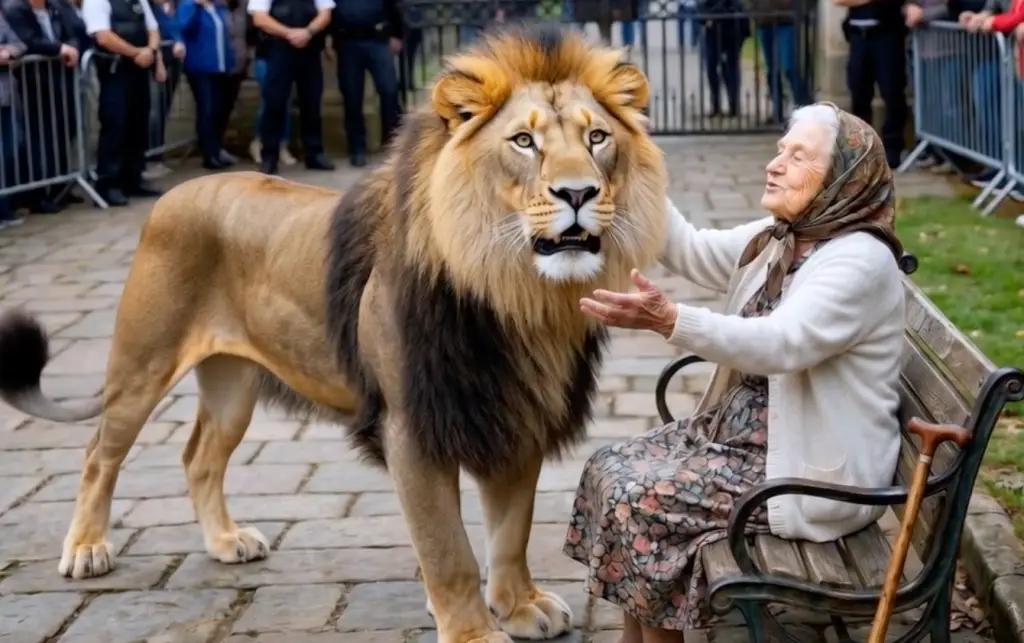
Then she leaned forward a little, her face softening in a way that made no sense at all.
“Atlas?” she said. Her voice was low, rough around the edges, and steady as a hand on a sleeping child. “My goodness. Look at you.”
The lion froze.
A sound came from him that I had heard only a handful of times in my career, a deep, pulsing chuff that pushed through his chest and seemed to vibrate in the ground. His posture lifted. The tension went out of his shoulders. He took the last steps to the bench, folded his huge front legs beneath him, and laid his head across the woman’s lap.
She put both hands into his mane.
Not dramatically. Not like some person trying to prove she wasn’t afraid. She touched him with the absent certainty of someone who remembered the shape of his skull under her palms. Her fingers found the place behind his ears, and Atlas closed his eyes.
That was how the sheriff’s cruisers found them.
Two patrol cars jumped the curb at the far end of the park and stopped hard in the grass. Doors flew open. Deputies dropped behind engine blocks with rifles and shotguns leveled toward the bench. I heard one of them shout for her not to move, though she already wasn’t moving.
I ran sideways across the lawn with both hands raised.
“Zoo staff!” I shouted. “Do not fire! Do not fire!”
“Get out of the line!” the lead deputy yelled back. His rifle stayed trained over the hood of the cruiser. “There’s a predator on a civilian!”
“Look at the civilian,” I said, planting myself between his muzzle and the lion. “Look at her.”
For a few seconds, nothing moved except the flashing lights washing red and blue over the oak trunks. The woman kept stroking Atlas’s mane. The lion opened one golden eye, glanced at the deputies, and let out another rumbling breath before settling his chin more heavily against her knees.
The deputy’s jaw tightened. He didn’t lower the rifle, but the barrel dipped a fraction.
I turned slowly, keeping my hands where everyone could see them, and took one cautious step toward the bench. Atlas watched me. His ears stayed forward, but his eyes followed every movement, reminding me that calm was not the same thing as safe.
I stopped far outside his strike range and crouched in the grass.
“Ma’am,” I said, making my voice as flat and even as I could. “My name is Dan Harper. I’m the senior carnivore keeper at Cedar Bend. I need you to tell me how you know this lion.”
The woman looked down at Atlas’s scarred brow. Her thumb moved once over the heavy bone above his eye.
“My name is Ruth Maddox,” she said. “And the last time he put his head in my lap, he was small enough to sleep in a produce crate.”
Ruth Maddox did not say it like a confession. She said it like a fact she had carried so long that emotion had worn itself smooth around the edges.
I stayed crouched in the grass, aware of every rifle behind me and every inch of lion in front of me. Atlas’s jaw rested across her thighs, his whiskers brushing the faded canvas tote on the bench. Ruth kept one hand buried in his mane. The other lay flat on the crown of his head, holding nothing down and yet somehow anchoring him more firmly than steel…
To read the rest of the story – CLICK the NEXT button 👇👇👇