


By the time the first patrol car reached Red Fir Road, the deputies would count forty-seven wolves in the timber.
Not circling.
Not feeding.
Watching.
But Cole Whitaker didn’t know that when he left Avery Nash on the frozen shoulder just after midnight. He only knew she wasn’t moving anymore, and that was enough to make him feel brave again.
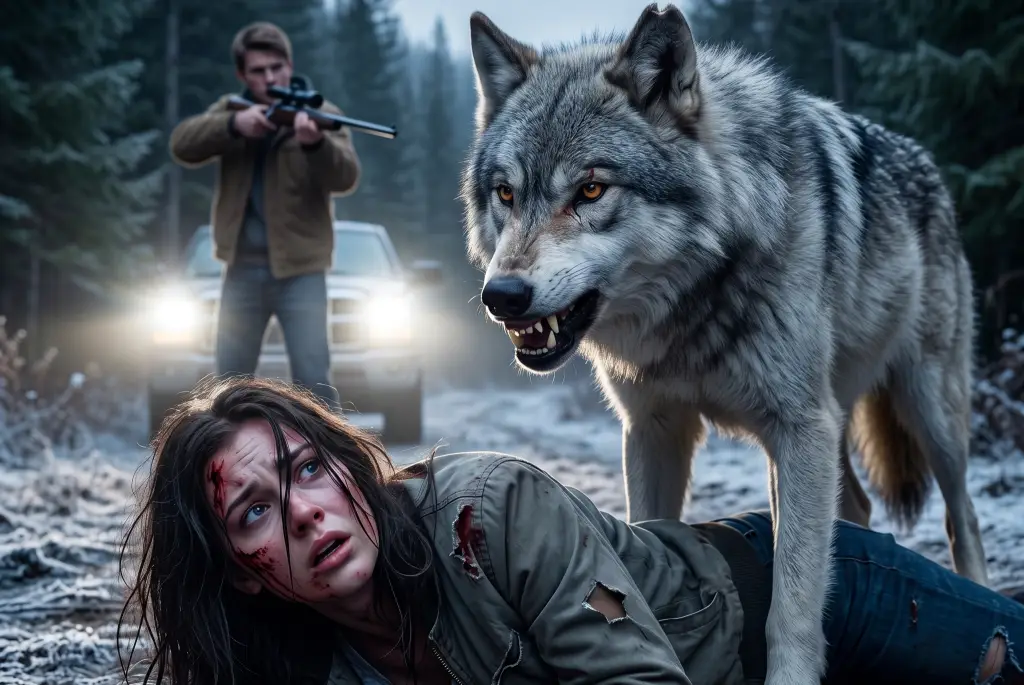
He stood over her with his hands clenched inside his jacket pockets, his breath coming out in white bursts under the pale Montana moon. Avery lay half in the ditch, half on the old logging road, one cheek pressed against the frost, her dark hair tangled across her face. The side of her mouth was bleeding. Her thin diner jacket had ripped at the shoulder.
Mason Dyer kept looking back toward the highway. “Cole, man. We need to go.”
Noah Kessler said nothing. He was staring at Avery’s hand, where her fingers had stopped twitching.
Cole crouched, put two fingers against the side of Avery’s throat, and waited. When he felt the weak pulse there, his mouth pulled into something that was not relief.
“She’s alive,” he said.
Mason swallowed hard. “Then call someone.”
Cole stood. “No.”
“No?” Noah finally looked at him. “What do you mean, no?”
“I mean she wanted to save the wolves so bad,” Cole said, his voice flat and cold, “she can spend the night with them.”
The three of them had known Avery since high school. Everyone in Cedar Hollow knew Avery Nash—the girl who lived in the cabin north of town, the girl who worked double shifts at Riverbend Diner, the girl who showed up at county meetings with muddy boots, photographs of wolf tracks, and a trembling voice that somehow never backed down.
Cole had called her “the wolf girl” for years.
That night, after her late shift, he had blocked Red Fir Road with his truck and told her one more time to withdraw her complaint against Whitaker Timber. His father’s company had already lost two weeks of work because Avery had documented illegal clearing near a denning area. Two weeks meant money. Money meant pride. In Cedar Hollow, Whitaker pride had always been treated like law.
Avery had stood in the glare of his headlights with her backpack strap gripped in one hand and said, “Your father can appeal it legally. I’m not lying for him.”
Cole had smiled then. Not because she was funny.
Because she was alone.
Now her phone lay several feet away, black screen cracked across the gravel. Cole walked over, crushed it harder under his boot, and climbed into the driver’s seat. Mason hesitated before getting in. Noah stood in the road a second longer, his face pale in the headlight spill.
“Noah,” Cole snapped.
Noah got in.
The truck reversed, turned hard, and headed south toward town. Its taillights shrank between the pines until the dark swallowed them.
Avery heard none of it.
When she opened her eyes, the sky above her was crowded with stars. At first she thought she was ten years old again, lying in the snow behind her grandmother’s cabin while Gran pointed out constellations with a mittened hand. Then pain moved through her ribs, deep and sharp, and the memory broke apart.
She tried to breathe. Her body answered with a small, broken sound.
The cold came next.
It was not the clean cold of a winter morning or the bracing cold of walking home with your hands around a paper cup of coffee. It was a patient, intimate cold. It had already found the seams of her clothes and the places where the ground could pull warmth out of her faster than the air could.
Avery turned her head, and a wave of nausea rolled through her. Her phone was close enough to see. Too far to reach.
Three feet might as well have been three miles.
She tried anyway. Her right arm moved an inch, maybe two, before her ribs seized and the world went gray at the edges. She lay still, panting through her teeth, listening to the woods.
Red Fir Road had once been used by logging trucks, but the company had abandoned this spur years ago. In summer, hikers sometimes took it toward the ridge. In January, after midnight, it belonged to wind, deer, coyotes, and whatever had the patience to wait.
“Help,” she whispered.
The word barely left her mouth.
Avery knew hypothermia better than most people her age. Her grandmother, Miriam Nash, had been a retired wildlife veterinarian who treated half the county’s injured animals from a converted shed behind the cabin. She had taught Avery how cold killed quietly. First the fingers. Then the thinking. Then the will to keep moving. By the time a person felt warm again, Gran used to say, they were already in trouble.
Avery’s fingers had gone numb.
Her legs felt far away.
Her thoughts, though, were still working in jagged pieces. Cabin north. Town south. Diner shift tomorrow at noon. Nobody will miss me until then.
Her parents had been dead for ten years. A patch of ice on Highway 37, a pickup coming too fast around a bend, a state trooper at the door before sunrise. After that, it had been Gran and Avery in the cabin, two stubborn people keeping each other alive until cancer took Gran too.
Avery had promised herself she would not become a story people told with pity in their voices.
She had worked. She had saved. She had cleaned tables, stocked shelves, patched the cabin roof, and learned how to speak at public hearings even when her hands shook. She had taken pictures of the orange survey flags Whitaker Timber drove too close to the old den. She had stood in front of the county board with a folder full of evidence and told the truth.
For that, Cole Whitaker had left her in the road.
The thought should have made her angry. Instead, it made her tired.
Avery forced her eyes open again. “Stay awake,” she whispered, though the words came out soft and slurred. “Just stay awake.”
A branch snapped in the trees.
Her breath stopped.
Another sound followed, lighter than a person’s step and more deliberate than a deer’s. Then another. Then several more, moving through the brush with a silence that made the small noises worse.
Avery turned her head toward the tree line.
Eyes opened in the dark.
At first she saw only two, yellow and steady. Then six. Then more, appearing between the trunks like sparks waking in ash. Shapes gathered under the pines, gray and black and silver, their coats almost invisible until they moved.
Wolves.
Not coyotes. Not dogs.
Wolves.
Avery’s pulse lurched so hard her ribs screamed. She knew the rules, and knowing them did not help. Don’t run. Don’t flail. Don’t stare. Don’t act like prey.
She was already prey.
Blood warmed the side of her face. The scent of it was in the air, metallic and sharp. Her body was broken, her phone dead, and the nearest porch light was a mile and a half away through timber.
One wolf stepped out first.
The others waited.
She was larger than Avery expected a female to be, gray through the shoulders, silver along the muzzle. Scars marked one cheek and crossed the bridge of her nose. Her left ear bent slightly where an old injury had healed wrong.
Avery’s stomach tightened.
The wolf came closer, placing each paw carefully on the frost-hardened ground. She did not lunge. She did not bare her teeth. She stopped a few feet away and studied Avery with amber eyes that felt older than the road, older than the pines.
Avery’s hand closed around a fallen branch. Her fingers barely obeyed. She lifted it an inch from the ground, a useless little warning.
“Go,” she breathed. “Please.”
The wolf sat.
Avery blinked through the cold haze settling over her mind. Wild wolves did not sit beside injured humans. They watched from a distance, or they left, or they tested the weakness in front of them.
This one sat as if she had been waiting for Avery to remember.
The crooked ear.
The pale notch along the rim.
The scar, shaped almost like a crescent moon.
Ten years earlier, one week after her parents’ funeral, Avery had followed Gran into a rocky den above Red Fir Creek. Hunters had shot a mother wolf outside the drainage, and eight pups had been found half-starved in the hollow behind the rocks. One little female had an infected tear in her left ear and a fever so high Gran had worked through the night with her jaw set and her sleeves rolled up.
Avery had bottle-fed that pup under a heat lamp. She had cleaned the ear with hands too small for the work. She had slept on a folded blanket beside the crate because every time the pup cried, Avery cried too.
Gran had let her name the pup.
“Ash,” Avery whispered.
The wolf’s ears moved.
The branch slipped from Avery’s hand.
“Ash?”
The wolf stood and took one last step forward. Her nose touched Avery’s knuckles, cold and damp and impossibly gentle. Then she lowered her head until her muzzle rested against Avery’s palm.
Avery closed her fingers weakly into the thick fur along Ash’s cheek. The old scar was there beneath her thumb.
“You remember me,” she said.
The other wolves shifted in the dark. Their bodies loosened. A few lowered their heads, not submissive exactly, but no longer poised to strike. They had been waiting for Ash to decide what Avery was.
Avery tried to laugh, but it turned into a cough that hurt badly enough to bring white spots to her vision.
Recognition was not rescue. A wolf could not call 911. A wolf could not start an IV, warm a body from the inside, stop internal bleeding, or carry her to the road. Ash could lie beside her. Ash could keep other predators away.
Ash could make sure she did not die alone.
The thought should have comforted her. It didn’t.
Avery’s eyelids sagged. Ash pressed closer, her body heat heavy against Avery’s side, and made a low sound in her throat that was almost a whine.
“I’m sorry,” Avery whispered. “I don’t think I can stay awake.”
Ash lifted her head.
The change in her was instant. She looked toward the ridge, then toward the road, then back at Avery. Her ears pricked forward. Her chest expanded.
Then the wolf raised her muzzle to the moon and howled.
It was not a hunting call. It was not a warning to another pack. The sound rose out of her long and urgent, carrying over the frozen road and into the sleeping valley below. Ash was calling for help…
To read the rest of the story – CLICK the NEXT button 👇👇👇