


The little girl had both hands on Eleanor Mercer’s headstone when Malcolm first saw her. For one confused second, he thought she was brushing leaves away. Then the fog shifted, and he saw the other child kneeling beside her, a bundle of white lilies pressed to her chest like something she had rescued from a fire. Their coats were too thin for the November cold. Their shoes were soaked dark at the toes. One of them had a grocery bag tucked under her arm, the plastic stretched around a few folded papers.
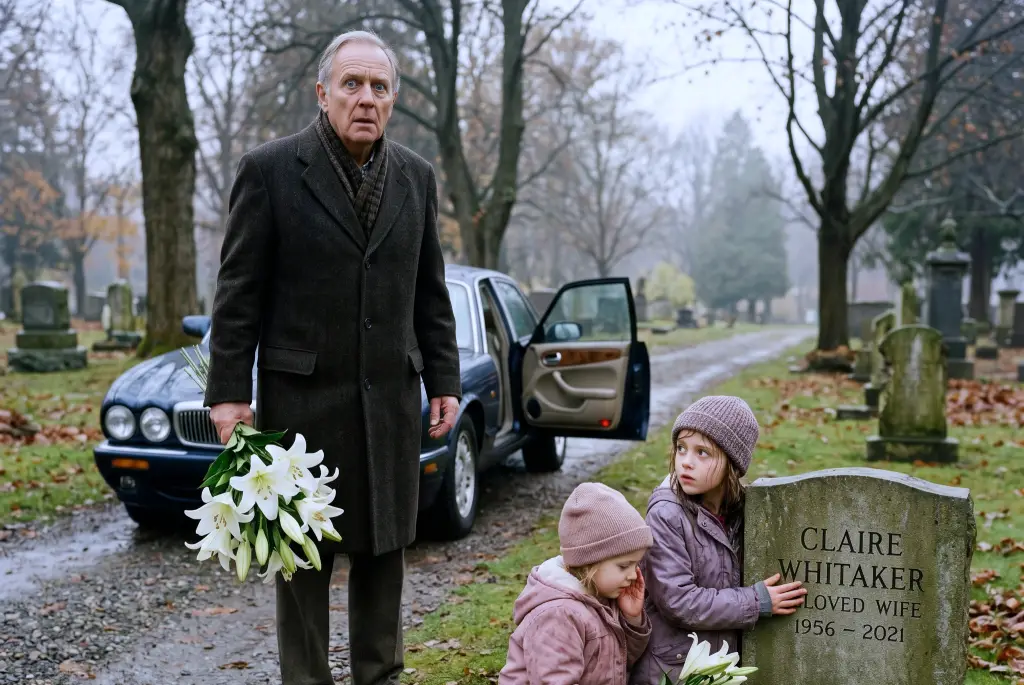
Malcolm stopped halfway up the slope.
He had been coming to St. Luke’s Cemetery every Friday morning for three years, long enough to know the sound of the iron gate in rain, the dip in the gravel path, the exact turn where the cemetery opened into the older section beneath the maples. No one visited Eleanor’s grave at this hour. Not family. Not friends. Not the women from the museum board who still sent tasteful cards every April.
These girls did not belong there.
The smaller one leaned closer to the stone. Her voice was soft, but the wet air carried it.
“Mama Ellie, we did what you said.”
The flowers in Malcolm’s hand slipped lower.
Eleanor had never been anyone’s mother.
That fact had lived between them for most of their marriage, first as a wound, later as a room they stopped entering. The doctors had been gentle. Eleanor had been brave in public and silent at home. Malcolm had learned how to buy plane tickets, endow scholarships, and make donations to children’s charities without mentioning the one grief neither of them knew how to repair.
But the child had said Mama Ellie as if the name belonged to her.
The older girl heard the shift of his shoe on wet grass and turned fast, one hand moving in front of her sister. She had dark hair coming loose from a braid, a scraped chin, and eyes that were far too watchful for a child’s face.
“Who are you?” she asked.
Malcolm had argued with bankers, city councils, contractors, and attorneys for forty years. He had built hotels out of warehouses and turned abandoned mills into apartments with rooftop gardens. He was not a man easily startled. Yet under that child’s stare, with Eleanor’s name carved in stone between them, he had to force his voice to work.
“My name is Malcolm Mercer,” he said. “This is my wife’s grave.”
The smaller girl’s mouth parted. She looked at the headstone, then at him. “Ellie was your wife?”
“Yes.” The word came out rougher than he intended. “Did you know her?”
The older girl stood at once, pulling her sister up by the sleeve. “We’re leaving.”
“Please wait.” Malcolm lifted one hand, then lowered it when both girls flinched. “I’m not angry. I just don’t understand.”
“That doesn’t mean you’re safe,” the older girl said.
Her sister whispered, “Ava.”
So that was one name. Ava. The smaller girl looked close to tears, but she stayed behind her sister anyway, half hidden and shivering. Malcolm set his own florist bouquet down by the path, slowly, as if sudden movements might scatter them.
“What’s your sister’s name?” he asked.
Ava’s face closed. “She doesn’t have to tell you.”
“Sophie,” the younger one said before she could be stopped.
Ava squeezed her hand. “Soph.”
“He’s sad,” Sophie whispered.
“So are lots of people.”
The exchange hit Malcolm with a strange, shameful force. These children spoke like people who had learned that sadness did not make adults kind. He looked at their cheap lilies, the grocery-store wrapper cloudy with rain, and tried to understand how two little girls had ended up at Eleanor’s grave calling her by a name he had never heard from anyone.
“Did Eleanor send you here?” he asked.
Sophie nodded, but Ava answered first. “We shouldn’t have come.”
“I’m glad you did.”
“No, you’re not.” Ava bent to snatch up the lilies. “Come on.”
Sophie hesitated. “But Mama Ellie said—”
“Now.”
They turned down the slope, slipping on wet leaves. As Sophie moved, something pale fell from her coat pocket and landed in the grass. Malcolm noticed the tiny blue stitching along one edge before he understood what it was.
“Wait,” he called. “You dropped something.”
Ava did not turn. Sophie looked back once, her face small and frightened beneath the gray sky, and then both girls were running toward the iron gate.
Malcolm followed three steps and stopped. Chasing them would only prove whatever Ava already believed about adults. He stood there with rain settling on his hair until the girls disappeared beyond the cemetery wall.
Only then did he bend down and pick up the square of cloth.
It was a handkerchief, the old-fashioned kind Eleanor had insisted still had a purpose in the world. The fabric was soft from washing, and along the corner she had embroidered three tiny blue flowers. Malcolm knew her stitches the way he knew her handwriting, the slant of her E’s, the small, unnecessary loops she added when she was thinking of something else.
He had watched her sew those blue flowers the winter before she died.
“For someone special?” he had asked her then, barely looking up from the set of renovation plans spread across the coffee table.
“For someone who needs something pretty that won’t break,” Eleanor had said.
He had smiled, distracted, and gone back to work.
Now Malcolm stood beside her grave with the handkerchief folded in his palm, feeling that old moment open under him like a trapdoor. He looked at the carved name, at the lilies the girls had left, at the wet footprints pressed into the grass.
“Ellie,” he said quietly, “who were those children?” The stone gave him the answer it had given him for three years. Nothing…
To read the rest of the story – CLICK the NEXT button 👇👇👇