


The first time Staff Sergeant Mason Reed heard the tiger, he thought a bridge had finally given way. The sound rolled across the flooded road in a low, torn note that did not belong to the wind, the rain, or the engines of rescue boats. It came from somewhere north of the old service route, past the drowned mailboxes and broken pines, where the water had turned half of Harlow County into one wide brown river.
Walt Pruitt cut the motor without warning.
Mason grabbed the bow rail to keep from pitching forward. Behind him, the elderly couple they had pulled from a farmhouse ten minutes earlier went silent beneath their borrowed ponchos. Rain ticked against the aluminum hull. Somewhere far off, a chainsaw stuttered and died.
“There,” Walt said, lifting one hand.
Mason listened again. At first there was only water: water dragging at fence wire, water slapping porch steps, water carrying lumber and propane tanks and the ugly loose pieces of people’s lives. Then the sound came a second time, lower than a cattle bawl, rougher than any dog.
Mason felt the hair rise along the back of his neck.
Three days after Hurricane Laurel came ashore, Harlow County no longer looked like a place with roads. It looked like a place that had once owned roads and might remember them later. The water had learned every ditch and low curve. It moved through front yards, across church parking lots, over little bridges, and straight through the screen doors of houses built by people who had trusted the last flood line.
For two days, Mason had been riding rescue boats with the Georgia National Guard, pulling people off roofs, porches, second floors, and the tops of pickup trucks. His uniform had dried and soaked through so many times it felt like another skin. Mud marked his knees and elbows. His gloves smelled of river water and gasoline, and the skin beneath his eyes burned from the kind of tired that made every noise arrive half a second late.
Walt, who was not Guard and did not pretend to be, had been assigned to Mason’s team because he knew these backroads even when the roads were gone. He was sixty-four, narrow and sun-browned, with a shrimp boatman’s hands and a face that looked carved around disappointment. In forty-eight hours, he had said maybe two dozen unnecessary words.
That was why Mason paid attention when Walt stopped speaking altogether.
The radio clipped to Mason’s vest hissed and popped. A dispatcher’s voice came through under a wash of static.
“Rescue Team Four, be advised, last known report still has two civilians near Langford Cutoff. Possible second-floor shelter. Also, sheriff’s office is getting calls about escaped exotic animals near Rusk’s Coastal Wilds. Reports are unconfirmed. Use caution.”
The elderly woman under the poncho stiffened. Her husband drew her closer, though both of them were already pressed shoulder to shoulder on the rear bench.
Mason keyed the mic. “Dispatch, Four. What kind of exotic animals?”
A pause followed. Static filled it.
“Caller said big cats. Possibly tigers. Again, unconfirmed. Wildlife response has been notified, but human rescue remains priority.”
Walt made a sound that was not quite a laugh. “Travis Rusk finally let his circus come apart.”
“You know the place?” Mason asked.
“Everybody knows it.” Walt restarted the motor, easing the boat around the top of a submerged stop sign. “Used to be a little roadside zoo when folks still took kids to those kinds of places without thinking too hard. Petting pen, snack stand, photo booth, couple of big cats behind chain-link. Last few years, it got quiet. Quiet usually means somebody’s stopped wanting witnesses.”
Mason looked toward the north, where the tree line broke into a flat gray sheet of moving water. “You think the report’s real?”
“I think a flood tells the truth about places people lie about.”
That answer stayed with Mason as they pushed on toward Langford Cutoff. He tried to keep his mind where it belonged: on the civilians they still had to reach, the current speed, the floating debris, the rooflines, the voices calling from windows. He had done enough disaster work to know that imagination was a liability. You did not let your mind build pictures of what might be out there until your eyes forced you to.
But once the dispatcher said tiger, the word kept circling back.
He had grown up inland, near pastures and stock ponds and men who owned rifles because coyotes sometimes came too close to calves. He did not romanticize animals. A tiger loose in floodwater was not a miracle, not a sign, not some storybook creature waiting for the right human heart. It was power and terror in the wrong place, a captive animal dragged into a disaster it could not understand.
Still, Mason could not stop seeing it before he saw it: orange against muddy water, claws searching for anything solid, a body built for strength reduced to another thing the flood could carry away.
The two civilians near Langford Cutoff turned out to be Roy and Darlene Abbott, both in their late seventies, both trapped on the upper floor of a farmhouse that had belonged to Roy’s father. Darlene kept apologizing as Mason and a younger Guardsman named Eli Brooks helped her down through a window and into the boat. Roy refused to leave until Mason promised someone would come back for the plastic storage bins stacked on the dining room table.
“Pictures,” Roy said, as if that explained everything.
Mason understood that it did. In a flood, people learned quickly what could be replaced and what could only be mourned.
“We’ll mark the address,” Mason told him. “I can’t promise when, but I promise it won’t be forgotten.”
Darlene clutched a grocery bag full of pill bottles to her chest and looked at Mason with wet, exhausted eyes. “You boys ought to be somewhere safe.”
“Yes, ma’am,” he said. “We’re working on that.”
He had said some version of those words for years. Hold on. Step here. Look at me. Take my hand. Don’t look down. He knew how to make his voice calm enough for frightened people to borrow.
What he had never learned was how to stop hearing Private First Class Ben Ortega in the sound of fast water.
Sarge, I can’t hold.
Mason tightened his grip on the rail until his knuckles ached inside the damp glove. That had been another county, another storm, eleven months ago. A trailer park outside Macon. A current that shifted faster than anyone expected. A rope that should have held. A nineteen-year-old soldier with five months in the unit and a grin too quick for the grim work they were given.
Mason had held Ben’s hand for three seconds.
Three seconds could become a whole life if you carried them wrong.
“You with me, Sergeant?” Walt asked from the stern.
Mason blinked back into the rain. The Abbotts sat huddled behind him. Eli was scanning windows with the boat hook ready.
“I’m here,” Mason said.
Walt studied him just long enough to show he did not believe that completely, then looked away. Old watermen were like that. They noticed things and did not always demand payment for the noticing.
They had turned back toward the temporary high-ground transfer point when Walt killed the motor. That was when Mason heard the sound.
Not bridge metal. Not a building giving way.
Something alive.
Walt angled the boat toward a broken service road that ran beside a concrete spillway. The road itself was gone beneath three or four feet of rushing water. A snapped utility pole had wedged diagonally across the spillway, gathering branches, tin roofing, fence panels, and the stripped pale limbs of trees. The debris pile shifted and groaned as the current worked against it.
Then something orange moved inside the wreckage.
For a second, Mason’s mind refused to arrange the pieces.
The animal lifted its head.
Darlene Abbott whispered, “Oh, dear God.”
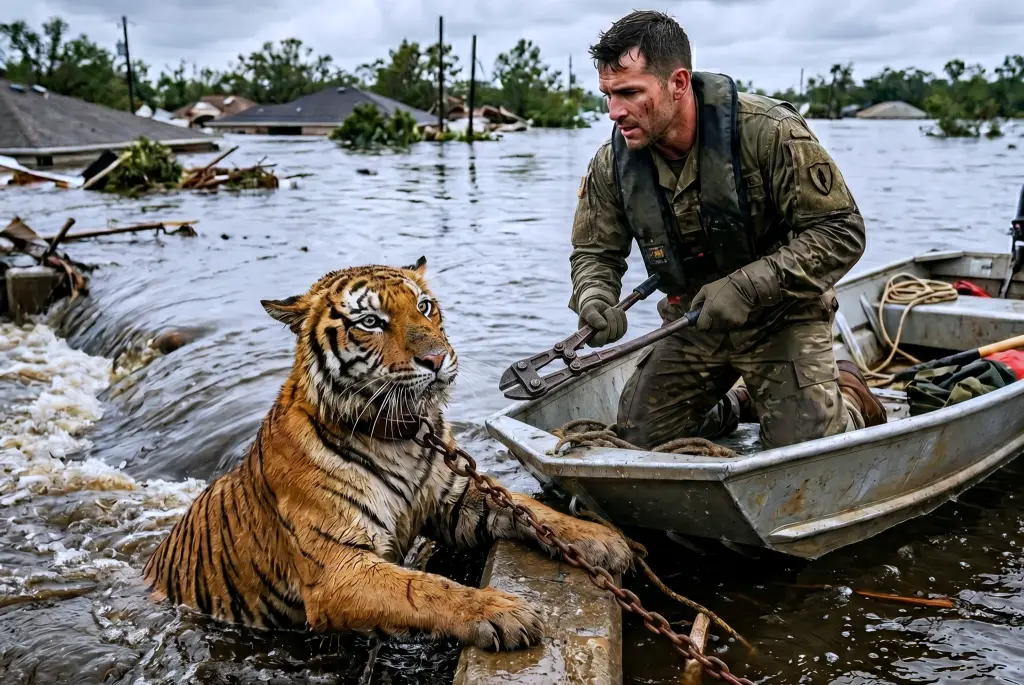
The tiger clung to the slick lip of the spillway with both front paws, claws scraping useless white marks across the concrete. Mud and rain streaked his face. Blood darkened the fur along one shoulder. The rest of his body was in the water, pulled sideways every few seconds by a current strong enough to turn fence posts into spears.
A length of chain trailed from somewhere near his neck, vanishing beneath the tangle of debris.
Walt reached slowly for the radio. “Rescue Four to Dispatch. We have visual confirmation on one live tiger in floodwater near the north service road by Rusk’s Coastal Wilds. Animal is trapped against the spillway, distressed, possibly injured.”
Static answered first. Then dispatch came back, sharper than before.
“Rescue Four, maintain distance. Do not engage. Sheriff’s office and wildlife response are being notified.”
Mason watched the tiger try to climb. One paw slipped. The animal’s shoulder struck a jagged sheet of metal, and his mouth opened around a sound that seemed too tired to become a roar.
Walt lowered the radio but kept it in his hand. “We’ve got civilians aboard.”
“I know.”
“And this boat wasn’t built with tigers in mind.”
“I know that too.”
The tiger looked at them then. Mason saw no gratitude in those eyes, no plea softened into human shape. He saw fear, fury, pain, and a ferocious refusal to let the water decide.
The radio crackled again. “Rescue Four, wildlife vet is delayed by washouts. Sheriff’s instruction is to hold position at a safe distance until trained personnel arrive.”
Walt stared at the current tearing through the spillway. A section of porch railing slid past, turning slowly like something deciding where to die. “He won’t still be there.”
The chain jerked tight.
The tiger’s head snapped sideways, and both of his paws slid lower on the concrete. Mason saw the line clearly then—not random flood trash, not a piece of fence hooked by chance. The chain ran from a heavy collar buried in the wet ruff beneath the tiger’s jaw, down into the debris like an anchor.
His stomach went cold.
He had seen floodwater take one living thing while it was still fighting. He had heard a voice turn from effort into panic. He had learned exactly how small a hand could feel when the current wanted it more.
Sarge, I can’t hold.
Behind him, the radio kept ordering distance. In front of him, the tiger’s claws skated another inch down the concrete. Mason turned, opened the emergency kit at his feet, and took out the bolt cutters…
To read the rest of the story – CLICK the NEXT button 👇👇👇