


The first incident report called it “prolonged contact,” which was the kind of careful language people used when they were afraid to write what they had actually seen. By the time I reached the observation room at Prairie Creek Wildlife Park, the contact had lasted four minutes and twenty-six seconds. I knew because I had a stopwatch in my hand, my thumb pressed so hard against the button that the edge left a mark in my skin.
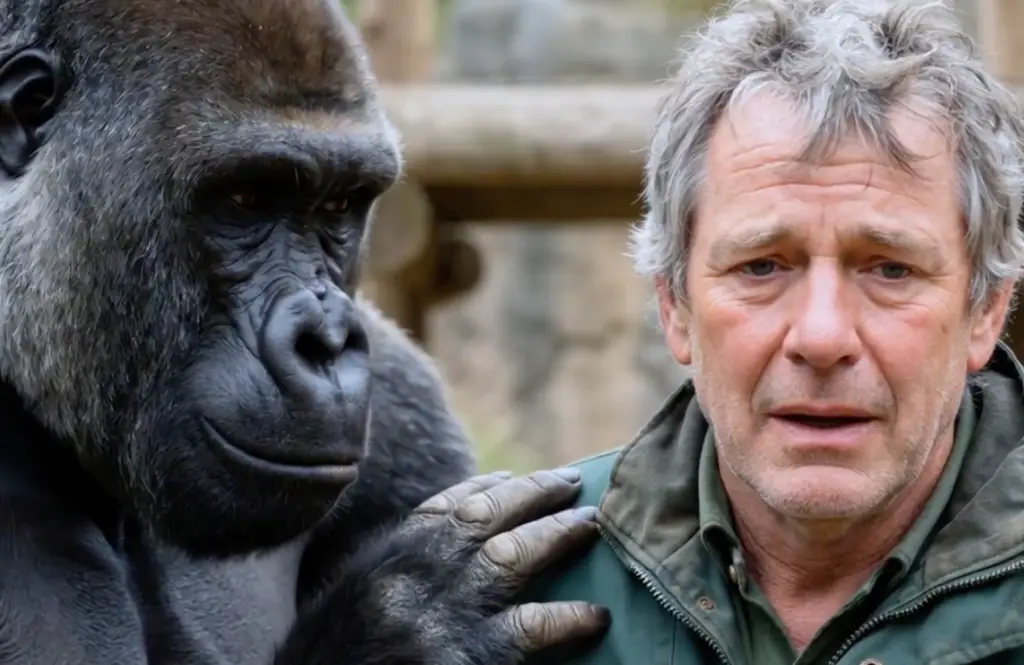
Below the glass, in the outdoor gorilla habitat, Atlas sat in the wet leaves with both arms wrapped around Frank Mercer.
Atlas was a western lowland silverback, nearly four hundred pounds, broad as a kitchen table through the chest and old enough to carry authority in the quietest turn of his head. Frank looked small inside that embrace, though no one who knew him would ever have called him small. He was fifty-five, thick through the shoulders, with a permanent stoop from years of hauling feed bags, fixing gates, and kneeling in straw beside sick animals no visitor ever saw.
For twenty-eight years, Frank had worked the primate building as if it were an extension of his own house. He knew which latch stuck in the rain, which drain backed up after leaf fall, which gorilla would toss lettuce but eat romaine if you broke the rib down the center. He could read the troop’s mood from the hallway before anyone opened a door.
That was what made the scene below us so wrong.
Atlas was not attacking him. There was no chest beating, no threat bark, no stiff-legged display. But he was not playing, either. His hold was too steady for play, too deliberate for comfort. He had one forearm locked across Frank’s ribs and the other braced around his waist, pinning him with the terrible gentleness of an animal strong enough to break him by accident.
Beside me, Noah Pike shifted his weight. Noah was twenty-six, maybe twenty-seven, with the earnest, underfed look of a young keeper who survived on vending-machine coffee and a sense of duty. He held a clipboard against his chest like it might protect him from what we were watching.
“He’s doing it again,” Noah said.
“I can see that.”
“I mean, this is the third time since lunch.”
Atlas loosened his grip at last, but he did not move away. He dropped forward onto his knuckles and placed himself between Frank and the service door, his shoulder pressed against Frank’s thigh. When Frank took one step, Atlas took one with him. When Frank stopped, Atlas stopped. The silverback’s eyes did not leave Frank’s face.
I lowered the stopwatch. “How long has this been going on?”
Noah looked at the clipboard. Then he looked at the floor. “Depends what you mean by going on.”
“Noah.”
He swallowed. “We started writing it down in August.”
He handed me the log before I asked for it. The pages were damp at the corners from being carried in and out of the habitat building, and the columns were filled with tight block letters: time, location, staff present, duration, behavior observed. At first, the entries appeared two or three times a week. Then every day. By mid-October, the page looked like a pulse racing out of control.
“Atlas ignores you?” I asked.
“Mostly.”
“And the other keepers?”
“Same. If I bring breakfast, he stays on the ridge unless I’m late with the sweet potatoes. If Marianne cleans the indoor stalls, he watches, but he doesn’t come down. But Frank?” Noah looked through the glass. “The second Frank enters the transfer hall or the yard, Atlas is there. He won’t let him get more than a few feet away.”
Down below, Frank reached the service door and patted the pockets of his jacket. He checked the left, then the right, then the left again. The keys were clipped to his belt, bright against the faded canvas.
Atlas watched his hands.
The sight brought a cold pressure behind my ribs. “What changed with Frank?”
Noah’s jaw tightened. “Nothing official.”
“That isn’t what I asked.”
He tapped the pen once against the clipboard and stopped himself. “He’s been forgetting things.”
I turned toward him.
“Little things at first,” Noah said. “A feed bucket left in the wrong prep room. A radio not charged. He called Marianne by her sister’s name, and Marianne doesn’t have a sister. Stuff you could laugh off if you wanted to. Frank laughed it off better than anybody.”
“And now?”
Noah stared down into the habitat. “Now it’s not little.”
Frank had the keys in his hand. He held the ring close to the lock, then paused with the teeth of the key half an inch from the cylinder. His shoulders lifted in a way I recognized before my mind was ready to name it. Not fear of the animal. Not fear of the door.
Fear of suddenly not knowing what came next.
Noah spoke without looking at me. “Last month I found him in the back corridor between holding stalls. He was just standing there with his hand on the transfer pin. He’s done that sequence since before I was born, but he looked at it like it belonged to somebody else.”
“Did he tell anyone?”
“He told me he was tired.”
“And you believed him?”
Noah flinched at that, and I regretted the sharpness, but only a little. There were places in a zoo where kindness could get a person killed. There were doors you could not forget. There were animals who did not understand human apologies.
“His wife made him see someone,” Noah said. “After Labor Day. A neurologist in Wichita.”
The wind pushed brown leaves across the habitat, scraping them against the concrete lip of the moat. Atlas lifted one hand and laid it across Frank’s shoulder, not roughly, not lovingly exactly, but with unmistakable pressure. Stay.
“What did they find?” I asked.
Noah’s eyes shone, though he did not cry. “Early-onset Alzheimer’s. Aggressive. That’s the word his wife used when she called HR and asked what happens to his pension if he has to leave early.”
Frank dropped the key.
It landed in the mud by his boot. He stared at it for two long seconds, as if the earth had opened and taken something from him. Then Atlas moved.
He stepped around Frank, eased the huge curve of his body against the keeper’s side, and wrapped one arm across Frank’s chest again. This time Frank did not fight him. He closed his eyes and rested one shaking hand on Atlas’s wrist.
Through the observation glass, I could not hear what Frank said. I could only see his mouth move.
Noah said, “He talks to him when it happens.”
“What does he say?”
“Usually?” Noah’s voice thinned. “He tells Atlas he’s still here.”
The next morning, I asked for every camera angle from the primate building for the past six weeks. By noon, the security office had sent me a folder so large it froze my laptop twice, and by four o’clock I was sitting in a windowless veterinary conference room with Dr. Lena Patel while the day outside went dark…
To read the rest of the story – CLICK the NEXT button 👇👇👇