


Blake Mercer brought roses back to a home that no longer belonged to him. He stood in the hallway of a West Loop condo building on a gray Saturday afternoon, holding a bouquet so large it looked almost theatrical. Dark red roses, glossy paper, black ribbon, the kind of arrangement a florist built for anniversaries, apologies, and men who had waited too long to understand what they had lost. Blake had chosen them carefully. He had also chosen the navy suit Claire used to say made him look handsome, the watch his parents had bought him for his thirtieth birthday, and the cologne he believed made people take him seriously.
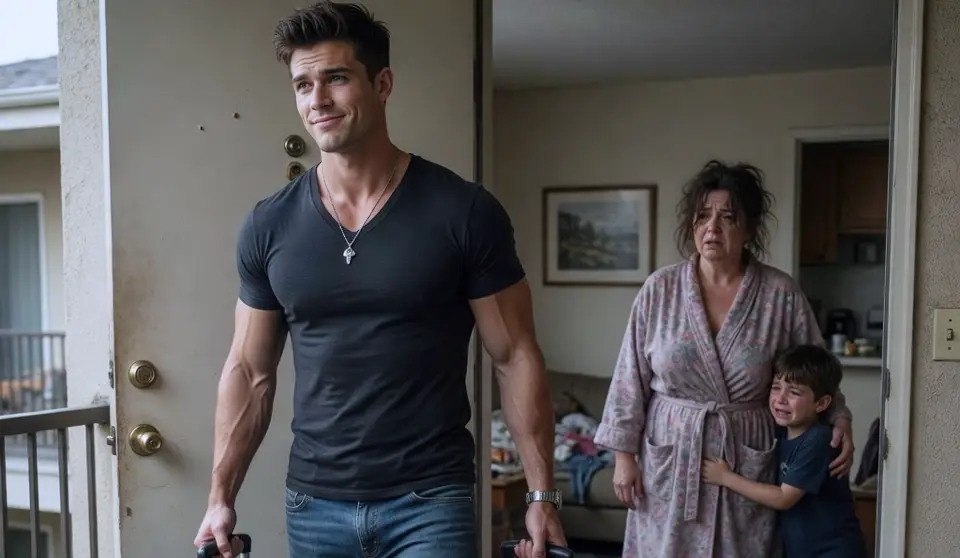
He expected Claire to open the door.
Instead, a man in a gray sweatshirt answered with a dish towel over one shoulder and bare feet on the entryway floor. Behind him, warm light spilled through the condo Blake had once treated like a hotel, and just inside the door sat a pair of tiny dinosaur rain boots next to a man’s brown leather shoes.
The man looked at the roses first. Then he looked at Blake.
“You must be Noah’s dad,” he said.
Blake felt the first clean crack of panic run through him, though he covered it with a smile that had once worked on almost everyone. “I need to speak with Claire.”
The man did not move away from the door. “She’s here.”
That was the moment Blake realized he had built his whole apology around a woman who might not be alone.
A year earlier, he would have laughed at that possibility. Claire Mercer, as he still thought of her then, had been too tired for mystery. Too practical for romance. Too buried under work calls, preschool forms, grocery lists, laundry, and a four-year-old boy with a dinosaur obsession to become the kind of woman another man waited for in a doorway.
That was how Blake saw it, anyway.
He had not always looked at Claire that way. When they met at a rooftop birthday party in Chicago, he noticed her before she noticed him. She stood near the glass railing with the city behind her, wearing a pale green dress and laughing at something a friend had said. She wasn’t trying to dominate the room, which made the attention around her feel more natural. People leaned in when she spoke. They remembered what she told them. She had the rare quality of seeming generous without seeming available.
Blake asked around before approaching her. He learned quickly that Claire Bennett was twenty-four, already climbing inside a tech company, and earning enough to own a condo in one of the neighborhoods he liked to pretend he could afford. She had bought the place with savings, a first-time buyer program, and help from parents who believed in backing a daughter who backed herself.
Blake liked all of that.
At twenty-six, he had a business degree, a polished LinkedIn profile, several short-term sales jobs behind him, and a talent for explaining why every manager who had ever supervised him was too small-minded to recognize his potential. He did not call himself unemployed, even when he was. He preferred words like “transitioning,” “consulting,” and “considering the right opportunity.”
His true discipline lived elsewhere. He treated his appearance like a profession. Meridian Athletic Club got more loyalty from him than any employer ever had. He lifted, tracked protein, paid for expensive haircuts, kept his sneakers spotless, and wore cologne with the confidence of a man who believed attraction could cover every unpaid bill.
For a while, Claire mistook his attention for devotion.
Blake knew how to make a woman feel chosen. He sent flowers to her office, remembered restaurants she mentioned in passing, kissed her forehead in front of friends, and said things like, “You shouldn’t have to do everything yourself,” while letting her do almost everything anyway. Four months after that rooftop party, they were married on a beach in Florida with white chairs in the sand, roses around the arch, and a photographer who made the whole thing look softer than it was.
Then came real life. A mortgage. Health insurance. Daycare waitlists. A baby who woke every two hours. Promotions that came with more pressure. A hallway that needed repainting. A dishwasher that leaked twice in one month. A little boy named Noah who loved pancakes, trucks, and sleeping with one sock on.
Claire became the engine of the house because someone had to be. She paid the mortgage, scheduled pediatric appointments, handled preschool drop-off, sent birthday gifts to Blake’s relatives, remembered when Noah needed more pull-ups, and answered work messages after bedtime with one hand while folding tiny shirts with the other. Blake, meanwhile, remained a man of future plans.
By the fifth year of their marriage, he had been “between roles” for seven months.
His days had a rhythm he protected like a sacred practice. He woke after Claire had already taken Noah to preschool. He made coffee slowly, checked messages, watched finance clips from men who looked successful in rented studios, went for a run if the weather suited him, and spent long afternoons at the gym. He came home pleasantly tired, showered for too long, ordered smoothies with money he did not earn, and treated the mess around him as evidence that Claire had become unreasonable.
She asked for dishes in the dishwasher instead of beside it. She asked him to apply for jobs that existed, not jobs he imagined should exist for a man of his potential. She asked him to help with bedtime without sighing, to know the name of Noah’s teacher, to take out trash before it smelled, to stop leaving protein shaker cups in the car.
Blake heard none of that as partnership. He heard disrespect.
The fight that finished the marriage began with a phone. One evening, while Claire sat at the dining table with her laptop open and Noah’s half-eaten macaroni cooling beside her, Blake showed her a video of the newest flagship model. Better camera. Cleaner design. Everyone online said it was the upgrade of the year.
Claire watched the video for seven seconds. “How much?”
When he told her, she closed her eyes.
“Blake, no.”
He laughed because he thought she was joking. “It’s not a toy. I use my phone for everything.”
“You use it to scroll on the couch.”
“That’s not fair.”
“What isn’t fair is me trying to cover preschool, insurance, groceries, the hallway repair, and your gym membership while you ask for a fourteen-hundred-dollar phone you don’t need.”
The word need irritated him more than the refusal. Claire had become obsessed with need. Noah needed shoes. The condo needed repairs. The savings account needed rebuilding. Blake, apparently, needed to be patient, useful, realistic, grateful. No one had talked to him that way when they were dating. Back then, she had looked at him as if his dreams were already achievements.
“You used to care about nice things,” he said.
Claire rubbed the bridge of her nose. “I still care about nice things. I just don’t confuse them with proof of character.”
That sentence stayed with him for three days. By Friday night, he had polished it into an injury.
After Noah fell asleep, Blake waited in the living room until the condo quieted. The dishwasher hummed through its final cycle. The city glowed beyond the windows. Claire sat on the couch with her laptop half closed beside her, one hand pressed to the back of her neck.
Blake stood in front of her, arms folded, wearing the black T-shirt that made his shoulders look broad.
“Claire,” he said. “We need to talk.”
She opened her eyes slowly. “What is it now?”
He hated how tired she sounded. He hated that he had become another item on her list instead of the center of the room.
“I want a divorce,” he said.
He had imagined many reactions. Tears. A sharp inhale. A desperate question. Maybe a promise to try harder. He had prepared a speech about how she had changed, how she no longer cared about herself, how he refused to shrink his life around a woman who had stopped growing.
Claire only looked at him.
The lack of drama unsettled him, so he reached for cruelty. He told her she had let herself go. He said he was embarrassed when they went out together. He said all she talked about was work, bills, and Noah’s runny nose. He mentioned her jeans, her sneakers, the way she had stopped getting her nails done, the way she wore her hair in a knot and called it practical.
“I take care of myself,” he said, because he wanted the words to sound like virtue instead of vanity. “I still have standards. I still want more out of life.”
Claire listened without interrupting. When he finished, she took one slow breath and leaned back against the couch as if some heavy sound inside her had finally stopped.
“Thank you,” she said.
Blake blinked. “What?”
“I was going to ask you to leave this weekend,” Claire said. Her voice was quiet, but there was no tremble in it. “You just saved me from having to start the conversation.”…
To read the rest of the story – CLICK the NEXT button 👇👇👇