


The first time I saw my sister in seven years, she was standing ten feet from our mother’s casket with my old engagement ring on her hand. Brooke did not wave. She did not cry. She entered the Savannah funeral chapel beside the man who had once promised to marry me, wearing a black dress so carefully fitted it looked less like grief than strategy. When she adjusted the strap of her purse, the diamond caught the muted morning light and threw it straight at me.
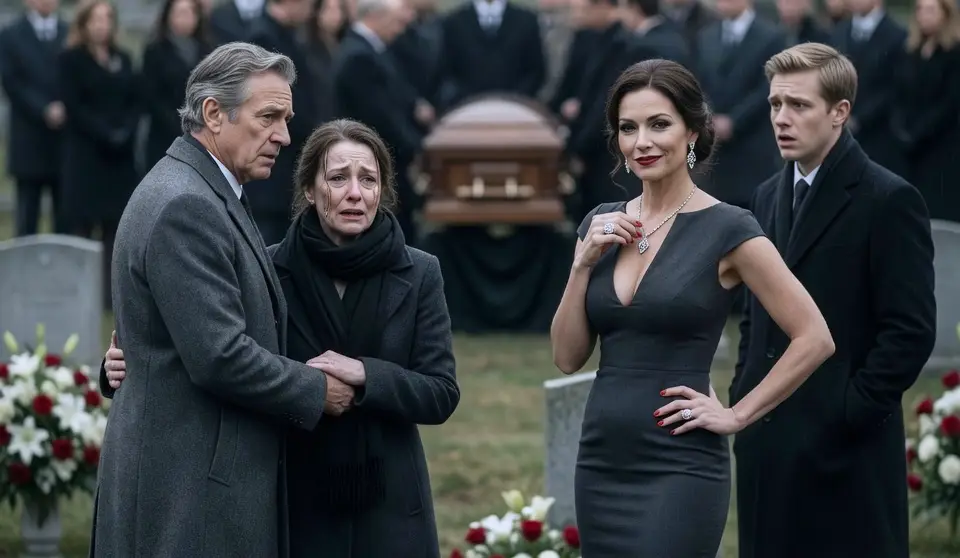
It was not a similar ring. It was not a coincidence my tired mind invented after too many nights beside a hospice bed. It was the same four-carat emerald-cut diamond Preston Cole had placed on my finger seven years earlier, when I still believed love could be measured by the steadiness of a man’s voice.
Brooke saw me recognize it. Then, with our mother lying only a few steps away, my little sister smiled.
I had imagined seeing her again so many times that I thought I knew what would happen to me. I thought my throat would close, or my hands would shake, or all the old humiliation would rise up and make me thirty-two again. Instead, a strange stillness moved through me. It was not peace. It was the kind of calm that comes when you have already survived the thing a person thinks they can still use against you.
Preston stood at her side, expensive and polished, one hand resting lightly at her waist. He looked older than I remembered, though not in a way strangers would notice. His hair was still perfect, his suit still tailored, his face still arranged for whatever room he had entered. But there was a tightness around his mouth now, a small, permanent strain.
He had no idea who was in the hallway behind me.
My husband had stepped out to speak with the funeral director about the music, giving me a moment alone with the people who had once broken my life open. Brooke must have thought she had chosen the perfect room for a final little victory. Our mother’s funeral. My grief. Her ring. His hand at her back.
But none of what happened that morning can be understood from the ring alone.
It started long before that, in the old house where Brooke and I grew up, a white two-story place in Savannah’s Ardsley Park with cracked porch tiles, camellias by the fence, and windows that stuck every summer no matter how often my father swore he would fix them. My mother, Eleanor Hayes, made that house feel alive. She knew how to turn ordinary things into shelter: soup on rainy afternoons, clean sheets after a hard week, a hand on the back of your neck when you were trying not to cry.
My father, Thomas, was steadier and quieter, an accountant who believed in locked doors, paid bills, and telling the truth even when a softer lie would have made dinner easier. Mom was the warmth. Dad was the frame. Between them, our childhood felt safer than it probably was.
Brooke and I were only twenty months apart, close enough to share clothes and far enough apart to compete for everything else. She was the pretty one before either of us understood what that meant. I was the dependable one, the one teachers trusted and neighbors called “mature.” Brooke could walk into a room late, apologize with a smile, and leave with everyone forgiving her. I arrived on time and made sure the room had enough chairs.
We loved each other. That was the part people forgot when they tried to simplify us later. We loved each other fiercely as girls, whispering through the wall between our bedrooms and stealing Mom’s perfume before church. But love did not keep score from entering the room. If I won an award, Brooke suddenly needed a new achievement. If I made a friend, she learned how to charm her. If Mom praised me for being responsible, Brooke found a way to become unforgettable.
By the time I met Preston Cole, I had built a life in Atlanta that looked impressive from the outside. I was thirty-two, a creative director at a branding agency in Midtown, living in a loft near the BeltLine with concrete floors, big windows, and more silence than I liked to admit. I worked too much. I dated men who loved ambition in theory and resented it by the third month. I told myself loneliness was just the cost of being focused.
Then my friend Jenna dragged me to a charity auction at a private gallery in Buckhead, insisting that I needed “one night in heels that weren’t for a client pitch.” Preston was there as a sponsor, smiling for donors and talking to investors with the confidence of a man who had never been made to wonder whether he belonged.
He was thirty-five, the founder of a fast-growing cybersecurity company, handsome in the clean, camera-ready way business magazines love. But what disarmed me was not the money or the confidence. It was the attention. He asked what made a brand feel honest, then listened as if the answer mattered. He remembered my mother’s name after hearing it once. He noticed I had stopped drinking my champagne and had water brought over without making a performance of it.
After our first dinner, I called Mom from the parking deck because I could not wait until morning.
“I met someone,” I said.
She paused just long enough to make me nervous. “Does he make you feel safe, or does he make you feel chosen?”
At the time, I thought those were the same thing.
Preston moved quickly, but he made speed feel like certainty. There were dinners in tucked-away restaurants, weekend trips to the coast, flowers sent to my office after hard presentations, and long conversations about the future. My parents liked him immediately. Dad admired what he had built from nothing. Mom was more careful, but even she admitted he seemed devoted.
When Preston proposed on a chartered boat at Lake Lanier, the sunset turned the water copper and gold. He held out the ring in a velvet box and told me I had made him believe in a kind of life he had never slowed down enough to want. I said yes before my fear had time to ask questions.
Mom cried when I showed her the ring. Dad opened the good bourbon. Brooke hugged me with both arms and said, “Finally. I was starting to think I’d have to beat you to the altar.”
I laughed because everyone else laughed.
The first dinner where Preston met Brooke should have warned me. She arrived late to my parents’ house, breathless and pretty in a cream blouse, carrying a bottle of wine she had not chosen herself. Preston stood when she came in. Brooke looked at him the way she used to look at things in store windows when we were kids, pretending she was only admiring them.
During dinner, she laughed too hard. She touched his sleeve when she asked about his company. She tilted her head in that practiced way that made men think they had said something better than they had. I told myself she was being friendly because anything else would have required me to admit that some part of me had noticed.
Mom noticed too. Later, while Dad and Preston talked football on the porch, she stood beside me at the sink and kept her voice low.
“Brooke is laying it on thick tonight.”
“That’s just Brooke,” I said, rinsing a wineglass. “She flirts with waiters, dogs, and old ladies at the grocery store.”
Mom dried her hands, her expression still. “Maybe. Just don’t fall asleep at the wheel because you want everything to be pretty.”
I kissed her cheek and told her not to worry. I wanted to believe we had outgrown the old competition. I wanted to believe my sister would not reach for the one thing I had trusted her to bless.
Four months before the wedding, Preston began to drift. At first, it was subtle enough to explain. Late meetings. Investor calls. A phone turned face down at dinner. He canceled our Saturday breakfasts twice, then three times, each with a reason that sounded reasonable until the reasons became a pattern.
He also began to dislike things he had once claimed to love. My dry humor was “hard to read” around his board members. My favorite green dress was “a little intense.” My habit of leaving notebooks on the kitchen island became “clutter.” I worked harder to become easier to love, which is a sentence I am ashamed to write now, though it was true then.
Brooke started calling more often around the same time. She said it was wedding planning. Flowers, playlists, hotel blocks, menu tastings. Mom was handling most of it, but Brooke always had a reason to be involved. She offered to meet vendors when I was busy. She texted Preston directly about “little logistics” and told me I should be grateful she was taking pressure off my shoulders.
The first real piece of proof was a bracelet.
I found it wedged between the passenger seat and the center console of Preston’s car, a thin silver chain with a turquoise charm. Our grandmother had given it to Brooke on her twenty-first birthday. She had worn it for years, touching it whenever she wanted people to notice her hands.
Preston did not blink when I held it up.
“She dropped it last week,” he said. “Her car was in the shop, and I gave her a ride to meet the florist. I thought I told you.”
Brooke’s version matched his almost word for word.
“I’ve been looking everywhere,” she said, laughing too brightly through the phone. “Preston was just being nice. Don’t make it weird.”
I apologized to both of them.
Three weeks before the wedding, Preston sat beside me on my couch and said we should “pause.” He used that word as if our wedding were a campaign launch, not a promise already woven through two families. He said I seemed anxious. He said he worried we were rushing. He said maybe we needed space to be sure.
I cried hard enough that my chest hurt. He held me with one arm and stared over my shoulder.
That night, I woke at 2:16 a.m. to find his side of the bed empty. His voice came from the hallway outside his office, low and careful.
“No,” he said. “Not tonight. She’ll hear me. I said soon.”
The next day, I left work early and bought his favorite pastrami sandwich from a deli near my office. Even then, some foolish part of me thought love could be rescued with one more tender gesture. The security guard in Preston’s building knew me and waved me toward the elevators.
On the eighteenth floor, his assistant looked up from her desk and lost color.
“Caroline,” she said. “I didn’t know you were coming.”
“I’m just dropping off lunch.” I lifted the paper bag.
Her eyes moved to Preston’s closed door. “He’s in a meeting.”
“I’ll wait.”
She stood too quickly. “Actually, he asked not to be interrupted.”
“Is he alone?”
She did not answer, and that was answer enough.
I walked around her and opened the door.
Preston was leaning against his desk with Brooke in his arms. Her hands were locked behind his neck. His palms rested on her waist with the ease of habit, not surprise. They pulled apart when the door opened, but the room had already told me the truth.
Brooke looked flushed and frightened for half a second. Then pride came back to her face like armor.
“How long?” I asked.
Preston said my name. Brooke said, “Since the engagement party.”
I remember the paper bag hitting the carpet. I remember Preston telling his assistant to walk me to the elevator because I was “upset.” I remember understanding, with a clarity that felt almost physical, that humiliation was not only what they had done. It was how calmly they expected me to leave the room.
My parents came to Atlanta that night because I called Mom from my bathroom floor and could not form sentences. Dad paced my living room with both hands on his head. Mom sat on the tile beside me and held me the way she had when I was little, even though there was no way to make this small enough for a mother to fix.
The wedding was canceled. Preston sent formal emails about shared property and remaining personal items. Brooke moved into his condo before I had finished collecting mine. Six months later, my mother called to tell me they had married at the courthouse.
A photo appeared online before I could avoid it. Brooke in a white silk suit. Preston smiling beside her. My old ring on her finger.
That was the night something inside me stopped pleading.
I took a transfer to my agency’s Portland office and moved across the country before spring. Mom helped me pack, wrapping dishes in newspaper and asking, once, whether I thought I might someday forgive Brooke.
“Not now,” I said.
“I’m not asking for now.” She taped a box shut with hands that trembled only slightly. “I’m asking you not to let what she did become the only thing you carry.”
I did not know then how often her words would return to me.
In Portland, I rebuilt my life in pieces. Work first, because work had rules. Then friends. Then quiet mornings that did not hurt. Eventually, a man named Daniel Reed came into my life slowly enough that I did not feel hunted by hope. He was patient where Preston had been dazzling. He listened without trying to win. He let trust grow at the speed it needed.
By the time Mom’s pancreatic cancer came back, Daniel was my husband.
Her final months pulled me back to Savannah, to the house with the stuck windows and the garden she had fought to keep alive even when chemo took her strength. She died at home before sunrise, with Dad on one side of the bed and me on the other. Three days before that, she made me promise something I did not know how to give.
“Try with your sister,” she whispered. “Not because she earned it. Because I don’t want bitterness to be the last language my daughters share.”
So I called Brooke when Mom died. I spoke the words. She came.
And on the morning of the funeral, she walked into that chapel wearing my ring.
When she asked to speak with me privately, I followed her into the family room off the main chapel because Dad’s face had already gone pale and I would not give our mother’s friends a scene to whisper about. Brooke closed the door, adjusted her purse, and let the diamond flash again.
“We bought a lake house,” she said. “Seven bedrooms, outside Atlanta. Preston’s fund is doing incredibly well. We’re thinking about starting a family soon, maybe adding a nanny suite.”
I stared at her. “You pulled me away from Mom’s casket to tell me about square footage?”
Her smile sharpened. “I thought you’d want to know we’re fine. How about you? Still hiding out in Portland with your little design job?”
For a moment, I could almost see the girl she had been, reaching for my sweater, my friends, my mother’s praise. Then the image faded, and all I saw was a woman who had come to a funeral carrying a trophy she still needed me to envy.
I opened the door.
“Daniel,” I called.
He stepped in from the hall a moment later, tall and calm in his dark suit, his eyes going first to my face before they moved to the room. Preston appeared behind him, probably having followed Brooke, probably ready to smooth over whatever tension he imagined he still controlled. Then he saw my husband. Preston’s mouth opened before his charm could catch up. – “Reed”…
To read the rest of the story – CLICK the NEXT button 👇👇👇