


The baby elephant stopped breathing the moment the bottle touched her mouth. Dr. Mara Ellison saw it before anyone else did—the tiny change beneath the loose gray skin, the way the calf’s ribs held still instead of rising. Wade Harper froze with one knee on the rubber floor, both hands wrapped around the oversized nursing bottle. The nipple hovered against the calf’s lips, warm formula dripping down his wrist, but he didn’t dare move it closer.
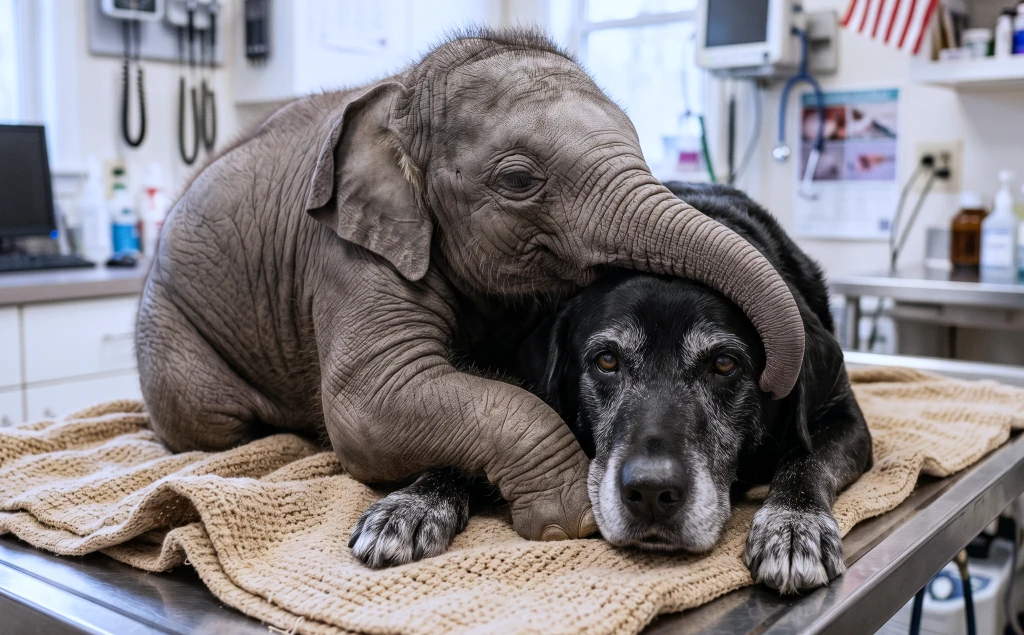
“Back off,” Mara said softly.
Wade lowered the bottle an inch. Across from him, in the padded quarantine stall, the three-week-old calf pressed her spine into the corner as if she could disappear through concrete. Her trunk curled tight under her chin. Her ears stayed flat, and her ruined eyes leaked clear fluid down the dry, wrinkled channels of her face.
Only when Wade shifted his weight away did the calf drag in a thin, ragged breath.
Nobody spoke for a few seconds. The summer heat had settled hard over Cedar Hollow Wildlife Refuge, turning the Missouri air thick with red dust and cut hay. Outside the quarantine barn, cicadas screamed in the oak trees. Inside, the only sounds were the low hum of the air unit and the calf’s uneven breathing.
Mara crouched beside Wade and looked at the bottle. Four ounces gone. Maybe less.
“She has to take more than that,” Wade whispered.
“I know.”
“She won’t make it on IV fluids.”
“I know that too.”
He looked at her then, and Mara wished he hadn’t. Wade had worked big animals for thirty years. He had loaded sedated zebras out of flooded barns, wrestled oxygen masks onto collapsed camels, and sat through more necropsies than most veterinarians saw in a lifetime. Fear did not sit naturally on his face.
Now it had found a place there.
The calf’s name was Junie, though she had arrived at Cedar Hollow with a numbered seizure tag looped loosely around one back leg and no name at all. Federal agents had brought her in from a shuttered roadside attraction near the Mississippi Gulf Coast, a place that had sold photo ops with baby animals long after the money ran out and the inspections stopped. Junie’s mother had been found lying on concrete, too thin to stand, her joints swollen from years without proper footing. She died before the transport team reached the state line.
Junie had survived the trailer ride, the first round of fluids, and the emergency antibiotics. What she had not survived was the infection that had gone untreated for too long. Both corneas were clouded beyond repair. Mara had confirmed it herself under sedation, one hand steady on the ophthalmoscope, the other clenched inside her glove.
The calf was blind.
That alone would not have been a death sentence. Elephants could adapt to sound, scent, touch, and memory. Calves could learn the boundaries of a safe enclosure. Herds could teach what eyes could not. But Junie had no mother, no herd she trusted, and no reason to believe the hands trying to help her were different from the hands that had taken everything else.
For six days, she had refused almost every feed.
They had tried three formulas, four nipples, warmed towels, recorded elephant rumbles, a patient older cow named Willow at the fence line, and a young rescue calf who usually charmed frightened babies into curiosity within minutes. Junie had turned away from all of it. When staff approached, she trembled. When someone touched her, she panicked. When they tube-fed her, her heart rate shot so high Mara had put a stop to the second attempt before they reached the target volume.
Starvation was slow. Panic could be immediate.
Wade stood, carrying the bottle as if it had become evidence of failure. “What do you want me to tell Claire?”
Mara watched Junie tuck herself smaller into the corner. The calf’s head sagged, but she did not sleep. She listened to every human movement with the rigid alertness of an animal waiting for the next bad thing.
“Tell her I’m coming,” Mara said.
The administrative building sat two hundred yards from quarantine, but the walk felt longer in the heat. Mara crossed the gravel service road with the taste of dust at the back of her throat. In the main elephant yard, Willow stood under the shade cloth with one ear drifting lazily against her shoulder. When Mara passed, the old cow lifted her trunk and gave a low rumble that vibrated faintly through the fence.
Mara stopped.
For a moment, she let the sound move through her boots. She had built her life around those frequencies—the language beneath language, the messages elephants carried through earth and bone. Junie should have been pressed against a mother’s legs, learning the map of the world from touch and sound. Instead, she was lying in a padded room where every footstep belonged to a stranger.
By the time Mara reached the conference room, Claire Dunleavy was already there with Junie’s chart open in front of her. Claire ran Cedar Hollow with a calm that some people mistook for coldness. Mara knew better. Claire was the person who remembered every grant deadline, every feed invoice, every donor promise, and every animal whose life depended on all three. She had learned to put grief in a file folder until the work was done.
Lena Ortiz, the senior elephant keeper, sat beside the window with both hands wrapped around a paper cup she had not touched. Her khaki shirt was streaked with formula and disinfectant. A crescent of dried mud curved along one cheekbone.
Claire slid the lab results across the table. “Her kidney values are moving the wrong way.”
Mara did not sit. “How far?”
“Far enough that I called you in here instead of waiting for evening rounds.” Claire tapped the paper once. “She’s dehydrated. She’s catabolizing muscle. We can support her for a little while, but we can’t make her want to live by running fluids.”
Lena looked down. “She knows when we’re coming now. Before we even open the door.”
“Because every good thing we do still feels like force,” Mara said.
“I’m not blaming anyone,” Claire replied.
“I didn’t say you were.”
The room quieted around that. Mara could hear the old wall clock above the coffee machine, each tick too crisp in the air-conditioned stillness.
Claire folded her hands. “We have to discuss the line.”
Lena’s jaw tightened.
Mara looked at the lab sheet again, though she already knew every number on it. “Not yet.”
“Mara.”
“Not yet.”
“I’m not asking you to give up because she’s blind. We both know blind animals can have full lives. I’m asking you to look at this specific calf, in this specific body, with this specific level of distress.” Claire’s voice stayed gentle, which made it harder to hear. “If every intervention terrifies her and she continues refusing food, we’re not saving her. We’re extending the part that hurts.”
Mara leaned both palms on the back of a chair. “Give me forty-eight hours.”
Lena looked up sharply. Claire did not.
“For what?” Claire asked.
“I don’t know yet.”
“That is not an answer I can take to the board.”
“It’s the only honest one I have.” Mara kept her voice level because she could feel it wanting to break. “Her heart is weak from dehydration, not from defect. Her lungs are clear. She tracks vibration. She flinched when Wade shifted his knee before he touched her, which means she’s processing the room. There’s a calf in there still trying to understand where she is.”
“And if she can’t?”
“Then I’ll be the one who calls it.”
Lena closed her eyes.
Mara swallowed once. “Forty-eight hours. If her numbers crash, if her pain escalates, if she stops responding completely, I won’t argue. But if we end this today, we’ll never know whether fear was the only thing standing between her and the bottle.”
Claire looked toward the window, where the quarantine barn sat white and low beneath the hard afternoon sky. When she turned back, she looked older than she had five minutes before.
“Forty-eight hours,” she said. “No more tube feeds unless you believe it’s life-or-death in that moment. No heroics that increase suffering. And Mara?”
“Yes.”
“You need something better than hope.”
Mara nodded, because Claire was right.
By six-thirty, the sun had dropped behind the ridge, but the heat still rose from the gravel in shimmering waves. Mara should have gone home. Instead, she turned toward the small county animal shelter that shared Cedar Hollow’s back access road and half its veterinary supplies. On bad days, she often stopped there to suture a stray, check a litter of sick puppies, or stand for ten minutes among problems small enough to solve.
That evening, the shelter smelled of bleach, wet concrete, and dry kibble. Dogs barked in uneven bursts from the public runs, but the back quarantine wing was almost silent. Tessa Reed, the shelter coordinator, was kneeling in front of a stainless-steel bowl, trying to coax a spoonful of canned food toward a dog lying on a cot inside the last kennel.
The dog was large, black, and broad through the chest, with a graying muzzle that made him look older than his body suggested. A shaved strip along one shoulder revealed a healing wound stitched in a clean line. He did not lift his head when Mara approached. He only moved his eyes.
“Rough one?” Mara asked.
Tessa glanced over her shoulder. “Depends whether you mean yours or mine.”
“Mine is losing.”
“So is he.”
Mara crouched outside the kennel. The dog’s tail moved once, not a wag exactly, more like an acknowledgment from somewhere far away.
“What happened?”
“Owner died out west. Family brought him here because they couldn’t manage him.” Tessa held up the spoon. “He’ll take a bite if I sit with him long enough, but mostly he just watches the wall.”
Mara studied the dog. There was no aggression in him. No frantic shelter energy. He looked emptied out, as if some essential cord had been cut and he had not yet figured out why his body kept breathing.
Her phone buzzed in her back pocket.
Lena’s name flashed on the screen. Mara stood fast enough to make her knee pop. “What is it?”
“Not an emergency,” Lena said, though her voice was tight. “She’s calling again. That little chirping sound. I thought you’d want to know.”
Through the phone speaker came a faint, broken cry, high and thin at the edge but rough underneath. Junie had made it twice before, always after the staff left her alone. It was not pain exactly. It was searching.
Mara closed her eyes for half a second.
Then the kennel cot creaked.
The black dog had lifted his head. His ears, which had barely moved since Mara walked in, angled toward the phone. The tiny cry came again, distorted by the speaker, and the dog pushed himself up on stiff legs. He took two slow steps to the kennel gate and pressed his nose through the wire.
Tessa stared. “He hasn’t stood up for anyone.”
Mara lowered the phone until the speaker faced the dog. Junie cried once more from the quarantine barn, lost and thin and far away.
The dog answered with a sound so low Mara felt it in her wrist before she heard it.
He did not bark. He did not whine for food or attention. He leaned his scarred shoulder against the kennel door, closed his eyes, and made the same deep, trembling murmur again. Mara looked from the phone to the dog, then back to Tessa. – “What’s his name?” she asked…
To read the rest of the story – CLICK the NEXT button 👇👇👇