


The baby began to cry the moment Ryan Whitman said his wife didn’t need to stay. Claire stood in the doorway of Arthur Bell’s law office with rain dripping from the ends of her hair, one hand still gripping the strap of her old black purse. Across the conference room, her husband sat with another woman close enough that their shoulders touched, while a tiny infant shifted in a carrier at their feet. Ryan did not look surprised to see Claire. That was the part that made the room tilt a little.
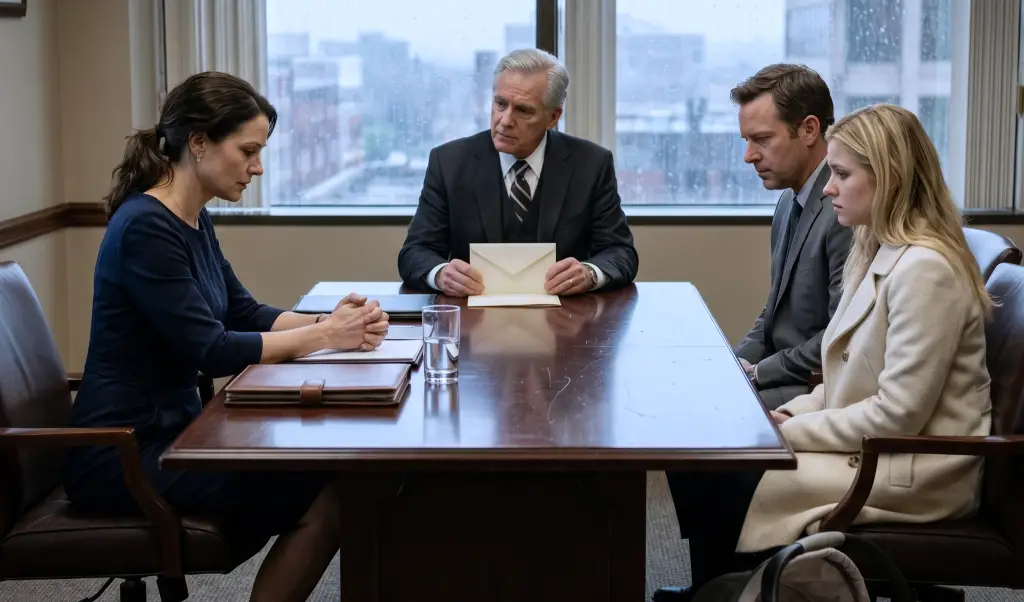
He had known she was coming.
Kelsey Hart, the woman beside him, turned just enough to take Claire in from shoes to coat. She was younger than Claire by at least ten years, polished in a cream-colored wrap coat and gold earrings, with the kind of careful makeup that looked expensive even in bad weather. Her hand moved automatically to the baby carrier, not to comfort the child exactly, but to mark her place in the room.
Arthur Bell, Eleanor Whitman’s attorney, had risen from the head of the table the instant Claire appeared. He was a silver-haired man in his late sixties with a narrow face, a dark suit, and the tired patience of someone who had watched families behave badly around polished wood and legal folders for most of his career.
“Mrs. Whitman,” he said, his voice gentle. “Please come in.”
Ryan leaned back in his chair. “Arthur, come on. This is family business.”
The attorney’s eyes moved from Ryan to Claire, then to the infant carrier. “Your mother gave very specific instructions about who should be present.”
“My mother wasn’t thinking straight near the end.”
Claire felt those words land in her chest with a dull, ugly weight. Three days earlier, Ryan’s mother had known exactly which window in her hospital room caught the morning light, exactly where Claire kept the lemon drops she liked after treatment, and exactly when Ryan was lying about why he couldn’t visit. Eleanor Whitman had been thin as paper by then, pain folded into every breath, but her mind had remained painfully clear.
Arthur Bell did not argue with Ryan. He simply pulled out the chair nearest the door and looked at Claire again.
“Please,” he said.
Claire stepped into the room because Eleanor had asked her to. Not because she wanted Ryan’s money, or the house, or whatever was tucked into the leather folder on the table. She came because Eleanor had been the one person in that family who ever reached for Claire’s hand under the table when Ryan made one of his little remarks, the kind that sounded harmless until you heard them every day for twelve years.
Her dress was still damp at the hem. It was the plain black one she had worn to the funeral home, the same dress she had bought years ago from a clearance rack at Macy’s and saved for weddings, funerals, and church services where no one looked too closely. Kelsey’s eyes lingered on it for a second too long before she smiled at the baby.
“Poor thing,” Kelsey murmured. “All this tension.”
Ryan rubbed his forehead. “Can we not do this?”
Claire sat down without answering him. The chair felt too high, the table too polished, the air too still. Outside the window, downtown Cleveland blurred behind streaks of rain, office towers dissolving into gray light while traffic moved along Superior Avenue like nothing important had happened.
Eleanor Whitman had died before sunrise on Tuesday.
Claire had been there when the night nurse dimmed the monitor and stepped quietly into the hall. Ryan had not. He had texted around midnight saying he was exhausted and would come first thing in the morning, but first thing had come too late, and Claire had been the one to hold Eleanor’s hand when the older woman opened her eyes one last time.
“Don’t let him make you small,” Eleanor had whispered.
Claire had bent closer, thinking she had misheard.
Eleanor’s fingers had tightened around hers with a strength the cancer should have taken by then. “Promise me, sweetheart.”
Claire had promised because dying people should not have to beg for peace. At the time, she thought Eleanor was only asking her not to collapse when grief came. Now, sitting across from Ryan and the woman he had brought openly into his mother’s estate meeting, Claire wondered if Eleanor had meant something far more specific.
Arthur Bell opened the folder in front of him. “Before we begin, I want to clarify the nature of this meeting. This is not a theatrical reading of a will in the way people imagine from movies. Mrs. Whitman requested that I review the key terms with those named in her estate documents, and she gave written permission for certain personal materials to be shared in this room.”
Kelsey’s chin lifted slightly. “Personal materials?”
“A letter,” Arthur said.
Ryan’s expression changed at that. It was quick, but Claire saw it: the brief tightening around his mouth, the irritation giving way to something closer to unease. He knew his mother well enough to know that Eleanor had never wasted paper.
“She wrote letters all the time,” he said. “Birthday cards, recipes, church committee notes. It doesn’t mean anything.”
Arthur took a cream-colored envelope from the folder and placed it on top of the legal pages. The envelope was thick, old-fashioned, sealed across the back, and written in Eleanor’s slanted hand. Claire recognized the handwriting before she could read the name.
Her throat tightened.
Kelsey looked down at the envelope, then at Ryan. “Why would there be a letter?”
Ryan did not answer her. He was staring at Arthur now, and for the first time since Claire entered the room, his confidence looked rehearsed instead of real.
Arthur rested one hand on the envelope. “Eleanor instructed me to read this before I disclose the final distribution of the estate.”
Ryan sat forward. “That’s not normal.”
“No,” Arthur said. “It was, however, her wish.”
The baby made a small unhappy sound from the carrier. Kelsey leaned down to adjust the blanket, her bracelet catching the overhead light. Claire noticed the child’s tiny fist pushing free, pink and helpless, and felt an ache she did not want to feel. Whatever Ryan had done, whatever Kelsey had believed or planned, the baby had not chosen to be placed between adults like evidence.
Ryan turned sharply toward Claire. “Did you know about this?”
Claire almost laughed, though there was no humor in her. “I didn’t even know you were bringing her.”
Kelsey’s face flushed. “I have a name.”
“So do I,” Claire said, and the quietness of her own voice surprised her.
The room shifted around those five words. Ryan looked at her then, really looked, as if he had forgotten she could speak without asking permission from his mood. For years Claire had softened herself before arguments reached the walls. She had apologized for taking too long at the grocery store, for asking where he’d been, for crying at the wrong time, for noticing the perfume on his collar and the dinner receipts that did not match his stories.
Eleanor had noticed too.
At first, Claire had told herself Ryan’s distance came from stress. His sales job had gotten harder, his commissions less reliable, his pride more brittle. He hated hospitals, he said. He couldn’t stand seeing his mother weak. He was bad with sickness. Claire had believed each excuse until belief became work, and work became habit, and habit became the marriage.
Then came the late nights. The new passcode. The gym membership he never used. A hotel charge in Columbus he explained too quickly. The woman’s name that appeared once on his phone and disappeared before Claire could pretend not to see it.
Kelsey.
Claire had imagined meeting her in a parking lot, or in the produce aisle, or outside Ryan’s office with her sunglasses pushed into her hair. She had not imagined seeing her here, beside Eleanor’s attorney, with Ryan’s child tucked into a carrier on the floor.
Arthur broke the silence by sliding a document toward Ryan. “Your mother confirmed these instructions with me twice in the final month of her life. The last time was nine days before she passed.”
Ryan’s jaw worked. “She was on pain medication.”
“She was alert. Her hospice physician noted the same.”
Kelsey’s gaze flickered again, this time with real nervousness. “Ryan, what is he talking about?”
“Nothing,” Ryan said. “He’s making this sound dramatic.”
Arthur opened the envelope.
The small rip of paper seemed louder than the rain.
Claire gripped the edge of her chair under the table. She did not know what she expected from Eleanor’s last words. A goodbye, maybe. A blessing. One of those practical instructions she used to leave on yellow sticky notes around her kitchen: soup in freezer, church key in blue bowl, don’t let Ryan throw out the good ladder.
Arthur unfolded two pages. His expression softened as he read silently for a moment, and then he lifted his eyes.
“This letter begins with a condition,” he said.
Ryan looked annoyed. “A condition?”
Arthur did not look at him. He looked directly at Claire.
Then he began to read.
“My dear Claire, if Ryan brought Kelsey into that room with the baby, then my son has done exactly what I feared he would do…”
To read the rest of the story – CLICK the NEXT button 👇👇👇