


By the time the bottle in Marco Santos’s hand went cold, everyone outside the glass knew the baby elephant was running out of chances. The calf was pressed into the farthest corner of the isolation stall, his body folded so tightly into itself that he looked smaller than any elephant had a right to look. His trunk was tucked under his chin. His ears lay flat against his skull. Every few breaths, a thin wheeze dragged through him and caught, as if even the air had to fight its way in.
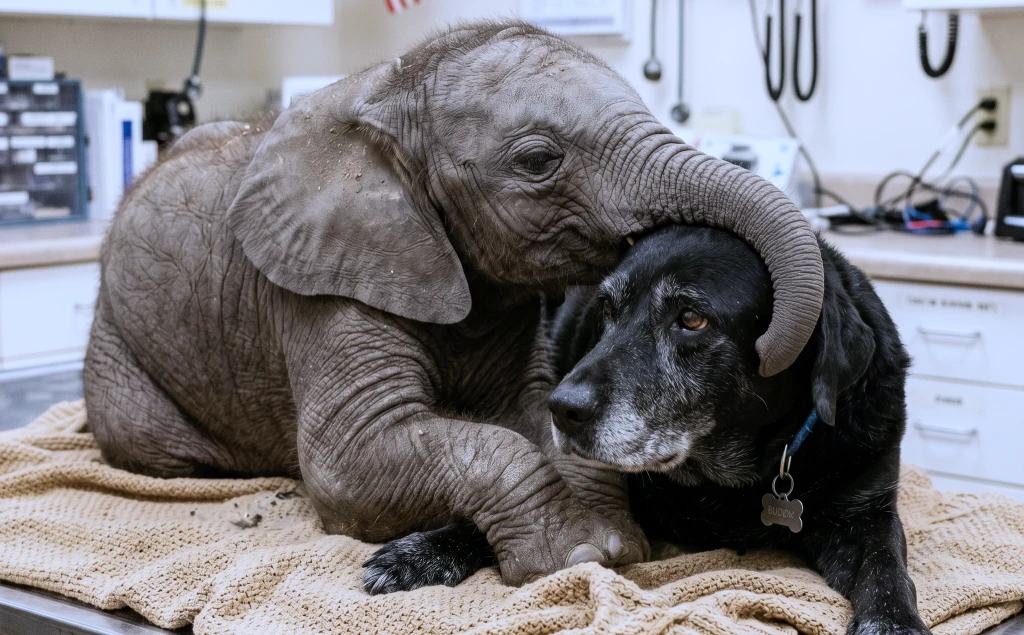
Dr. Nathan Reed stood with his forearms against the steel rail and watched Marco kneel six feet away with the oversized nursing bottle held low in both hands. Nathan had spent twenty-three years working with rescued animals, most of them large, frightened, and damaged by people who should never have been allowed near them. He knew the difference between fear and surrender.
This was surrender.
“Come on, Milo,” Marco murmured. His voice was gentle, steady, almost boring on purpose. “No hands. No rush. Just smell it.”
The calf’s name had been written on a temporary intake tag by a volunteer three days earlier, mostly because nobody at Cedar Ridge Wildlife Sanctuary could keep calling him “the blind elephant calf” without feeling the cruelty of it. Milo was only a few weeks old. He should have been nosing at his mother, bumping into her legs, learning the world by smell and touch while a herd rumbled around him.
Instead, he lay on rubber matting in an isolation room in the Ozark foothills of southern Missouri, his eyes clouded white from an untreated infection that had gone too far before anyone found him.
Marco loosened the bottle cap just enough for the warm scent to drift out. The formula had been mixed and tested a dozen ways: coconut oil for calories, probiotics, a little molasses, anything that might wake up the instinct to nurse. On the other side of the viewing window, Olivia Hayes had both hands clenched around a clipboard she was no longer reading.
Milo’s trunk twitched.
For one small second, Nathan saw the reflex his body had not completely forgotten. The tip of the trunk uncurled, tasting the air. Milo shifted his weight forward, just a fraction, and Marco stayed perfectly still.
Then the calf’s front legs locked. He dragged himself backward until his spine hit the padded wall, and the wheeze in his chest sharpened into a panicked, shallow rasp.
Marco did not chase him. He did not reach for him. After twenty minutes, he tightened the cap on the bottle, rose carefully to his feet, and backed out through the heavy door. When he reached the hallway, he looked at Nathan and shook his head once.
Olivia turned away first. She had been the sanctuary’s senior elephant caretaker for nearly fifteen years, and Nathan had seen her stay steady through broken tusks, infected feet, flood rescues, court seizures, and one old matriarch’s final morning under a sycamore tree. But she looked older now, her khaki shirt stained with dried formula, her hair twisted into a knot that had started coming loose hours ago.
“He’s down another three pounds,” she said. “Maybe four. I weighed him twice because I didn’t want to believe the first number.”
Nathan rubbed the bridge of his nose. “The fluids bought us another day.”
“Fluids aren’t food.”
“I know.”
“And we can’t tube him again, Nathan.” Her voice stayed low, but it broke around his name. “The last time, he stopped breathing for almost nine seconds.”
He knew. He had counted every one of those seconds with his hand pressed against the calf’s rib cage, waiting for the heart under his palm to decide whether it wanted to keep going.
Milo had arrived at Cedar Ridge after state wildlife officers and county investigators shut down a roadside attraction near the Alabama coast. The place had advertised camel rides, tiger selfies, and “rare baby animals” on a peeling billboard beside the highway. By the time the seizure happened, half the animals were dehydrated, many were sick, and Milo’s mother was already too weak to stand for more than a few minutes.
She died the night after transport.
Nobody said that part near Milo. Nathan knew it was foolish. The calf could not understand the words. Still, every person in the elephant wing had quietly agreed not to speak about his mother where he might hear the sorrow in their voices.
The problem was that he seemed to know anyway.
He refused bottles. He recoiled from hands. He ignored the low comforting calls of June, Cedar Ridge’s oldest female elephant, when they brought her to the fence line to rumble reassurance through the rails. He did not respond to Piper, a young rescued calf who usually drew shy newcomers out with nosy persistence. He flinched at footsteps, at door hinges, at the squeak of cart wheels. Blindness had trapped him in a world made of vibrations, chemical traces, and memories nobody at Cedar Ridge could see.
That evening, the decision moved from the isolation wing to the conference room.
Caroline Pike, Cedar Ridge’s director of operations, sat at the end of the long laminate table with Milo’s bloodwork spread in front of her. The air conditioner rattled overhead, working too hard against the early June heat. Nobody touched the coffee. Nobody reached for the plate of grocery-store cookies someone had set out that morning and forgotten.
“His kidney numbers are moving in the wrong direction,” Caroline said. She did not sound cold. She sounded like a woman forcing herself to remain useful. “The IV line is keeping him from crashing, but that’s all. If he won’t take calories soon, we are not treating him anymore. We are prolonging it.”
Marco leaned against the wall with his arms crossed. Olivia sat beside Nathan, her clipboard closed on the table. She had drawn a small crescent into the cardboard backing with the edge of her thumbnail.
Caroline looked at Nathan. “You know what I’m asking.”
He did. Everyone in the room did.
There were words they used in animal care when mercy became indistinguishable from defeat. Quality of life. Humane endpoint. Final intervention. Nathan had said those words himself, gently and honestly, to families with old horses and to staff members who had stayed up all night with animals who could not be saved.
He hated all of them now.
“Give me ten days,” he said.
Caroline’s eyes narrowed. “For what?”
“I don’t know yet.”
“That is not a plan.”
“No,” Nathan admitted. “It’s time to find one.”
“Nathan.”
He leaned forward, palms flat on the table, and made himself speak like a doctor instead of a man begging the universe to be decent. “His heart rhythm is still strong. His lungs sound rough but not failing. Neurologically, he’s tracking sound. When the compressor outside kicked on this morning, his left ear moved toward it. When Olivia crossed the hallway, he knew her gait from Marco’s. He’s processing. He’s present.”
“He’s also starving,” Caroline said.
“Because every source of help smells like the thing that hurt him.” Nathan looked from Caroline to Olivia, then to Marco. “Hands, bottles, towels, disinfectant, doors, transport straps, people. We are the problem before we even touch him.”
Olivia’s eyes stayed on the table. “Then what isn’t the problem?”
The question sat there, quiet and enormous.
Nathan had no answer. Not then. He only knew that Milo was not refusing life because his body had forgotten how to want it. He was refusing the world because the world had narrowed into fear.
Caroline closed the folder. “Seventy-two hours.”
“Ten days.”
“Five.”
Nathan shook his head. “If his organs crash, I’ll make the call myself. If he shows signs of pain we can’t control, I won’t argue. But if the only reason we lose him is that we couldn’t find a way past his fear, I need more than five days to live with that.”
Caroline looked at Olivia, who gave a tired nod without lifting her head. Marco muttered something in Spanish under his breath and stared at the floor.
At last, Caroline said, “Seven days. And I want daily numbers. Weight, hydration, respiratory rate, stress signs, everything. If he gets worse faster than we can justify, we stop.”
Nathan nodded because it was the only victory available. When the meeting ended, the others drifted out one by one, leaving him in the room with the stale coffee and the humming lights. Through the window, he could see the pale roof of the isolation wing beyond the service yard.
Seven days was not hope. It was a narrow hallway with a locked door at the end.
He left Cedar Ridge after sunset, though he did not drive home. Instead, he took the gravel access road down the hill to the county animal shelter. The shelter shared a fence line with the sanctuary, along with a rotating cast of exhausted staff, borrowed equipment, and after-hours emergencies. Nathan often stopped there when he needed to look at something smaller than elephants and more forgiving than bloodwork.
That night, the kennels smelled of bleach, wet concrete, and kibble. Most of the dogs barked when he entered, throwing themselves against chain-link gates with the desperate optimism of animals who believed every set of footsteps might be their way out.
Only the last dog stayed silent.
Elaine Brooks, the shelter coordinator, found Nathan standing outside the quarantine run with one hand on the gate. She was in rubber boots, her gray hair pinned under a baseball cap, and she had the wary expression of someone who had seen too many veterinarians come looking for miracles they could not name.
“You look awful,” she said.
“Good to see you too.”
“Milo?”
Nathan nodded.
Elaine’s face softened. “I’m sorry.”
He kept looking at the dog inside the kennel. He was a big black Lab mix, broad-headed and deep-chested, lying on a raised cot with his front paws crossed like he had once been taught manners and still remembered them. A healing scar ran along his left shoulder. It was clean and pink at the edges, but the shape of it made Nathan’s stomach tighten.
The dog did not bark. He did not wag. He lifted his head and watched Nathan with a stillness that felt almost human, though Nathan knew better than to romanticize it. Animals did not need to be human to suffer honestly.
“Who is he?” Nathan asked.
“Boone,” Elaine said. “He belonged to a wilderness guide in Montana. Eli Mercer. Worked pack trips, search routes, trail maintenance, whatever paid enough to keep the truck running. His niece lives in Springfield. She brought Boone down after Eli died.”
Nathan crouched beside the gate. Boone’s tail moved once against the cot, a slow, reluctant thump.
“What happened to the shoulder?”
“Backcountry accident,” Elaine said. “From what the sheriff’s deputy told the family, Eli went out looking for a missing mule after a storm. Boone stayed with him after he went down. Search crew found the dog lying against him, torn up, freezing, and refusing to move. They had to sedate him before they could get close enough to help him.”
Nathan looked at Boone again. The dog held his gaze, not pleading, not challenging. Just present, in the heavy way grief could make a body present.
“His niece tried to keep him,” Elaine continued. “She really did. But he wouldn’t eat in her apartment. Wouldn’t sleep. Wouldn’t let her out of his sight, then wouldn’t come when she called. She brought him here sobbing and wrote a check for his care that I still haven’t cashed.”
Nathan shifted closer to the gate. Boone’s nose moved, taking in the scent of sanctuary hay, disinfectant, elephant formula, sweat, and the long day Nathan had carried down from the hill.
“He’s eating here?”
“Only if I sit with him.” Elaine folded her arms. “He’s not aggressive. He’s not even anxious in the usual way. He’s just… gone quiet.”
Nathan thought of Milo curled in the corner of the isolation stall, blind and motherless, withdrawing from every hand that tried to save him. Then he looked at Boone, a pack animal who had lost the person around whom his whole working life had been arranged.
Two different species. Two different kinds of loss. The same terrible absence at the center.
The idea arrived whole enough to frighten him.
Elaine saw it happen. “Nathan,” she said slowly, “whatever you’re thinking, I already don’t like it.”
He stood, his knees stiff from crouching, and kept his eyes on the dog. Boone lowered his chin onto his paws but did not look away.
“I need to borrow him tomorrow morning,” Nathan said.
Elaine stared at him. “Borrow him for what?”
Nathan took one breath, then another. Up the hill, inside a padded room that smelled of iodine and warm milk, a blind calf was waiting out the last days of a life that had barely started. – “For Milo,” he said. “Before we give up on him…”
To read the rest of the story – CLICK the NEXT button 👇👇👇