


The calf would not take the bottle. Not when Marcus Bell warmed the formula to the exact temperature Dr. Wade Mercer asked for. Not when he rubbed a drop of it along the oversized rubber nipple so the smell would carry. Not even when he knelt on the padded floor of the quarantine stall and held perfectly still, letting the sweet scent drift toward the little elephant curled in the far corner. Finn heard him anyway.
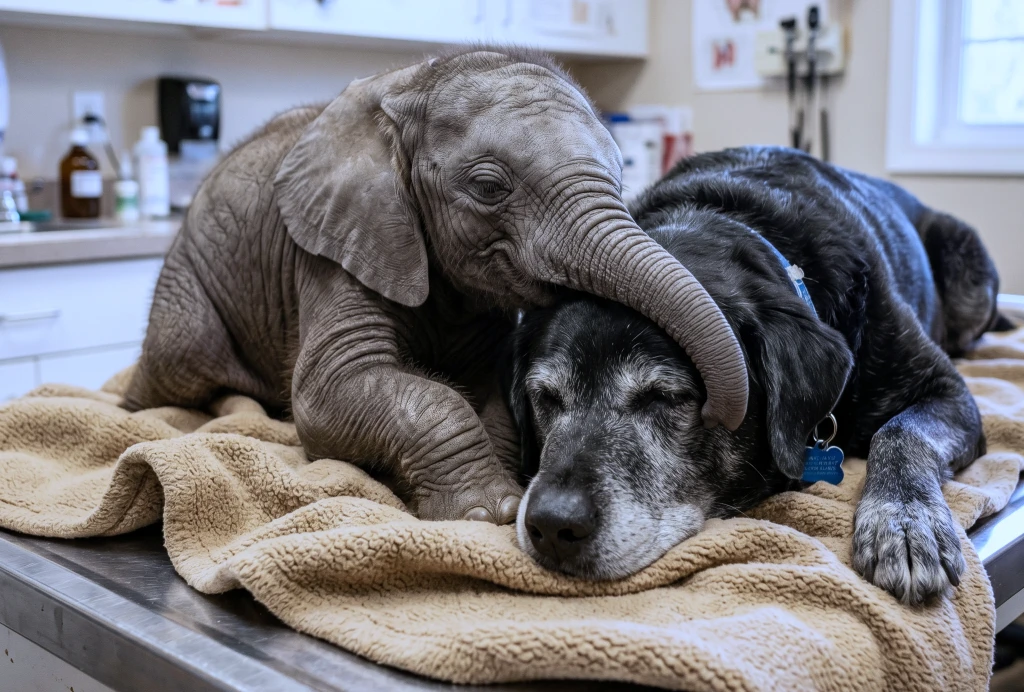
His ears tightened flat against his head, and his trunk tucked harder beneath his chest. The movement was so small that most people would have missed it, but Wade had been watching dying animals for twenty-three years. He knew the difference between sleep and surrender. He knew when a body was conserving the last of itself because hope cost too much energy.
Behind the viewing glass, Lena Parker pressed both hands against her khaki work pants until her knuckles went pale. She was the senior elephant keeper at Cypress Bend Wildlife Refuge, and she had been living on vending-machine crackers, coffee, and panic since the federal trucks rolled in five days earlier.
“He smells it,” she whispered.
Wade nodded, though the sight gave him no comfort. Smelling food and choosing life were not the same thing.
Inside the stall, Marcus kept his eyes lowered, his body turned slightly away so he would not loom over the calf. He was a big man, careful by nature, with the patience of someone who had spent years convincing frightened animals that human hands did not always mean pain. He did not reach for Finn. He did not speak above a murmur.
“Easy, little man,” Marcus said. “Nobody’s making you do anything.”
Finn’s breathing changed. It came quicker, thinner. The baby elephant’s clouded eyes, sealed and scarred by infection, leaked clear fluid down the soft folds of his face. His gray skin hung loose over his ribs. At three weeks old, he should have been pressing against his mother’s legs, stealing milk, bumping his trunk into everything because the world was new and worth investigating.
Instead, he folded himself tighter against the wall.
The bottle stayed untouched.
Wade looked away first. He hated himself for it, but there were moments when professionalism became a poor disguise for grief. He had seen starvation, hoarding, chained cats, burned horses, parrots that had plucked themselves bloody from loneliness, and tigers raised in cages barely wider than their own bodies. Cypress Bend took the cases no one else knew how to place. That was the work.
Finn was still different.
He had been confiscated from a collapsed roadside animal park near the Gulf Coast after months of complaints, unpaid staff, and missing veterinary records. Federal agents found the calf in a concrete pen beside his mother, who was too weak to rise. By the time the transport trailer reached Cypress Bend, the cow was gone, and Finn’s infection had already stolen his sight.
They could treat the bacteria. They could hydrate him. They could quiet the fever, clean the ruined eyes, and soften the floor beneath him.
They could not explain to a blind infant that his mother was never coming back.
Marcus stayed in the stall for almost half an hour. He shifted the bottle once, no more than a few inches, and Finn recoiled so hard his back struck the padded wall. The sound was muffled, but Lena flinched as if the blow had landed against her own body.
“That’s enough,” Wade said.
Marcus did not argue. He capped the bottle, stood slowly, and backed out through the heavy door. When the latch clicked shut, he leaned his forehead against the steel for one second before turning around.
“He’s not fighting us,” Marcus said quietly. “That’s the part I don’t like.”
Lena’s mouth trembled, but she swallowed the expression before it became anything Wade would have to answer.
“He’s waiting,” she said.
No one asked what for.
An hour later, the conference room in the administration building felt too cold and too bright. The air conditioner rattled in the ceiling, pushing out air that smelled faintly of dust and old coffee. Finn’s lab results were spread across the table between them: kidney values climbing, electrolytes unstable, weight down again.
Diane Walsh, the refuge director, removed her reading glasses and set them on top of the file. She was not a cruel woman. Wade knew that. Diane had built Cypress Bend from an underfunded rescue property with three barns and a leaking office roof into one of the most respected private wildlife refuges in the state. She had fought donors, contractors, city inspectors, and her own board for animals most people considered too expensive to save.
But Diane could read numbers.
“Wade,” she said, “his organs are beginning to suffer.”
“I know.”
“The fluids are keeping him from crashing. They are not feeding him.”
“I know that too.”
Lena sat beside him, her shoulders curved inward. Marcus stood near the door, bottle still in his hand, the formula cooling inside it.
Diane looked from one face to the next before settling back on Wade. “We need to discuss a humane endpoint.”
There it was. Not the word itself, but the room made space for it. Euthanasia did not need to be spoken to arrive.
Wade rubbed both hands over his face. He felt the grit of dried sweat along his jaw, the ache between his shoulder blades, the familiar weight of being the person asked to choose mercy when mercy had no clean shape.
“He’s processing sound,” Wade said.
Diane waited.
“This morning, when the compressor kicked on outside the isolation wing, his left ear tracked it. Not randomly. He followed the vibration. When Lena stepped closer with the bucket, his breathing changed before she touched the latch. He knows where things are. He knows when someone is near.”
“Awareness isn’t enough if every contact terrifies him,” Diane said.
“No,” Wade admitted. “But it means he isn’t gone.”
Lena looked up then. Her eyes were red, but her voice held. “We tried Hazel. We tried Poppy. He wouldn’t respond to either of them.”
Hazel was the refuge’s oldest elephant, a steady matriarch with a rumble so deep it seemed to travel through fence posts. Poppy was a young rescue who could usually coax even the most timid animal toward curiosity. Finn had turned away from both. Their comfort had not reached him, or perhaps it had reached too late and landed in a place grief had already closed.
“He doesn’t trust anything that comes from our side of the fence,” Wade said. “Not yet.”
Diane leaned back. “What are you asking for?”
“Time.”
“You asked for time when he arrived.”
“And I’m asking again.”
A long silence settled over the table. Outside the conference room window, the summer light struck the gravel road in a hard white sheet. Somewhere across the property, one of the cranes called sharply and stopped.
Diane put her glasses back on, though she did not look at the papers. “How much?”
“Ten days.”
Marcus exhaled through his nose. Lena closed her eyes.
“Ten days,” Diane repeated. “And what happens if he drops further?”
“If his pain increases beyond what we can manage, if his kidneys fail, if restraint becomes the only way to keep him alive, I won’t drag this out.” Wade heard the roughness in his own voice and hated that too. “But I need a chance to find something he can trust that isn’t us.”
Diane studied him for a long moment. “You don’t have something in mind.”
“No.”
“That’s not reassuring.”
“It’s honest.”
Her expression tightened at the edges. She turned one page of Finn’s file, then another, though Wade doubted she was reading anymore. At last she closed the folder.
“Seventy-two hours before we review again,” she said. “Not ten days without questions. Seventy-two hours. If there’s no meaningful change, we make the call.”
Wade wanted to argue. He did not. A smaller mercy was still mercy.
After the meeting, he did not go straight back to isolation. He walked past the clinic, past the hay barn, and through the side gate that connected Cypress Bend with the county animal shelter next door. The two places shared a fence line, a feed supplier, and whatever veterinary help Wade could spare on days when domestic rescue collided with wildlife emergency.
The shelter smelled of bleach, wet concrete, and kibble. Dogs barked in the front runs, but the quarantine row in back was quiet except for the buzz of flies against the window screens.
Connie Hayes, the shelter coordinator, was filling out intake notes at a metal desk. She looked up and frowned.
“You look terrible.”
“Good to see you too.”
“Elephant calf?”
Wade nodded.
Connie’s face softened. “I heard.”
“Everybody heard.”
“That bad?”
He leaned against the doorframe instead of answering. Connie had known him long enough not to fill silence with comfort he would not believe.
“I have a dog I wanted you to check,” she said after a moment. “Not urgent physically. The stitches look clean. But something’s wrong with him.”
Wade almost laughed. Not because it was funny, but because the day had become so full of broken creatures that one more seemed less like chance than accusation.
Connie led him to the last kennel.
The dog inside was lying on a raised cot with his head on his paws. He was large, black, broad through the chest, with the kind of bone and muscle that came from working outdoors rather than chasing tennis balls in a backyard. A pale healing scar curved from his left shoulder toward his ribs. When Wade stopped outside the gate, the dog did not bark. He lifted his head and looked at him with steady brown eyes.
“This is Boone,” Connie said. “He came in from Montana three days ago.”
Boone’s tail moved once against the cot. Not a wag exactly. More like an acknowledgment that Wade existed.
“What happened to his shoulder?”
“Bear country,” Connie said. “His owner was a backcountry guide. There was an accident on a trail. Search and rescue found Boone injured beside him.”
Wade looked at the dog again, and the tiredness in the animal’s face became clearer. Not fear. Not aggression. Something heavier and more private.
“He won’t eat unless I sit with him,” Connie continued. “Doesn’t care about the other dogs. Doesn’t care about toys. He lets me clean the wound, but it’s like he’s not really here for it.”
Wade crouched outside the kennel. Boone watched him. The dog’s nostrils moved, taking in iodine, hay, sweat, formula, elephant, grief.
Then Wade’s phone buzzed in his shirt pocket.
A message from Lena lit the screen.
He’s making that sound again.
She had attached a short video. Wade tapped it before thinking. From the little speaker came a thin, broken rumble—Finn’s voice, small and raw, calling into a darkness no one at Cypress Bend knew how to answer.
Boone’s ears came forward.
Wade froze.
The video ended, but the dog did not lie back down. Boone rose from the cot, stiffly because of the healing shoulder, and crossed the kennel without taking his eyes off Wade’s pocket. He pressed his nose through the chain-link, breathed in once, and made a low, trembling sound deep in his chest.
It was not a bark. It was not a whine. Wade stayed crouched on the concrete, his phone dark in his hand, while the dog stood there waiting for the sound to come back…
To read the rest of the story – CLICK the NEXT button 👇👇👇