


The bottle had already started to cool in Ben Ortega’s hands. Dr. Nathan Mercer could see the thin skin of milk forming at the rim, could smell the warm formula and coconut oil from where he stood on the other side of the steel rail. In any ordinary nursery pen, that scent would have pulled a hungry baby toward life. In the quarantine room at Hawthorn Ridge Wildlife Refuge, it made the calf in the corner shake harder.
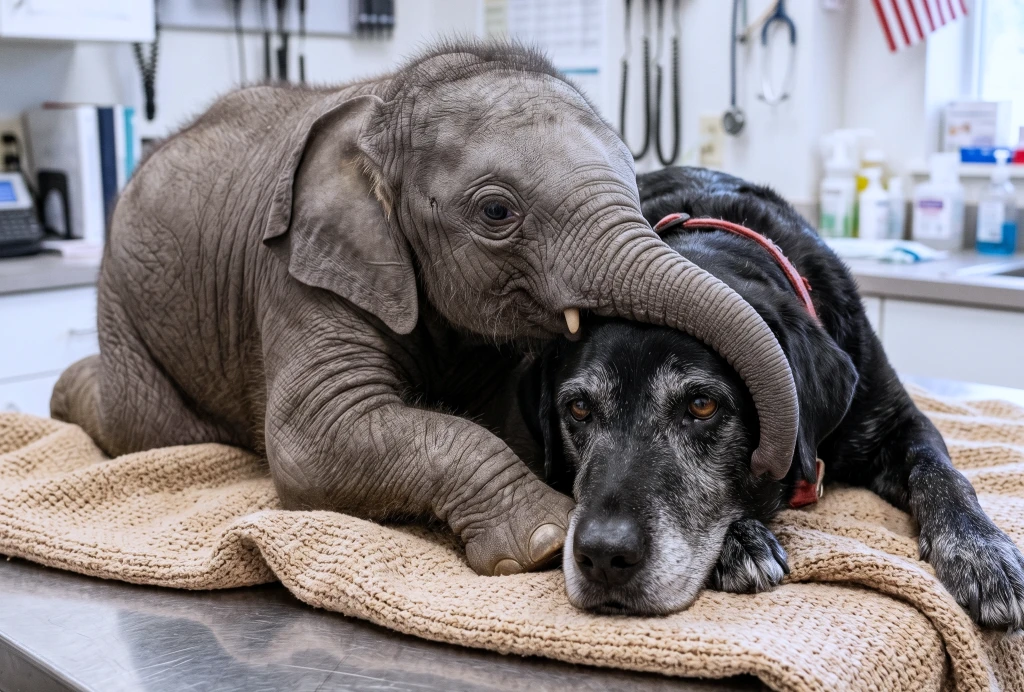
Milo was only three weeks old, but he had learned the shape of fear faster than any animal Nathan had ever treated. He lay folded against the padded wall with his trunk tucked tight under his chin, gray skin hanging loose over ribs that should have been hidden beneath baby fat. His eyelids were swollen nearly shut. Behind them, the infection that had gone untreated for too long had already done its permanent work.
The calf would never see the room he was dying in.
Ben moved one knee forward on the rubber mat, careful not to let his boot scrape. He had spent fifteen years handling elephants, including adults with trauma histories that made every gate latch and broom handle a possible threat. But he looked helpless now, holding the oversized nursing bottle a few feet from Milo’s face.
“Easy, little man,” Ben murmured. “Nobody’s coming at you.”
Milo’s trunk twitched toward the scent. For half a second, Nathan saw the reflex win over terror. The calf lifted his head, nostrils widening, his whole frail body leaning toward the bottle as if some memory of his mother still lived in the muscles of his mouth.
Then Ben’s hand shifted.
The movement was small, almost nothing, but Milo recoiled as if he had been struck. His rear legs kicked against the wall, his trunk slapped the mat, and a thin, panicked squeal tore out of him. Ben froze where he was, bottle lifted, jaw clenched against the instinct to reach for him.
Outside the rail, Claire Hart closed her eyes.
“No more,” she whispered.
Nathan did not answer right away. He was watching the monitor clipped to the rolling stand beside the enclosure. Milo’s heart rate had jumped so high that the numbers seemed to flash in accusation. His breath came shallow and fast, each inhale catching with a damp little wheeze.
Ben slowly lowered the bottle and backed away on his knees. When he stood, the bottle knocked once against his thigh. Milo flinched at the sound.
The calf had arrived six days earlier in a federal transport trailer, confiscated from an unlicensed roadside attraction in the Florida Panhandle after inspectors found sick animals locked behind warped plywood and rusted mesh. His mother had been too weak to stand when the trailer was loaded. She died before midnight at a veterinary hospital outside Pensacola.
Since then, Milo had refused almost everything that meant survival.
He would not take a bottle. He would not follow the scent of fresh-cut hay. He panicked when people came near him and went rigid when the refuge’s matriarch elephant, June, was brought to the neighboring fence to rumble reassurance through the walls. Even Poppy, the young female who could coax nervous calves into play by rolling tires with her forehead, got no response.
Milo had no herd, no mother, no sight, and no reason to trust the hands trying to keep him alive.
Claire stood beside Nathan in the observation corridor, her khaki shirt stained with powdered formula and disinfectant. She had been sleeping in a cot in the staff room since the transport arrived, grabbing twenty minutes at a time between fluid checks and medication schedules.
“We can’t tube-feed him again,” she said. “You saw what happened last night.”
Nathan nodded. The tube had kept calories in Milo’s body, but restraint had nearly broken the little that was left of him. The second attempt had sent the calf into such a violent stress response that Nathan had pulled the team back early, shaking with the knowledge that one more procedure might save his organs and stop his heart.
A half hour later, everyone who mattered was in the conference room.
The building had been built in the seventies and renovated only where donors could see it. The walls were clean, the table was scuffed, and the air-conditioning rattled like a tired lawn mower. Evelyn Ross, Hawthorn Ridge’s executive director, sat at the head of the table with Milo’s latest bloodwork printed in front of her.
Claire sat with both hands wrapped around a paper cup she had not drunk from. Ben stood near the door, arms folded, staring at the floor.
Evelyn removed her reading glasses and set them carefully on the file.
“Nathan,” she said, “his kidney values are worse.”
“I know.”
“He’s dehydrated. He’s losing muscle. His glucose is unstable. The fluids are buying hours, not days.”
“I know that too.”
Her voice softened, which somehow made it harder to hear. “Then you know what we have to discuss.”
Nobody said euthanasia. In rooms like that, some words did not need help entering.
Claire put her cup down. “He still reacts to sound.”
Evelyn looked at her gently. “Reaction isn’t the same as recovery.”
“No,” Claire said. “But it’s not absence either.”
Nathan leaned forward, rubbing both hands over his face. He had been a wildlife veterinarian for twenty-three years. He knew the difference between fighting for an animal and fighting his own unwillingness to lose one. The trouble was, Milo was still in there. Every time the building compressor kicked on, the calf’s ears moved. Every time June rumbled from the next paddock, his breathing changed. He was not gone.
He was unreachable.
“Give me fourteen days,” Nathan said.
Evelyn’s face tightened. “We may not have fourteen days.”
“Then give me as many as his body gives us. If his organs begin to fail past recovery, I’ll call it. I won’t make him suffer for my pride.”
Claire looked at him then, because everyone in the room knew what that sentence had cost.
Nathan forced himself to keep going. “But he isn’t refusing life because he wants to die. He’s refusing us. To him, we smell like the raid, the trailer, the gloves, the needles. Every human approach means something is about to happen to him.”
Ben’s voice came from the door. “So what doesn’t smell like us?”
That question stayed with Nathan long after the meeting broke apart.
He walked the back service road at sunset instead of going to his truck. Beyond the elephant barns, down a slope lined with cedar and sweetgum, sat the county animal shelter that shared Hawthorn Ridge’s old property line. The refuge and the shelter traded favors constantly: antibiotics, spare kennels, a hand with emergency intake, somebody to hold a flashlight in the middle of the night.
Usually, Nathan stopped there when he needed a small problem after a terrible one. A dog with stitches. A cat with a fever. Something ordinary enough to remind him that medicine could still end with an animal going home.
That evening, the shelter smelled of wet concrete, bleach, and warm kibble. Rosa Keller, the shelter coordinator, was rinsing a row of empty runs when she saw him come through the side gate.
“You look like bad news,” she said.
“I was hoping you had good news stored somewhere.”
“Wrong building.” She shut off the hose and wiped her hands on her jeans. “But I do have someone you should meet.”
She led him away from the noisy adoptable dogs to the last quarantine kennel, where the lights were kept lower. On a raised cot in the corner lay a black dog with a broad head, scarred shoulder, and white hairs just beginning to frost his muzzle. He was maybe six or seven, built like a Lab crossed with something heavier, the kind of dog who had once known a job and a person and exactly where he belonged.
He did not bark when Nathan approached. He did not rush the gate. He simply lifted his head and watched.
“This is Boone,” Rosa said. “He belonged to a search-and-rescue handler over near Asheville. Man named Adam Cole.”
Nathan crouched slowly. “What happened?”
“Flash flood last month. They were helping locate two hikers after a storm. Adam got one of them up the bank, then went back for the other.” Rosa’s mouth tightened. “Boone was found downstream with him. Shoulder torn open, hypothermic, still trying to keep people away from the body.”
The dog’s tail gave one slow thump against the cot, then stopped.
“Adam’s sister tried to keep him,” Rosa continued. “She lives in a second-floor apartment and works twelve-hour shifts. Boone wouldn’t eat unless she sat on the floor beside him. Wouldn’t sleep unless he could wedge himself against the front door. She brought him here sobbing.”
Nathan stayed crouched in front of the wire. Boone looked back at him without pleading, without showing fear, without asking for anything at all. His grief had not made him frantic. It had made him still.
“He’s not aggressive?” Nathan asked.
“No. That would be easier in some ways. Aggression gives you something to work with. This dog just keeps waiting for the world to make sense again.”
Nathan thought of Milo pressed into the corner of the quarantine room, blind and motherless, his body shutting down because every human solution felt like another assault. He looked at Boone’s scarred shoulder, at the dog’s steady breathing, at the quiet weight of him.
A thought rose in Nathan with such force that he almost stood up too fast.
It was reckless. It was professionally indefensible if anyone chose to be harsh about it. A domestic dog was still a predator, and Milo was a blind prey animal already balanced on the edge of panic. One bark, one startled lunge, one bad second in a padded room, and Nathan could lose both animals.
But Milo did not need another instrument, another formula, another hand reaching for him.
He needed a living presence that did not want anything from him.
Rosa saw his face change. “Nathan.”
“I need to ask you something.”
“No.”
“I haven’t said it yet.”
“I’ve known you long enough to know that face.”
Nathan looked through the wire again. Boone had lowered his head, but his eyes remained open, fixed on them. The dog was listening in the careful way working animals listen, not for words, but for tension.
Nathan rose slowly.
“Tomorrow morning,” he said, “I need to borrow Boone.”
Rosa stared at him. “For what?”
Nathan turned back toward the dark hill where the quarantine lights glowed behind the elephant barn. – “For the calf,” he said. “I want to put him in the room with Milo…”
To read the rest of the story – CLICK the NEXT button 👇👇👇