


The calf stopped breathing right after the bottle touched his mouth. Not completely. Not in the way that made alarms scream and people run. But the shallow, ragged rhythm that had been moving through his ribs broke apart, turned into a thin whistle, and then paused long enough for Dr. Mark Ellis to step forward before he remembered to stay still.
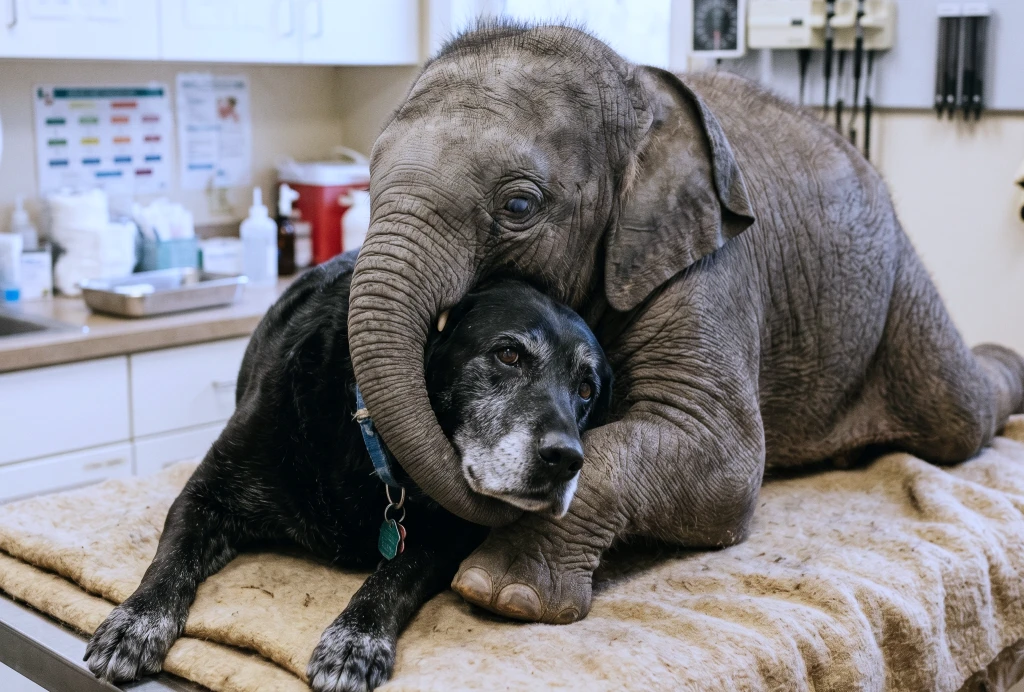
“Back up,” Mark said quietly.
Luis Torres froze on one knee inside the padded quarantine stall, the oversized nursing bottle still cradled in both hands. He had been working with dangerous animals for seventeen years, and his patience was almost unnatural. He could stand in a doorway for half an hour without shifting his weight. He could read the smallest flick of an elephant’s ear from across a barn. But even Luis looked shaken now.
The calf lay pressed into the far corner as if he could disappear into the wall. His name, on the emergency intake form, was Milo. He was three weeks old, eighty-seven pounds underweight, and blind. Infection had sealed his eyes before anyone at the roadside zoo bothered to call a veterinarian. By the time federal agents brought him to Juniper Ridge Wildlife Sanctuary in the Missouri Ozarks, the damage had already hardened into a cloudy, permanent silence behind both corneas.
Milo’s trunk trembled against his chest. The tip lifted once, searching the air, then curled back tight.
Luis lowered the bottle to the rubber mat. “He smelled it,” he said. “Then he panicked.”
Across the rail, Claire Bennett gripped the steel with both hands. She was the senior elephant keeper at Juniper Ridge, a practical woman with a sun-browned face and a ponytail that had been coming loose since dawn. Dried formula streaked the front of her work shirt. There was iodine on one sleeve and hay dust at her collar, and she looked like someone who had forgotten what sleep was supposed to do for a person.
“His heart rate jumped again,” she said.
Mark didn’t answer right away. He kept watching the calf’s ribs, counting the breaths without moving his lips. The barn around them smelled of warm rubber, disinfectant, milk replacer, and the sour edge of fear that clung to animals after transport. Outside, the June heat pressed against the metal walls. Inside, the fan clicked in a tired arc, moving air that did nothing to cool anyone down.
Milo breathed again, thin and fast.
Claire closed her eyes for one second. “We can’t tube him a third time.”
“I know.”
“No, I need you to hear me.” Her voice stayed low, but it tightened in a way that made Luis look up. “The second time nearly killed him. He thought we were trapping him again. If we restrain him now, he’ll fight until his body gives out.”
Mark knew that. He had known it before she said it. The tube had kept Milo alive for another twenty-four hours, but survival bought that way came with a cost. Every intervention made the calf trust human hands less. Every needle, every strap, every careful medical act landed in the same place inside him as the concrete pen, the hunger, the dead mother he had been found leaning against.
The federal agents had called the seizure “successful.” Mark had stood there when the trailer doors opened and watched success carried out on a sling, legs folded under him, trunk hanging limp. Milo’s mother had collapsed before transport. The agents had tried to save her, but malnutrition and infected joints had already done their work. The calf had arrived with no sight, no mother, and no idea that anyone left in the world was safe.
Since then, he had refused every kind of help that smelled like people.
They had brought in Pearl, the oldest matriarch at the sanctuary, hoping her low rumbles would reach him through the walls. Milo had turned his head away. They had let June, a playful young rescue, chirp and snort at the fence. Milo had flattened himself to the floor and trembled until Claire ordered everyone out. They had warmed formula to different temperatures, changed nipples, changed buckets, changed schedules, changed voices.
Nothing had changed Milo.
Luis slowly backed out of the stall and latched the gate behind him. He stood with the bottle hanging at his side, his jaw working once before he spoke.
“He’s not refusing because he doesn’t know how,” he said. “He knows. He just won’t let anything get close enough.”
Claire looked down at the calf’s small body folded against the wall. “He’s starving himself.”
The words were not dramatic. They were worse than that. They were accurate.
By late afternoon, the conference room in the administration building felt colder than any place on the property should have felt in June. The air conditioner rattled over the ceiling tiles. A stale pot of coffee sat untouched near the sink. Elaine Porter, the sanctuary director, spread Milo’s bloodwork across the table and set her glasses on top of the page as if pinning down bad news might make it easier to face.
“His kidney values are moving the wrong way,” Elaine said. “Fluids are slowing the decline, not reversing it. He needs calories. Soon.”
Claire sat beside Mark with her elbows on her knees. Luis stood near the door because he never liked sitting through medical meetings. On the wall behind Elaine, a framed photo showed Juniper Ridge on opening day: green pasture, clean fencing, three rescued elephants under a wide blue sky. Mark avoided looking at it. Hope looked unfair in photographs.
Elaine folded her hands. “Mark, we need to discuss the humane option.”
Claire’s head dropped.
Luis turned his face toward the window.
Mark rested his palm flat on the table. “No.”
Elaine didn’t flinch. She had built the sanctuary out of grants, debt, and stubbornness, and she had buried enough animals to know mercy was not always gentle. “I’m not saying today. But if he continues refusing food, we have to decide before his body starts shutting down in a way we can’t control.”
“He’s still responding.”
“He’s blind, orphaned, medically fragile, and terrified of every person who enters that barn.”
“All of that is true,” Mark said. He picked up the latest chart but didn’t read it. He already knew the numbers. “And this morning, when the compressor outside the isolation wing kicked on, his left ear tracked it. Not randomly. He followed the vibration. He’s mapping sound. He’s still trying to understand where he is.”
Claire looked at him then, her face tired and bare. “That doesn’t mean we can save him.”
“No,” Mark said. “But it means he isn’t gone.”
Elaine leaned back in her chair. For a long moment, she said nothing. Mark could see the calculation happening behind her eyes: suffering, liability, donor scrutiny, medical ethics, staff morale, the hard line between refusing to quit and making an animal pay for human hope.
“How long?” she asked.
“Ten days.”
Claire made a small sound, not quite relief. Luis looked away from the window.
Elaine shook her head. “You get five.”
“Elaine.”
“Five days,” she said, and now the director had returned to her voice. “If his pain increases, if his organ function crashes, if Claire tells me he’s suffering past what we can justify, we stop. I will not let this sanctuary become another place where an animal is kept alive because people can’t bear to let go.”
Mark held her gaze. “Agreed.”
After the meeting, he didn’t go home. His truck sat under a post oak near the clinic, windshield flashing gold in the low sun, but he walked past it toward the county animal shelter that shared Juniper Ridge’s back service road. He told himself he wanted to check on a shepherd mix recovering from surgery. That was partly true. Mostly, he needed five minutes in a building where the patients were smaller and the impossible decisions usually came with adoption paperwork instead of blood panels.
The shelter’s quarantine wing smelled like bleach, wet concrete, and kibble. Nora Price, the shelter coordinator, was rinsing a drain when she saw him and shut off the hose.
“You look awful,” she said.
“Good to see you, too.”
“Milo?”
Mark leaned against the chain-link gate. “Five days.”
Nora’s expression changed. She didn’t ask for details, which was one of the reasons Mark liked her. People who worked with animals long enough learned when questions were just a way to make someone say the painful part twice.
“I’ve got someone you should meet,” she said.
“Nora, unless he can talk a blind elephant into drinking formula, I’m not sure I’m useful tonight.”
“He can’t talk.” She looped the hose over a hook. “But I still think you should see him.”
She led Mark down past the barking kennels into the last row, where the noise fell off and the dogs watched from their cots with the wary stillness of animals who were still deciding what kind of place they had landed in. At the very end, a large black dog lay with his chin on his paws. He had the broad skull of a Labrador, the thick chest of something heavier, and a white seam of healing scar tissue running over one shoulder.
He did not bark when they stopped in front of him.
He lifted his head, looked at Mark through the wire, and thumped his tail once.
“This is Boone,” Nora said. “He came in four days ago.”
Mark crouched. The dog’s eyes followed him, calm but distant. Not dull. Not empty. Just fixed on a point somewhere behind the world in front of him.
“What happened to his shoulder?”
“Bear country,” Nora said. “His owner ran pack trips in Montana. Good man, from what his sister told me. Boone was with him when they got caught between a wounded bear and a mule string. Boone went in first.”
Mark looked at the scar again. “Owner didn’t make it?”
Nora shook her head. “Boone did. Barely. Search and rescue found him lying across the body, bleeding through the snow and refusing to move. They had to sedate him before the paramedics could get close.”
Inside the kennel, Boone slowly pushed himself upright. He didn’t come to the gate. He stood there, big paws planted, head level with Mark’s, as if he were waiting for a command from someone whose voice would never come again.
“The sister brought him down here because she lives in Springfield,” Nora said. “Small apartment. Two jobs. She tried. But he won’t settle. He eats if I sit with him, and he lets me clean the wound, but otherwise he just lies there staring at the wall.”
Mark stayed crouched, one hand resting lightly against the fencing. Boone stepped forward at last. He lowered his nose to Mark’s fingers and breathed him in with a long, careful pull, catching barn dust, antiseptic, elephant milk, sweat, and whatever else clung to a man after a day spent beside a dying calf.
Then Boone did something that made Mark stop thinking.
He pressed his scarred shoulder against the chain-link and leaned his whole weight into it, not asking to be petted, not wagging for attention, just seeking pressure. Contact. A boundary he could feel.
Mark looked at Boone’s heavy body against the fence and saw, with a clarity that made his stomach tighten, Milo curled blind in the corner of the isolation stall.
“Nora,” he said slowly.
She heard the change in his voice. “Mark, no.”
“I haven’t said anything.”
“You don’t have to. That face always means paperwork and trouble.”
Boone held still against the wire, his breathing deep and steady under Mark’s palm.
Mark stood, but he didn’t step back from the kennel. “I need to bring him to the elephant barn in the morning.”
Nora stared at him as if she had misheard. Behind the fence, Boone gave one low, tired sigh and kept his shoulder pressed against Mark’s hand…
To read the rest of the story – CLICK the NEXT button 👇👇👇