


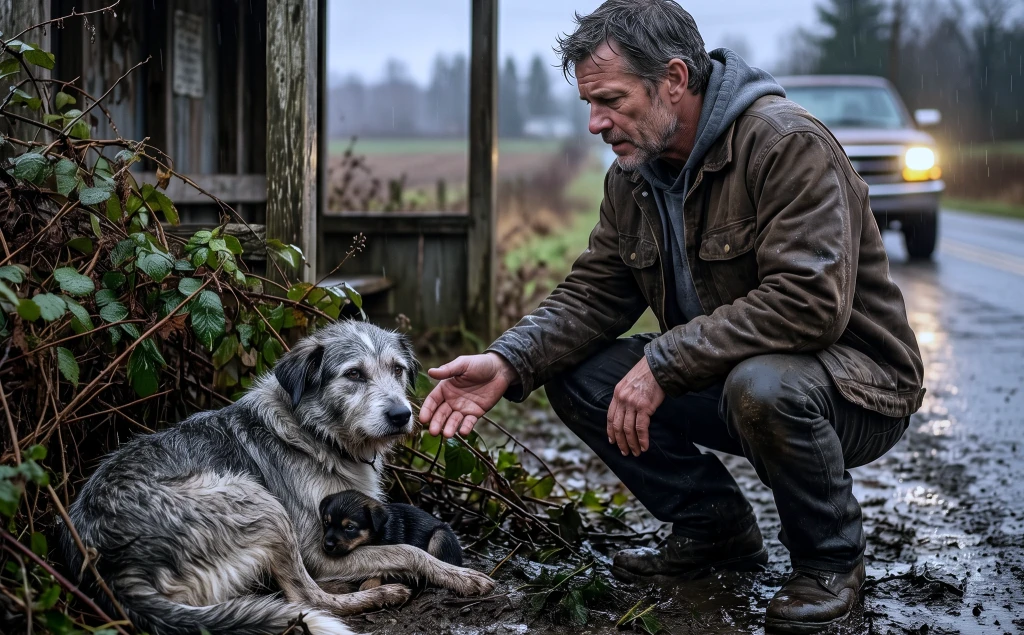
For six mornings, I drove past the old gray dog at the county bus shelter and told myself the same lie. Somebody else will stop. On the seventh morning, she didn’t lift her head when my truck slowed near the shoulder. She only curled her body tighter around something in the wet leaves and gave me a warning growl so weak it sounded more like pain than threat.
I drove another twenty yards before I hit the brakes.
My name is Caleb Turner. I run a small furniture repair shop outside Mill Creek, Ohio, in a brick building my father left behind when his hands got too stiff to hold a chisel. Every weekday, I took the same road before sunrise: cornfields on the left, the old county bus shelter on the right, then a bend past Miller’s Lumber and down to my shop, where the air always smelled like sawdust, stain, glue, and old wood trying to become useful again.
The first time I saw her, she was sitting under the cracked plastic roof of that bus shelter like she was waiting for someone who was late. Her coat was gray and patchy, her muzzle white, her ribs too visible even from the road. I slowed down just enough to see she had no collar.
“Somebody’s dog,” I said to the empty cab.
That was how I let myself keep driving.
In a town like Mill Creek, it is easy to hand your conscience to an invisible neighbor. Somebody knows where she belongs. Somebody already called animal control. Somebody has a farm. Somebody has more time. Somebody is kinder than you were before coffee.
But by the third morning, she was no longer sitting. She was lying on her side beneath the bench, her fur darkened by rainwater and road grit. Someone had tossed a fast-food wrapper near her, but the fries inside had gone soggy and untouched. I slowed again, my hand hovering near the turn signal, and then I remembered the walnut dresser waiting in my shop, the customer who had already called twice, the heater in the truck that barely worked, the fact that I knew nothing about frightened stray dogs.
By the fifth morning, I told myself she might bite.
By the sixth, I actually pulled over.
I sat there with the engine running and my hand on the door handle. The dog didn’t move. Rain ticked against the windshield, and the bus shelter leaned under the gray morning as if it were tired too. I opened the door, put one boot on the shoulder, and felt the cold water soak through the worn seam.
The dog turned her eyes toward me.
Not angry eyes. Not wild ones. Just exhausted.
“I’ll come back tomorrow,” I said, loud enough to hear myself.
Then I shut the door and drove away.
I hated that word before I even reached the lumberyard.
Tomorrow.
My father used to say it near the end. Tomorrow I’ll call the doctor. Tomorrow I’ll let you drive me. Tomorrow we’ll clean out the back room. By the time tomorrow finally came, he was in a hospital bed, and I was standing beside him with all the things we had postponed sitting between us like unpaid bills.
Still, I drove past that dog for six mornings.
On the seventh, she was under the wet brush behind the shelter instead of under the bench. Her body had sunk into the mud, and her head rested so low that, for one awful second, I thought I had waited too long. I got out of the truck without turning off the engine.
“Easy,” I said, holding my hands out where she could see them. “I’m not coming in fast.”
Her lips pulled back. The growl that came out of her was ragged and thin, but she meant every bit of it. When I took one more step, she tried to rise, and her front legs slid out from under her.
That was when I saw what she was guarding.
A puppy.
It was tucked against her belly in a fold of filthy fur, no bigger than a loaf of bread, trembling so hard the leaves around it shook. Its eyes were cloudy, barely open, and its tiny mouth moved without making much sound.
I sat down in the mud because my knees forgot what they were for.
The old dog tried to shift her body over the puppy again. She couldn’t manage it. Her head dropped to her paws, but her eyes stayed on my hands.
“All right,” I whispered. “I see him. I see.”
I called Dr. Emily Reyes, the only veterinarian within twenty miles who still answered her phone before office hours because she had long ago accepted that animals kept their own schedules.
“Caleb?” she said, half-asleep and already worried. “What happened?”
“There’s a dog at the old bus shelter. She’s bad, Emily. Really bad. And she’s got a puppy with her.”
The sleep left her voice. “Don’t touch the puppy until I get there.”
“She’s barely moving.”
“That doesn’t matter. If she thinks you’re taking him, she’ll use whatever she has left.”
I looked at the dog. She was shaking from cold, hunger, fever, and whatever strength it took to keep hating me for coming near her baby.
“She doesn’t have much left,” I said.
Emily arrived twelve minutes later in a rain jacket and rubber boots, with her field bag over one shoulder and the kind of calm face people wear when anger would waste time. She crouched a few feet away from the dog and waited until the growling started again.
“I know,” she said softly. “You’re his mama. Nobody’s arguing with that.”
The dog’s eyes flicked from Emily to me, then back to the puppy.
Emily moved slowly, inch by inch, talking under her breath the whole time. She checked the dog’s gums, touched her side, looked at the torn pads of her paws, and parted the matted fur along her spine. When she finally glanced at me, her expression had changed.
“She’s dehydrated, feverish, and starving. Her paws are infected. She’s been nursing with almost nothing in her body.” Emily looked toward the bus shelter, then the road. “She didn’t wander here yesterday.”
I swallowed. “Can we move them?”
“We have to.”
The puppy whimpered, and the old dog tried to pull him closer with her chin. She failed twice before her muzzle finally nudged him against her belly. Emily took a blanket from my truck and spread it on the ground.
“Caleb, when you pick up the puppy, keep him where she can see him. Don’t turn your back. Don’t act nervous.”
“I am nervous.”
“Then act useful.”
I bent down and slid both hands under the puppy. He was warm in the middle and cold everywhere else, lighter than a hammer, more fragile than any broken chair leg I had ever carried across my shop. The dog snapped at me. Her teeth clicked an inch from my wrist, but her body collapsed from the effort.
“I’m not taking him,” I told her. “Look. He’s right here.”
I placed the puppy on the blanket inside the truck bed, then stepped aside so she could see him. The sound she made then was not a growl. It was a broken, breathy cry that seemed to come from somewhere deeper than her throat.
We lifted her next. She fought us because mothers do not stop being mothers just because their bodies are done obeying. By the time we got her onto the blanket beside the puppy, she was shaking so hard her nails scraped against the truck bed. The puppy nosed blindly toward her, and she dragged him against her chest with the last bit of strength she owned.
Emily shut the tailgate and looked at me over the rain.
“If you’d waited one more day,” she said, “there wouldn’t have been two animals to save.”
I wanted to defend myself. I wanted to tell her I had almost stopped on Tuesday, that I had opened the truck door on Thursday, that I had thought about calling someone every morning and forgotten by noon.
But all of that was just a longer way to say I had kept driving.
Behind my shop, there was an old storage room my father and I used to call “the someday room.” Someday we would organize it. Someday we would throw out the warped boards, broken drawer pulls, cracked mirrors, mismatched chair legs, and paint cans that had hardened into useless bricks. That morning, I cleared half of it in less than an hour.
Emily treated the dog on a folded moving blanket while I dragged shelves aside and plugged in a space heater. The dog watched every motion, too tired to lift her head but not too tired to distrust us. The puppy kept searching for milk she barely had.
“No big meals,” Emily warned me after the injections were done. “Small portions. Water often. Keep them warm. Don’t crowd her. Don’t let customers wander back here. And don’t expect gratitude.”
I looked at the dog’s hollow sides and the raw places on her paws. “Will she live?”
Emily packed her bag slowly. “She’s been trying to live for at least a week with no help from anybody. Now we try not to ruin her work.”
For the first few nights, I slept on an old mattress just inside the shop door. I told myself it was in case she needed something, but the truth was uglier. I was afraid that if I went home, she would be gone in the morning, and the bus shelter would have followed her into my dreams.
She didn’t sleep much. Every time I turned over, her eyes opened. If I stood, she growled. If the puppy cried, she forced her head up even when her body shook from the effort. I learned to set food down and leave. Only after I shut the storage-room door halfway would I hear her eat.
On the fourth day, the puppy crawled out from under her chin and made it all the way to my work boot. He opened his mouth around my shoelace and began to gum it with great seriousness.
I froze with a mug of bad coffee in my hand.
“He came over here,” I told the old dog. “That was his decision.”
She watched me for a long time. Then, very slowly, she lowered her head back onto the blanket.
For three months, I called her “girl.”
Not because I couldn’t think of a name. I could have named her half a dozen things. Molly. June. Grace. Something soft enough for an old dog who had earned softness. But every time I opened my mouth, I remembered the way she had sat under that bus shelter like she was waiting for someone specific.
Maybe someone had already named her.
Maybe someone still missed her.
Then, on a damp Thursday afternoon in October, a boy walked into my shop holding a creased photograph in both hands.
He was small for his age, maybe ten or eleven, with a backpack hanging from one shoulder and a jacket that looked a size too large. He stopped just inside the doorway, careful not to step past the mat.
“Are you Mr. Turner?” he asked.
“I am.”
He crossed the room and held out the photograph.
In it, a younger version of the gray dog sat on a porch in bright summer light. Her coat was clean, her ears lifted, her eyes fixed on the woman beside her. The woman wore a pale blue sweater and had one hand resting on the dog’s head. In front of them stood a little boy with missing front teeth, laughing so hard his whole face seemed open.
I looked from the photograph to the child standing in my shop.
Same eyes. Older now. Quieter.
“Her name is Rosie,” he said.
Rosie.
For three months, she had been “girl” because I was afraid to give her the wrong name. All that time, the right one had been sitting in a child’s mouth, waiting for enough courage to come out.
The boy swallowed and looked toward the back of the shop. Then he asked the question that made the photograph feel suddenly heavier in my hand. “Does she still hide when men raise their voices?”…
To read the rest of the story – CLICK the NEXT button 👇👇👇