


The old lion did not roar when he boarded the safari shuttle. That was the first thing Caleb Mercer noticed, even before the screaming started. The animal came up the folding steps at 9:17 on a bright Arizona morning, one massive paw after another, his mane dulled with dust and burrs from the dry grass. He filled the front doorway so completely that the sun vanished behind him, leaving forty-two tourists trapped in the narrow aisle-light of the stalled bus.
The young guide at the wheel froze with one hand on the radio. A woman in the first row dropped her iced coffee into her lap and did not seem to feel it. Somewhere behind Caleb, a child began making a small, hiccupping sound, the kind that came before a full cry when fear had not yet found enough breath.
“Coyote Springs dispatch,” the guide said, but his voice climbed too high and cracked. “This is shuttle four in the predator loop. I need immediate—”
Static tore through the speaker. Then the radio went dead.
The lion stepped fully onto the bus.
Caleb sat in the second row with his cane braced between his knees and a hospital bracelet tucked under the cuff of his work shirt. The plastic edge had been worrying his wrist all morning, but he had refused to cut it off. It belonged to the life he was supposed to be living today: intake desk, surgical oncology, forms on a clipboard, his daughter asking questions he did not want answered. In the inside pocket of his jacket was an appointment envelope from Sundown Regional Cancer Center, folded once, then folded again.
On the seat beside him was something older: a photograph soft from handling, hidden inside a yellowed veterinary form.
He had not come to Coyote Springs Wildlife Safari to ride a shuttle with tourists. He had not come for souvenirs, or shaded viewing decks, or the guide’s cheerful facts about conservation work printed on the side of the bus. Caleb had come because there was one animal here he needed to see before anyone in a white coat told him how much time he had left.
Now that animal stood ten feet away in the aisle.
“Everybody stay seated,” the guide said. His name tag read TYLER. He could not have been more than twenty-two, with a sunburn across his nose and terror sitting openly on his face. “Nobody move. Please. Just—nobody move.”
The tourists did exactly the opposite. They shrank, twisted, grabbed children, bumped elbows against windows and seatbacks. A man in a golf visor tried to climb over his wife to reach the rear of the shuttle. Two teenagers in matching camp shirts ducked so low their heads disappeared beneath the seats. A grandmother pressed both hands over her mouth, her eyes fixed on the animal’s teeth.
The lion’s tail flicked once.
That single motion quieted more people than Tyler’s pleading had. The animal lowered his head, sniffed at the rubber matting, and took another step. His left foreleg came down a fraction later than the right. Not much. A stranger might have missed it. But Caleb had been waiting fifteen years to see that limp again, and recognition passed through him with such force that he nearly forgot where he was.
“Atlas,” he breathed.
No one heard him over the panic. The mother behind Caleb was whispering to her little boy to stay down, stay down, stay down. Tyler slapped the door control again and again, but the front panels only shuddered in their track. Outside, the gravel road shimmered white in the heat. The shuttle’s engine had coughed itself silent three minutes earlier, taking the air-conditioning with it. Then a fuse had snapped above the windshield, the warning light had blinked, and the front door had opened as if invited by disaster.
Until that moment, the tour had been ordinary.
Caleb had watched people press phones to the windows and narrate the morning for friends who would never watch the videos all the way through. Tyler had told them the older male lion often rested near the shade structure on warm days, that he was a rescue, that he had a bad leg from an injury before he came to the park. The tourists had lifted their phones higher at the word rescue. Caleb had turned toward the glass so quickly his ribs hurt.
He saw the rise of sunburned grass. He saw a low concrete water trough, a line of mesquite, a service road beyond the habitat fencing. Then he saw the lion near the medical gate, head down, moving with the old uneven rhythm Caleb remembered from a kitchen floor covered in towels.
Atlas.
The cub had been small enough to fit against Caleb’s chest then, all fever and bone and anger. The lion in the aisle was no cub. He was age and muscle and weather, darker through the mane than Caleb had expected, gray beginning to frost his muzzle. But pain had its own signature. Caleb knew the slight hesitation before that left paw touched ground. He knew the way Atlas held himself, not weakly, never weakly, but with a practiced bargain between pride and injury.
The lion took another step toward the rows.
“Sir,” Tyler whispered from the front. “Please don’t make eye contact.”
Caleb did not look away.
Atlas’s nostrils opened as he tested the shuttle air. It was thick with sunscreen, spilled coffee, hot vinyl, gasoline, fear. Caleb had spent too many years with injured animals not to know what fear could do. It sharpened a room. It made prey smell like prey. It made kind hands jerk too fast and soft voices break into screams.
A lion did not have to be cruel to become dangerous. He only had to be cornered inside everyone else’s panic.
Caleb loosened his grip on the cane. The movement was tiny, but the mother behind him saw it and whispered, “Please, mister, don’t.”
Atlas heard her. His head turned toward the sound, and the boy in her lap buried his face in her shirt. Caleb’s knees wanted to pull back. His body, old and angry at him for every appointment skipped and pill forgotten, tried to make itself small. He pressed his palms down against his thighs instead.
He had made a promise once to a half-dead cub in the mud. Promises did not expire just because the body that made them grew tired.
The lion came beside the second row and stopped.
Up close, Atlas smelled of dust, raw meat, old hay, and something medicinal Caleb could not place. His mane brushed Caleb’s sleeve. His breath moved over the old cotton jacket Caleb had worn without thinking that morning, the same jacket he had kept hanging in the hall for years because his wife, Helen, had liked the way it smelled of cedar shavings and the barn.
Caleb did not reach for him. He let the animal decide what the distance meant.
Atlas lowered his head. His nose touched Caleb’s cuff, then the side of his cane, then the jacket again. The shuttle held so still that Caleb could hear a water bottle rolling somewhere under the rear seats, tapping faintly against the metal legs.
The lion stopped breathing for one long second.
Caleb felt it. The animal’s whole body seemed to pause around a scent buried beneath fifteen years of sun and storage and human decline. Caleb’s throat tightened. He closed his eyes and made the smallest sound he could, a rough three-note hum from an old harmonica tune Helen used to pretend she hated. He had played it beside the stove when Atlas was a cub too weak to sleep unless someone sat near him.
The first note trembled. The second steadied. The third barely made it out.
Atlas lifted his eyes to Caleb’s face.
“Oh my God,” Tyler said.
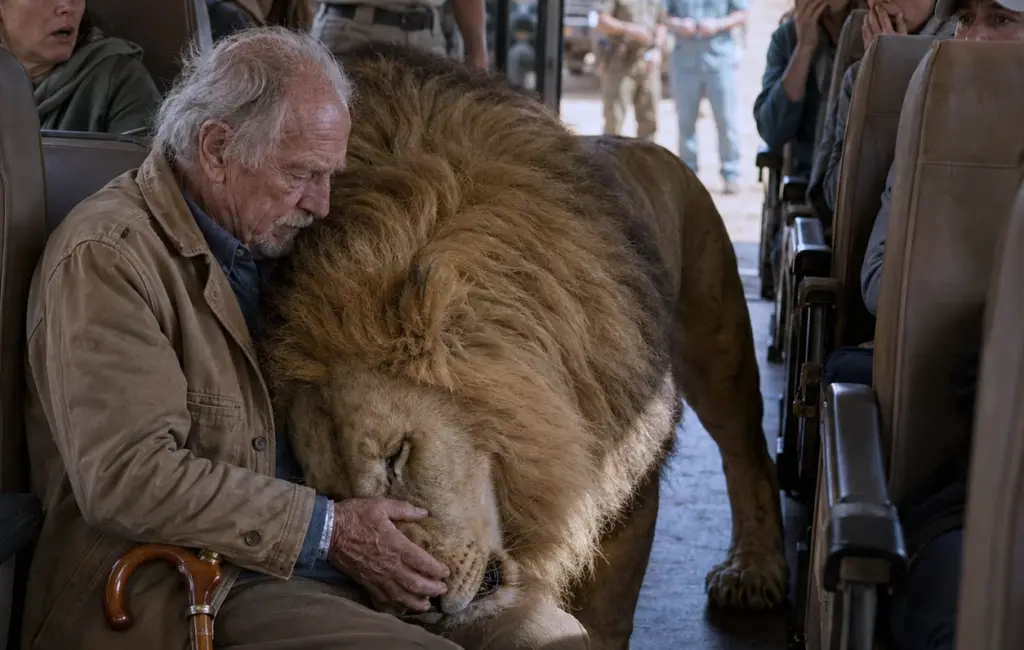
The lion bent slowly, heavily, with a care that made the movement more frightening than a leap would have been. He lowered his head across Caleb’s knees, the weight of him pressing pain through both of Caleb’s legs. Someone near the back started crying without sound. The man in the golf visor stopped trying to move. Tyler covered his mouth with the hand that still held the radio.
Caleb’s fingers shook as they slid into the mane.
There was no miracle in it. He knew that. This was not a pet returning to its owner, not some tame creature remembering tricks. Atlas was a lion, old and wounded, with power enough in one paw to end the fragile arrangement of mercy Caleb had been handed. But the animal had remembered something. A smell. A sound. A hand that had once cleaned infection from a torn leg while Helen warmed formula on the stove at two in the morning.
“Hey, old man,” Caleb whispered, though he did not know which of them he meant.
The lion’s eyes half closed.
Outside the windshield, a white park truck came hard around the bend and skidded sideways in a sheet of gravel. Two rangers jumped out with dart rifles held low. A woman followed them, moving faster than either man. She wore khaki field pants, a dark braid under a Coyote Springs cap, and a veterinary shirt with DR. M. CHEN stitched above the pocket.
“Do not enter the bus,” she called. Her voice was calm enough to make people obey. “Nobody stands. Nobody reaches over him. Keep your hands where he can see them.”
Tyler found part of his voice. “Dr. Chen, he’s on a guest.”
“I can see that,” she said.
One of the rangers lifted his rifle half an inch.
Caleb’s hand closed in the lion’s mane. “Don’t.”
The ranger looked at Dr. Chen. She raised two fingers, and the rifle lowered again.
“Sir,” she said, coming no closer than the open doorway. “Can you hear me?”
Caleb did not answer right away. His fingers had moved, almost by memory, beneath the heavy mane toward the damaged shoulder. He found the old scar along the left foreleg first. It was thicker now, ridged beneath the fur, the pale lightning mark left by the wire that had nearly taken Atlas’s leg before he had ever learned to roar.
Then Caleb’s thumb brushed a place that did not belong to memory.
He parted the mane with two fingers. The skin underneath was raw in a rubbed circle high on the neck, hidden where guests looking through windows would never see it. The fur around it was broken and darkened. It was not a scratch from brush. It was not a scrape from a gate. Caleb had seen rope burns, collar wounds, chain marks, and restraint injuries on too many creatures people had gotten tired of caring for.
His hand went still.
Dr. Chen must have seen his face change. “What did you find?”
Caleb looked from the wound to the rangers, then past them to the man stepping out of a second vehicle in a spotless white shirt and polished sunglasses. The man looked too clean for the dust, too composed for the fear, and too annoyed for the danger. Caleb kept one hand in Atlas’s mane and lifted his voice just enough for the front of the shuttle to hear. “Who put this collar mark on him?…”
To read the rest of the story – CLICK the NEXT button 👇👇👇