


The lion stepped onto the safari bus at 9:18 in the morning, and forty-three people forgot how to breathe. He came through the front door like the heat itself had taken shape: gold mane dusty from the road, one heavy shoulder rolling higher than the other, mouth open just enough to show the pale curve of his teeth. His paws landed on the metal steps with a sound too soft for something that large. By the time his head cleared the door frame, the first row had already begun to move backward.
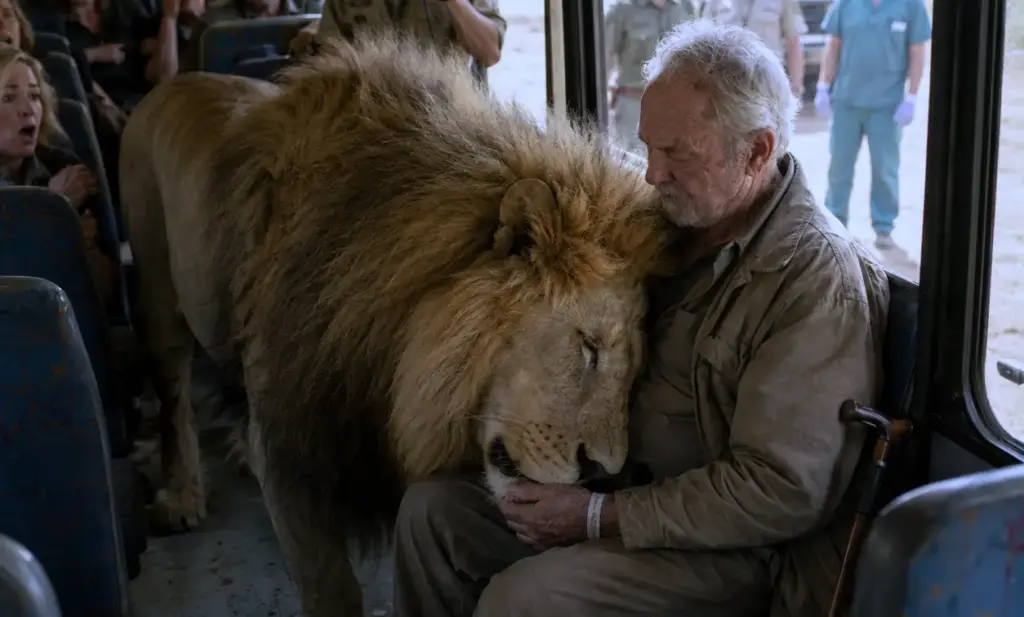
Someone screamed. Someone else dropped a phone. A little boy in a dinosaur T-shirt slid under his mother’s arm and started sobbing into her purse while the tour guide, a twenty-three-year-old named Jordan Miller, stood frozen with the radio pressed to his mouth.
“Red Mesa dispatch,” Jordan said, but the words came out thin. “I need response at Lion Ridge. Bus three. I need—”
Static swallowed the rest.
The old man in the second row did not move.
Walter Hayes sat with both hands folded over the knob of his cane, his shoulders rounded inside a faded canvas work jacket that was much too heavy for a Texas June morning. His face was brown and lined from years of sun, and under his left cuff, half-hidden by denim, a white hospital bracelet had worked its way loose against his wrist. On the seat beside him lay a sealed envelope from Cedar Ridge Regional Cancer Center, the top corner bent from being handled too many times.
He had not come to Red Mesa Wildlife Safari for the tour.
He had come to say goodbye to one animal.
The bus had been rolling through the predator loop only ten minutes earlier, its air-conditioning rattling weakly against the hundred-degree heat while tourists pressed their faces to the tinted windows. A father from Dallas was narrating into his phone. Two college girls in the back were laughing at a zebra that had gotten mud across its nose. A retired couple across the aisle from Walter kept comparing the park to a trip they had once taken in Kenya, though they said it quietly, as if the memory might offend the animals outside.
Walter had listened to all of it with a patience that looked like sleepiness. He had kept one hand in the inner pocket of his jacket, where an old photograph rested inside a folded veterinary intake form. The paper was soft at the creases. The picture had faded, but he still knew every inch of it: his younger hand holding a lion cub wrapped in a towel, the cub’s injured foreleg stretched across Walter’s palm like a broken branch.
When Jordan had announced they were approaching the lion habitat, Walter had sat a little straighter.
“On your left, folks,” Jordan had said, putting on the cheerful voice of a guide who had repeated the same facts all summer. “That shaded rise is where our older males usually rest during the hot part of the day. You may see Samson if he’s feeling social. He’s one of our senior lions, about sixteen years old, and he’s been with Red Mesa since before most of us worked here.”
Walter had turned his head toward the glass.
He had not seen Samson at first. He saw the live oaks, the yellow grass, the boulders arranged for tourists to believe they were looking at wilderness. He saw a water trough in the distance and a service road beyond it. Then he saw movement near the medical fencing: a flash of mane, a limp he knew before he saw the face.
His chest had tightened so hard he had to lower his eyes.
That was when the engine coughed.
The bus gave two ugly jerks and rolled to a stop in the middle of the gravel track. The air-conditioning died with a sigh. For a few seconds, no one understood the seriousness of silence. People made jokes at first, fanning themselves with brochures and asking whether this was part of the “authentic safari experience.”
Jordan tried to smile. “Looks like she’s being stubborn this morning. Everybody stay seated while I call it in.”
But the radio did not answer cleanly. It hissed and popped in his hand, catching pieces of voices from somewhere too far away. Jordan stepped toward the front console, checked the ignition, then glanced at the door controls. Walter saw the young man’s face change before anyone else did.
There was a sharp electrical snap above the windshield.
The red light over the front door blinked once.
Then the door folded open.
Outside, for a heartbeat, there was only white heat and dust. Then Samson appeared in the doorway, and the bus turned into a box full of trapped sound.
“Close it!” a woman shouted.
“I’m trying,” Jordan said. He slapped the door switch twice, then three times, but the panels only trembled in place.
A man in a baseball cap shoved past his wife to get away from the aisle. The college girls scrambled over one another and knocked a backpack onto the floor. A bottle of water rolled under the seats, clicking against metal supports, while a little girl whispered, “Mommy, mommy, mommy,” in a voice that broke smaller each time.
Samson lowered his head and climbed in.
He was bigger than Walter remembered, though of course that was foolish. Walter had not seen him up close in fifteen years. The cub that had once slept inside an old laundry basket beside Walter’s stove had become an animal that filled the aisle with muscle and heat, his mane dark at the edges, his eyes the color of dried honey. His left foreleg still bore the old weakness. The limp was worse now, but the rhythm of it was the same.
Walter knew that limp.
He knew the small hesitation before the paw came down. He knew the way Samson carried pain as if he had made peace with it but had never forgotten who gave it to him.
“Sir,” Jordan whispered from the front. His voice shook. “Sir, don’t move.”
Walter did not answer.
He had spent half his life around frightened animals, and fear had a smell. It lived in sweat, in sharp breath, in the sourness of panic that rose off people when they realized doors were not promises. The bus was full of that smell now. Samson’s nostrils widened as he took it in, his tail twitching once against the door frame.
A lion did not need hatred to kill. Panic could do it. Pain could do it. One wrong movement could turn a living animal into a storm.
Walter loosened his fingers from the cane.
The mother with the little boy saw the motion and whispered, “Please don’t.”
Samson’s eyes shifted toward Walter.
For one terrible second, the whole bus seemed to lean with that gaze. The lion took one step, then another. The metal floor dipped beneath him. Walter could hear claws lightly scrape where the rubber mat had split near the aisle.
The old man’s body wanted to betray him. His knees drew up a fraction. His breath caught behind his ribs. A wild, ancient part of him demanded he shrink away with everyone else, but he pressed his palm flat to his thigh and made himself stay.
He had made a promise once.
It had been to a creature small enough to fit in a towel, but it was still a promise.
Samson stopped beside the second row. His head lowered until his mane brushed Walter’s sleeve. His breath moved over Walter’s hand, damp and hot, smelling of meat and grass and old dust. One of the passengers behind them began to pray under her breath.
Walter did not reach out. He did not speak. He let the lion work through the scents: sunscreen, fear, vinyl seats, gasoline, strangers, and beneath all of it, perhaps too faint to matter, the old canvas jacket Walter had worn on winter nights when he fed a starving cub from a bottle every two hours.
Samson sniffed the cuff.
Then the lion froze.
His ears shifted forward. His breath changed. Walter felt the animal’s whole body pause in recognition of something the people on the bus could not see.
Walter’s throat tightened. Without thinking, he began to hum the first three notes of a song his wife used to tease him for playing too often on a cheap harmonica: slow, uneven, barely there. The sound trembled in his mouth, worn down by age and fear, but it was enough.
Samson’s eyes moved to Walter’s face.
“Oh, Lord,” Jordan whispered.
The lion lowered himself with a care that looked almost painful. His massive head came down across Walter’s knees, heavy enough that Walter had to grip the seat with one hand to steady himself. The passengers stared as the old man’s fingers, shaking now, slid into the mane.
No one screamed then.
No one dared.
Walter bowed his head over the lion, and for a moment his face changed. The years did not vanish, not exactly, but something behind them opened: a room he had kept locked for a decade and a half, where a cub cried in the dark and his wife warmed milk on the stove at midnight.
“Samson,” Walter said, so softly only the first two rows heard him. “You found me.”
The lion’s eyes half-closed. His tail gave one slow sweep along the floor.
Outside, an engine roared closer. Gravel spat under tires. Through the open door, Walter saw a white park truck skid to a stop at an angle. Two rangers climbed out with dart rifles held low. Behind them came a woman in khaki pants and a gray Red Mesa veterinary shirt, her dark hair pulled back, her face already measuring distance, angle, danger.
“Everyone stay still!” she called. “Nobody stands up. Nobody reaches over him.”
Jordan found his voice. “Dr. Ortiz, he’s on a guest. He’s on—”
“I see him,” the veterinarian said.
One of the rangers raised his dart rifle.
Walter’s hand tightened in Samson’s mane. “Don’t.”
The ranger froze, but only because Dr. Ortiz lifted one hand.
“Sir,” she said, careful and calm. “Can you hear me?”
Walter did not look away from the lion. His fingers had moved through the mane to the thick skin beneath it, searching by memory. He found the old scar first, the pale lightning mark across the left foreleg where a wire snare had cut deep when Samson was only a cub.
But then his thumb touched something else.
It was under the mane, hidden from the windows and the tourist paths. The fur there was broken. The skin beneath was raw in a rough circle, as if something had rubbed and rubbed until the body gave up defending itself.
Walter went still.
He knew old injuries. He knew fresh ones. He knew the difference between a scrape from a gate and a mark left by restraint.
The ranger outside shouted his name again, though Walter had not told anyone on the bus who he was. Walter lifted his eyes from the wound to the people standing in the dust. – “Who put a chain on my boy again?” he asked…
To read the rest of the story – CLICK the NEXT button 👇👇👇