


The first thing Nora Bennett noticed was not the paint. It was the wedding photograph lying face-down in a puddle of blue tempera beside the piano. She had been inside the Whitaker house for less than ten minutes. The front hall still smelled faintly of lemon polish and fresh lilies, the kind of expensive calm that made people lower their voices without knowing why. But beyond the arched doorway, the family room looked as if grief had been given hands and told to tear the place open.
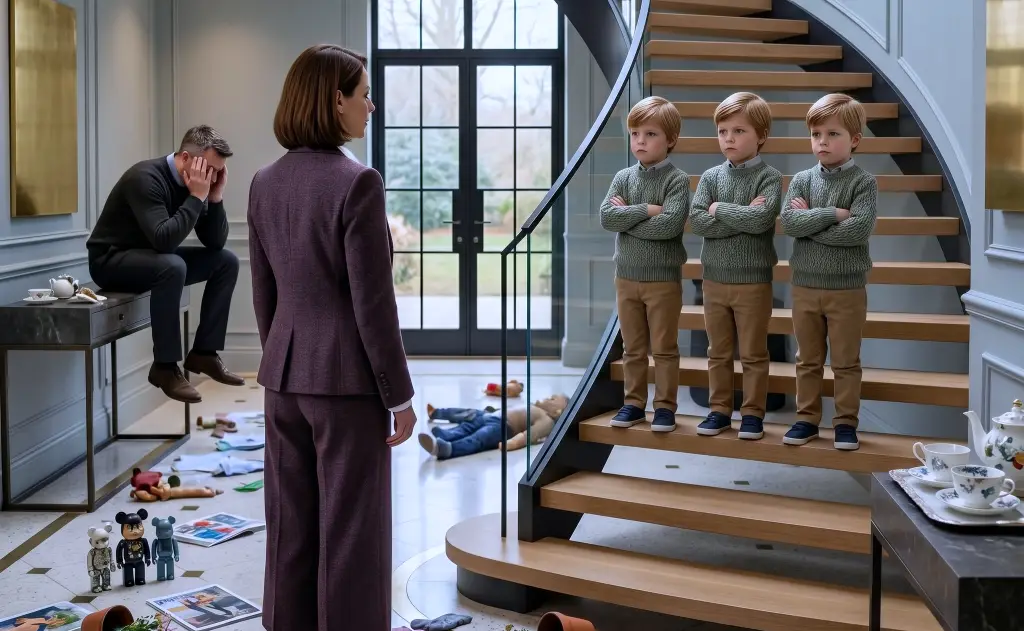
Red paint streaked the white-paneled walls. A cream-colored sectional had been shoved sideways hard enough to crack one of its legs. Feathers drifted out of torn designer pillows and clung to the dark floorboards, the bookshelves, the hem of Nora’s navy dress. Near the fireplace, three six-year-old boys stood shoulder to shoulder, breathing hard as if they had just survived something larger than misbehavior.
They were triplets, though Nora could already see they were not the same boy repeated three times. Noah stood in front with his chin lifted and his fists closed, daring the world to come closer. Eli kept one hand on Noah’s sleeve, trying to borrow his bravery. Owen, the smallest, held a battered toy fire truck against his chest and stared at Nora with a guarded, almost exhausted fear.
“Don’t touch her,” Noah said.
Nora followed his eyes to the photograph on the floor.
It showed a woman in a wedding dress laughing beside a man Nora recognized from the interview: Grant Whitaker, wealthy developer, widower, father of three boys every nanny agency in Chicago had learned to whisper about. The glass in the frame was cracked from corner to corner, and blue paint had crawled along one silver edge.
Nora did not move toward it.
That surprised Noah. She saw the hesitation pass across his face, quick and unwilling. He had expected shouting, orders, maybe a threat to call his father. He had prepared himself to hate her on schedule.
“You’re the new one,” he said.
“I’m Nora.”
“We don’t care.”
“I figured you might not yet.”
Eli’s eyes flicked toward his brother. Owen held the fire truck tighter.
“You can’t make us like you,” Noah said, voice rising. “Nobody can. We don’t want another nanny. We want Mom.”
The word landed harder than the toy car he kicked toward Nora’s shoes a second later. It skidded across the floor and stopped against the toe of her flat, leaving a wet streak of paint.
Nora looked down at it, then back at the boys. “I know.”
Noah’s anger sharpened. “You don’t know anything.”
“You’re right. I don’t know you yet.” Nora stepped around a broken dinosaur and lowered herself carefully onto the floor, leaving several feet of space between them. The paint soaked into the side of her dress, but she made no move to brush it away. “But I know what it looks like when kids try to make someone leave before that person gets the chance to leave first.”
Eli’s lips parted. Owen glanced up at Noah, as if checking whether they were allowed to react.
Noah recovered first. “Maybe we just hate you.”
“That’s possible,” Nora said. “But hate usually takes more than ten minutes. This looks older.”
The boys went still.
Somewhere in the big house, a clock chimed once. Nora let the quiet stretch because she knew what adults often ruined with too many words. Children in pain did not need a lecture at the first crack in their armor. They needed proof that the person in front of them could sit in the wreckage without flinching.
“I lost my parents when I was seven,” she said. “After that, I lived in houses where I was always trying to figure out how long I’d be allowed to stay.”
Owen’s eyebrows pulled together. “Both of them?”
“Both.”
“How?”
“A fire.” Nora kept her voice even, not softening the truth so much that it stopped being true. “For a long time, I was angry at everybody who tried to be kind to me. If I scared people off, I could pretend I had chosen to be alone.”
Eli wiped his nose with the back of his hand, smearing blue across his cheek. “Did they leave?”
“Some did.”
“And the ones who didn’t?”
Nora looked at the photograph on the floor. “They had to be very stubborn.”
Noah shifted his weight, and the movement brought Nora’s attention to something behind him. A cardboard storage box sat half-hidden under the piano bench. One flap had been torn. Inside, she could see the corners of framed pictures, a child’s drawing, a folded yellow sweater, and a Christmas ornament wrapped in tissue paper.
Across the top of the box, in black marker, someone had written: EMILY WHITAKER — PERSONAL ITEMS.
Nora’s stomach tightened, but she did not let it show on her face. “Is that your mom’s box?”
Noah stepped in front of it. “You can’t have it.”
“I didn’t ask for it.”
“Mrs. Pritchard said we weren’t supposed to look in there anymore,” Eli whispered, then immediately lowered his head when Noah turned on him.
Nora kept her eyes on Eli. “Who’s Mrs. Pritchard?”
“The last nanny,” Owen said. His voice was so small it barely reached the doorway. “She said Mom was making us sick.”
Noah kicked at a torn pillow. “She said Dad wanted the house normal.”
Nora felt a slow, cold anger move through her, but she held it steady behind her ribs. The boys did not need her outrage first. They needed her to be careful with what was already in their hands.
“May I see the box?” she asked.
“No.”
“All right.”
That answer seemed to confuse them more than any argument would have. Noah looked down at the box, then back at Nora, as if her refusal to fight made the fight inside him lose its balance.
“She took Mom off the piano,” Eli said. “She took the beach picture from the stairs too.”
“And the picture where Mom had cake on her nose,” Owen added. “That one was in the kitchen.”
Nora nodded slowly. “And you brought them back out.”
Noah’s face flushed. “She hid them.”
The word hid said more than any explanation could have. Nora looked around the damaged room again and saw the scene differently: not a tantrum, not a spoiled rich child’s war against boundaries, but a desperate excavation. Three boys had found the last visible pieces of their mother and fought the furniture, the walls, and every adult rule in the house to keep her from being buried twice.
She did not touch the box. Instead, she leaned forward just enough to see the paper taped to the inside flap.
It was printed on Whitaker household letterhead.
Nora read only the first line before Noah jerked the box toward himself, but it was enough.
To support the children’s emotional adjustment, visible grief triggers should be reduced in common family spaces.
At the bottom, in a darker pen, there were two initials: G.W.
Grant Whitaker.
Nora understood then why Noah’s anger had edges sharp enough to cut anyone who came close. This was not only about a nanny hiding photographs. In the boys’ minds, their father had approved the disappearance of their mother.
The front door opened somewhere down the hall.
All three boys froze.
Owen backed into Eli. Eli reached for Noah. Noah snatched the cracked wedding frame from the floor and held it against his chest as footsteps came closer, quick and uneven.
“Dad,” Eli whispered.
Grant Whitaker appeared in the archway wearing a charcoal suit, his tie loosened as if he had pulled at it on the drive home. His eyes swept over the ruined furniture, the painted walls, the feathers, Nora on the floor in her stained dress. Then he saw the cardboard box beneath the piano, the wedding photograph in Noah’s arms, and the paper Nora was still looking at.
Noah turned the box flap outward with shaking hands.
“Did you tell her to throw Mom away?” he asked.
Grant’s gaze dropped to the initials at the bottom of the page, and the color left his face…
To read the rest of the story – CLICK the NEXT button 👇👇👇