


The lion came through the open bus door at 9:27 a.m., and every safety rule the passengers had laughed through ten minutes earlier turned into a prayer. He climbed the first step slowly, one enormous paw after another, his mane carrying dust from the service road and his left shoulder dipping in a rhythm that did not belong to a healthy animal. The guide at the front of the bus still had the radio in his hand. A little girl behind him had both fists pressed against her mouth. Somewhere in the back, a phone hit the rubber floor and skidded under a seat.
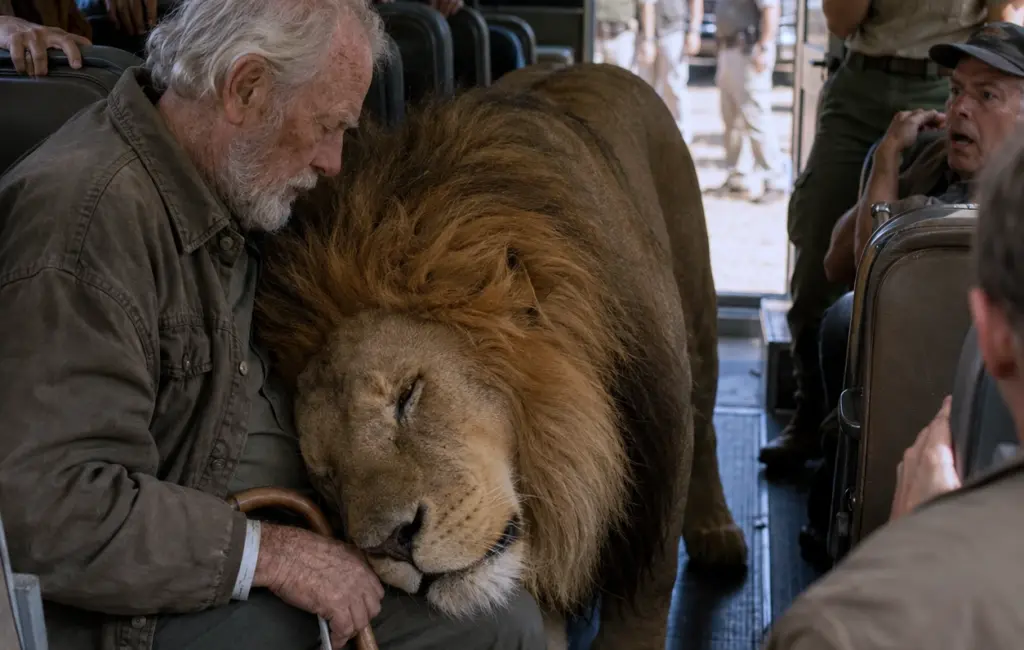
Nobody reached for it.
The lion’s head rose above the fare box, and the bus seemed to shrink around him. He was not roaring. That made it worse. He was breathing hard, looking from row to row with amber eyes that took in sunscreen, panic, vinyl seats, spilled soda, cheap perfume, and the sour human smell of fear.
In the second row, Grant Whitaker did not move.
He sat with both hands resting on a hickory cane, his elbows tucked close to his ribs beneath a canvas field jacket that was far too heavy for a June morning in southern Oklahoma. The jacket had frayed cuffs, a torn pocket, and the faint, permanent smell of feed, rain, and old barns. Under the sleeve on his left wrist, a hospital bracelet had slid halfway out of sight.
Beside him, unopened on the seat, lay an envelope from St. Agnes Regional Cancer Institute.
Grant had not come to Dry Creek Wildlife Park for the safari tour.
He had come because of one old lion.
The bus had rolled into the predator loop fifteen minutes earlier with the air conditioner rattling above the passengers like a handful of loose change. Families crowded the windows. A man in a Tulsa Drillers cap narrated everything into his phone as if the animals had been waiting all morning for his commentary. Two teenagers in the back were arguing over whether lions were faster than horses.
Grant had kept quiet through all of it. He had bought the senior ticket with cash, taken the second-row seat because climbing farther back was more trouble than it was worth, and kept one hand inside his jacket pocket, where an old photo rested against his chest.
The picture was creased nearly white at the fold. In it, Grant was twenty pounds heavier and fifteen years younger, standing in a muddy clinic yard with a lion cub wrapped in a striped towel against his chest. The cub’s front leg was bandaged from paw to shoulder. One corner of the photo showed a woman’s hand reaching in from the side, fingers curved as if she had been trying to steady both the cub and the man holding him.
Grant had not looked at the photo on the bus. He did not have to.
He knew the cub’s face.
“Coming up on your left,” the guide had said, forcing cheer over the weak microphone. His name tag said Mason Reed, and he couldn’t have been more than twenty-two. “That rise under the cottonwoods is where our senior male usually naps when it gets hot. His name is Boone. He’s been with Dry Creek since he was about a year old.”
Grant’s fingers tightened around the photo in his pocket.
Outside the tinted glass, the habitat looked almost peaceful. Dry grass leaned in the wind. A watering trough flashed dull silver in the sun. Artificial boulders stood in careful clusters meant to look wild enough for photographs. Farther back, near a line of medical fencing, something gold moved through the shade.
Grant saw the limp before he saw the face.
The left paw paused an instant too long before it touched the ground. The shoulder lifted and dropped as if the old injury still had an opinion about every step. Grant felt the years narrow, felt the bus and the tourists and the heat pull away until he was kneeling again in a clinic with a dying cub snapping weakly at his thumb because pain was the last thing in him strong enough to fight.
Then the bus engine coughed.
It was an ugly, metal sound. The vehicle lurched twice, rolled another few feet, and went still in the middle of the gravel track. The air-conditioning quit with a soft sigh. People groaned before they understood they should be afraid.
Mason tapped the microphone. “All right, folks. Looks like our bus is taking a little break. Stay seated while I radio maintenance.”
A boy near the window laughed. “Do the lions know that?”
A few people chuckled. Grant looked past Mason to the dash, where a red warning light blinked over the front door.
Mason turned his body slightly, trying to hide the movement of his hand as he pressed the radio. “Base, this is Tour Seven. We’ve stalled in Ridge Loop between markers four and five. Requesting service vehicle.”
Static answered.
He tried again. The radio crackled, caught half of somebody else’s sentence, then went dead except for a thin hiss.
The red light over the door blinked faster.
Grant watched Mason see it. The boy’s smile stayed on his face for half a second after his eyes had already changed. He stepped toward the control panel and hit the door switch once.
Nothing happened.
He hit it again.
The folding door snapped open.
Heat rushed in first. Then dust. Then the sound of a heavy body stepping from gravel onto metal.
The first scream came from the third row. After that, the bus filled with motion too cramped to become escape. A father yanked his daughter backward. A woman slid across her husband’s lap to get away from the aisle. Someone whispered, “Oh God, oh God,” in a fast, flat voice that made Grant think of hospital waiting rooms.
Mason stood between the open door and forty-one terrified people with nothing in his hands but a dead radio.
“Stay seated,” he said, and his voice broke in the middle. “Everybody stay seated.”
Boone put one paw on the bus floor.
He was older than the cub in Grant’s memory, older than the photos on the park’s website, older even than Grant had let himself imagine during the long drive that morning. His mane had darkened around the edges. Gray dusted his muzzle. The old snare scar on his left foreleg had widened with age into a pale, crooked slash.
But it was him.
Grant knew the hesitation in the left paw. He knew the wary tilt of the head, the way Boone carried pain without surrendering the rest of himself to it. He knew the animal before him was not tame, not safe, not anything a person should romanticize into a pet.
He also knew fear could make a wounded animal dangerous before anger ever did.
“Sir,” Mason whispered, because Boone’s eyes had shifted toward the second row. “Please don’t move.”
Grant did not answer. His hands wanted to shake, so he tightened them around the cane until the pain in his knuckles gave them something else to do. Behind him, a woman tried to pull a crying child down between the seats.
“Don’t hide him under there,” Grant said quietly.
The woman froze.
Grant kept his eyes on Boone. “Slow. Bring him up against you. No sudden pulling.”
The mother obeyed because his voice had the steadiness of someone who had been frightened before and survived by not wasting motion. The child climbed into her lap, hiccupping into her shirt. Boone’s ears twitched toward the sound, but his body stayed aimed at Grant.
The lion took another step.
The bus floor dipped beneath him. His mane brushed the armrest across the aisle. A water bottle rolled out from under a seat and tapped against his paw. Everyone saw it. No one breathed while Boone lowered his head, sniffed it once, and ignored it.
Grant slowly moved his right hand off the cane.
Mason made a small sound. “Don’t.”
Grant let his hand settle palm-down on his own knee. Not reaching. Not inviting. Just there.
Boone stopped beside the second row.
The lion’s head lowered until his mane touched Grant’s sleeve. His breath moved over Grant’s wrist, hot and damp and alive. Grant could smell raw meat, hay, sun-baked dust, and under it something medicinal, something wrong. Boone’s nose moved along the old canvas cuff, paused, then pressed harder.
Grant felt the moment the animal found the memory.
It was not magic. Grant knew better than that. It was scent and sound and old association, buried somewhere deeper than training. The jacket had hung in Grant’s mudroom for years. He had worn it through bottle feedings, wound cleanings, sleepless nights, and the long drive to surrender Boone to the only sanctuary that had promised not to turn him into a show.
Grant opened his mouth, but no words came. His throat had tightened too much.
So he hummed.
It was only three low notes from a tune Ellen used to sing in the kitchen when she was tired and trying not to cry over whatever broken creature he had brought home. Grant’s voice had gone rough with age and illness. The sound barely carried beyond the first rows, but Boone heard it.
The lion’s eyes lifted to Grant’s face.
Mason whispered something that might have been a prayer.
Boone lowered himself with painful care. His front legs folded first, then his heavy chest, then his head came down across Grant’s knees with enough weight to make Grant grip the seat frame. Every passenger on the bus stared as the old man sat trapped under the lion’s mane, his hand trembling inches above the animal’s head.
Grant waited until Boone’s breathing slowed.
Then he touched him.
His fingers sank into the coarse mane, not petting the way tourists petted goats through feed-lot fences, but searching. Remembering. He found the thick ridge of scar tissue along the left foreleg and felt the old guilt that had never entirely left him. Boone had survived the wire, the infection, the fever. But survival had not made the damage disappear.
Outside, tires tore across gravel.
A white park truck stopped hard near the open door. Two rangers climbed out with tranquilizer rifles held low. Behind them came a woman in a khaki shirt, dark hair pinned at the back of her neck, a medical bag slung across her shoulder. She looked once at Boone, once at Grant, and did not waste time pretending the scene was under control.
“Nobody stands,” she called. “Nobody reaches over him. Keep your hands where he can see them.”
Mason turned toward her, pale with sweat. “Dr. Keene, the door failed. I couldn’t—”
“I see the door,” she said. “Is anyone hurt?”
No one answered. Grant felt Boone’s ear flick at the new voices.
One of the rangers lifted his rifle a few inches.
Grant’s hand closed in Boone’s mane. “Not yet.”
The ranger hesitated, more from surprise than obedience. The veterinarian held up one hand anyway.
“Hold,” she said. Then, to Grant, “Sir, can you hear me?”
Grant did not look away from Boone. “He’s hurt.”
“I know he has arthritis in that leg.”
“Not the leg.”
The veterinarian’s expression changed. “Where?”
Grant’s fingers moved carefully under the mane near the base of Boone’s neck. The fur there was matted, stiff in places, broken in others. Boone’s skin twitched under Grant’s touch, but he did not lift his head. Grant parted the mane enough to reveal a raw, circular band rubbed into the skin.
It was not a scratch from a branch. It was not a scrape from a gate.
Grant had seen rope burns on neglected horses, collar wounds on chained dogs, wire cuts on animals left too long in places people stopped checking. This mark had the same ugly shape, the same human logic.
Dr. Keene stepped closer to the bus door and looked in.
Her face went still.
Behind her, a man in a white polo and mirrored sunglasses arrived at the edge of the truck’s shadow. “Mara, we need the animal sedated immediately.”
Grant kept his fingers on the raw place beneath the mane. Boone’s breath warmed his lap. The passengers waited in a silence so tight it seemed to have weight. Grant looked past the veterinarian to the man in the sunglasses. – “Tell me,” he said, his voice low enough that people leaned in to hear it, “who put a collar on Boone…”
To read the rest of the story – CLICK the NEXT button 👇👇👇