


The unicorn’s horn cracked before Jonah Reed made a sound. It was a small sound, almost too soft for the size of the room. A brittle snap beneath a police boot, swallowed by the echoing rush of announcements, rolling suitcases, and winter coats brushing past each other inside Brookhaven Union Terminal. But Jonah heard it as clearly as he had heard shellfire.
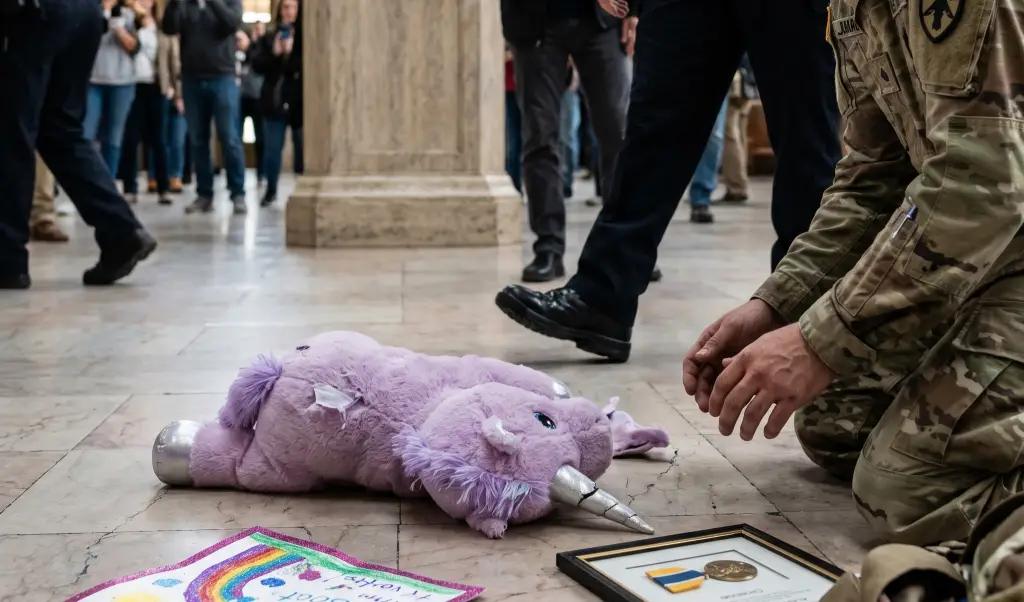
The lavender toy lay on the marble floor inches from his face.
One plastic eye stared at him sideways. The silver horn, the part Maisie would have touched first, bent under Officer Kyle Mercer’s boot until the seam split and white stuffing showed through.
Jonah did not move.
His right cheek pressed against the cold floor. His shoulder burned where another officer had twisted his arms behind him. The station smelled like wet wool, burnt coffee, floor cleaner, and the sticky soda spreading toward the edge of his medal citation. Around him, people held up their phones with the careful distance of strangers who wanted proof but not responsibility.
Only one man in the crowd was filming differently.
He stood near a marble column beneath the old brass clock, tall and still in a charcoal overcoat, his silver hair cut short, his phone held low against his chest. He did not shift for a better angle. He did not whisper. He recorded as if he was collecting evidence, not entertainment.
The officers had not noticed him yet.
Jonah had noticed almost nothing except the toy.
Less than half an hour earlier, the unicorn had still been wrapped in a clean gray hoodie at the bottom of his rucksack. He had carried it through three airports, two Army processing centers, and the last numb train ride from Washington, D.C. He had slept with one boot hooked through the strap of the bag because after fourteen months overseas, his body still believed anything precious had to be guarded.
The toy had survived dust, cargo holds, bad coffee, and a night when the roof of an aid station shook so hard the lights swung for ten minutes after the blast. Jonah had bought it at a tiny exchange near the edge of a base where most shelves held protein bars, socks, razors, and things nobody really wanted. The unicorn had been jammed behind a stack of travel pillows, absurdly clean and soft, like it had wandered into the wrong world.
He bought it because Maisie loved unicorns.
He bought it because she had turned seven while he was gone, and video calls were a cruel way to watch a child grow. On her birthday, the screen had frozen right as she leaned toward the candles. When the call came back, smoke drifted above the cake and Claire was clapping, but Jonah had missed the wish.
He had missed the first day of second grade too. He had missed the school concert where Claire said Maisie sang every word half a beat ahead of the other children. He had missed the loose tooth, the new freckles across her nose, and the way she had begun signing her drawings with a crooked M instead of asking her mother to write her name.
On the train that evening, his phone had lit up with Claire’s message.
She is trying so hard to stay awake, Claire wrote. There is a welcome-home poster on the wall. I need you to know there is purple glitter on the couch, the carpet, and somehow on Pancake. The cat looks expensive and offended. Are you still on time?
Jonah smiled at the screen until his throat tightened.
On time, he typed back. Tell her I’m ready for glitter. I love you both.
He watched the delivered mark appear and let himself imagine the apartment: Claire in one of his old sweatshirts, Maisie on the couch fighting sleep, Pancake blinking from the windowsill with sparkles in his fur. He imagined setting the rucksack down, pretending to look for something, then pulling out the lavender unicorn and watching his daughter’s face change.
That was the picture he held in his mind when the train eased into Brookhaven.
The station was old in the way American cities sometimes preserve beauty by accident. High arched windows reflected rows of lights. Brass railings ran along the stairs. The floors had been polished by a century of shoes. Jonah stepped from the train with his rucksack over one shoulder, his dress uniform wrinkled from travel, his body heavy from the kind of exhaustion that made sounds arrive a second late.
He did not know Sergeant Denny Larkin was watching him from beside the central columns.
Larkin had a thick neck, a shaved head, and the practiced slouch of a man who liked being underestimated until he decided not to be. His uniform fit too tight across the shoulders. His badge had scratches near the edge. He stood with Officers Brett Nolan and Kyle Mercer, all three of them half-bored and half-hungry for something to break the monotony of the late train shift.
Jonah crossed the concourse toward the taxi doors.
Larkin’s eyes moved over the uniform, the airborne patch, the combat medic badge, the rucksack. For a second, something flickered across his face that did not belong to a routine stop. It was recognition, but not of Jonah himself.
Recognition of a patch.
“Well,” Larkin said to the two officers beside him, “look what walked in.”
Nolan turned. Mercer followed the direction of Larkin’s stare and grinned. “You want him?”
“I want the bag,” Larkin said.
They stepped out before Jonah reached the doors, spreading just enough to close the path.
“Evening,” Larkin said. “ID.”
Jonah stopped. His body registered the positions first: one in front, one left, one right, exits behind them, crowd around them, hands near belts. His mind arrived a moment later with the voice he had repeated to younger soldiers for years.
Slow hands. Calm voice. Make no sudden moves.
“Good evening, Sergeant,” Jonah said. “Is there a problem?”
“ID,” Larkin repeated.
Jonah reached into his breast pocket and removed his military ID and driver’s license. “Staff Sergeant Jonah Reed. U.S. Army. I just got in from D.C. I’m headed home.”
Larkin pinched the ID between two fingers and looked at it as if someone had handed him a dirty napkin. He compared the photograph to Jonah’s face, then tilted it toward Nolan.
“You buy this online?”
Jonah blinked. “No.”
“You sure?” Larkin raised his voice a little, and a few people near the coffee stand turned. “Because we get plenty of guys in here wearing surplus-store uniforms, acting like the rules don’t apply.”
Jonah looked at Nolan, then Mercer, hoping one of them would let the moment become ordinary again. Neither did. Nolan rocked back on his heels with a smile he did not bother to hide. Mercer watched Jonah’s bag.
“You can call it in,” Jonah said. “I’ll wait. But my family is expecting me, so I’d appreciate—”
Larkin let the military ID fall.
It landed face down on the marble and slid through a wet streak of melted snow near Jonah’s boot.
Jonah stared at it.
For one short second, he was not in a station. He was crouched beside an overturned vehicle with smoke cutting the air and somebody’s blood slipping through his fingers no matter how hard he pressed. He heard a young lieutenant trying to breathe through pain. He heard himself shouting, “Stay with me. Look at me. I’m not letting go.”
Then he was back under the brass clock, with three officers watching to see whether he would break.
“Pick it up,” Jonah said.
His voice was low, and the softness of it made Nolan’s smile fade.
Larkin stepped closer. “What did you say?”
“I said pick it up.”
The crowd tightened. Someone whispered, “Oh no.” A woman near the ticket machines lifted her phone. A teenage boy stopped chewing and started recording with both hands.
Larkin smiled again, but this time it looked more deliberate. “Bag on the floor.”
“You don’t have consent to search my bag.”
“Listen to him.” Larkin looked around as if the crowd belonged to him. “One YouTube lawyer video and now he knows the Constitution.”
Jonah held still. “Sergeant, I am not refusing to cooperate. I’m asking you to follow procedure.”
The word procedure made something harden in Larkin’s eyes.
“Bag,” he said. “Floor. Now.”
Jonah thought of Claire waiting by the apartment door. He thought of Maisie asleep on the couch with marker on her fingers. He thought of the unicorn wrapped safely at the bottom of the rucksack.
He lowered the bag.
Mercer grabbed it before Jonah could unzip it. He yanked the top flap so hard the zipper tore loose from the seam. Jonah’s hand moved an inch before he forced it to stop. The sound of ripping fabric seemed to please Larkin.
Mercer flipped the rucksack upside down.
Jonah’s life spilled across the station floor.
A rolled fleece. Socks. A shaving kit. Wet wipes. A paperback Claire had mailed him six months earlier. Two tourniquets he carried because habit was stronger than geography. A folded drawing Maisie had made of the three of them standing under a purple sun. A waterproof folder slid out last and slapped open in a puddle of brown soda.
The Bronze Star citation inside began to soak at the corner.
Then the unicorn rolled free.
It tumbled once, absurdly gentle in all that harsh light, and came to rest beside Mercer’s boot.
Jonah forgot the crowd. “Please,” he said, and the word scraped his throat. “That’s for my daughter.”
Mercer looked down at the toy. He looked back at Jonah. Then he lifted his boot and placed it over the silver horn.
The crack came next.
A woman gasped. Someone cursed under his breath. The phones stayed raised.
“Oops,” Mercer said.
Jonah’s hands curled.
He had been trained to stop bleeding, open airways, move bodies, carry weight, and keep working when the first solution failed. He also knew how to hurt a man. Every soldier who survived long enough learned that violence lived closer to the surface than civilians wanted to believe. His body knew the distance between himself and Mercer’s knee, Larkin’s throat, Nolan’s wrist.
But his daughter was waiting for him.
If he moved, they would call it assault. If he reached for his phone, they would say he reached for a weapon. If he tried to walk away, they would put him on the floor and write the report afterward.
Larkin saw the calculation pass through Jonah’s face. Satisfaction moved over him like warmth.
“On your knees,” he said.
Jonah lowered himself to the marble.
His knees hit hard enough that pain shot up through both thighs. He laced his fingers behind his head because he knew what they wanted, and he would not give it to them. The station swam at the edges of his vision.
“Face down,” Larkin ordered.
Jonah did not move fast enough for him.
A boot struck the back of Jonah’s knee, and the floor came up cold and bright. His cheek hit first. Breath left his chest in a sharp sound. Nolan wrenched his arm back, and something in Jonah’s shoulder flared white-hot, but he kept his mouth shut.
The unicorn lay close enough that he could see a thread lifting from its ear.
Across the concourse, the silver-haired man near the column lowered his phone just enough to check that the recording was still running. His face had changed. The calm remained, but beneath it was an anger so controlled it looked almost peaceful.
Major General Robert Hale had almost approached Jonah on the train.
He had seen him boarding in Washington. At first, he noticed only the patch; then the name tape; then the tired set of the man’s shoulders. Hale knew exhaustion when it sat in a soldier’s bones. He also knew Jonah Reed.
He knew the medic who had crawled into a burning vehicle four months earlier and held a torn artery closed with his bare hands until rescue crews could cut a young officer free.
He knew the medal citation now lying in soda on the marble.
Most of all, he knew the young officer Jonah had saved.
Hale had stayed back on the train because gratitude could be a burden when a man was just trying to get home. He had intended to speak quietly at the platform, perhaps shake Jonah’s hand and ask after his family. Then he saw Larkin step into Jonah’s path, and years of command told him to watch before he moved.
Now he had enough.
He slipped the phone into his coat pocket with the camera still recording and walked toward the three officers. His steps were unhurried. People shifted out of his way without understanding why.
Larkin was circling Jonah like he owned both the uniform and the floor beneath it. “You boys come back and think the whole country owes you a parade,” he said. “Down here, you’re just another problem in a costume.”
Hale stopped behind him.
“Sergeant,” he said.
Larkin turned halfway, irritated. “Back up. Police business.”
Hale did not back up. He looked past Larkin to Jonah, then to the crushed unicorn, then to the wet citation open on the floor.
When he spoke again, every phone in the circle caught the sentence clearly. “Take your boot off that child’s toy, and take your hands off my soldier…”
To read the rest of the story – CLICK the NEXT button 👇👇👇