


The sound was so thin that Dan Mercer almost missed it beneath the hum of the heaters. He had opened the primate house at Cedar Ridge Wildlife Park for thirty-two years, long enough to know the morning noises by order and pitch. The low coughs from the older males. The quick warning barks when a keeper’s boots struck the concrete too fast. The rustle of straw, the scrape of bowls, the irritated chatter of animals who believed breakfast should have arrived ten minutes earlier. This sound was different.
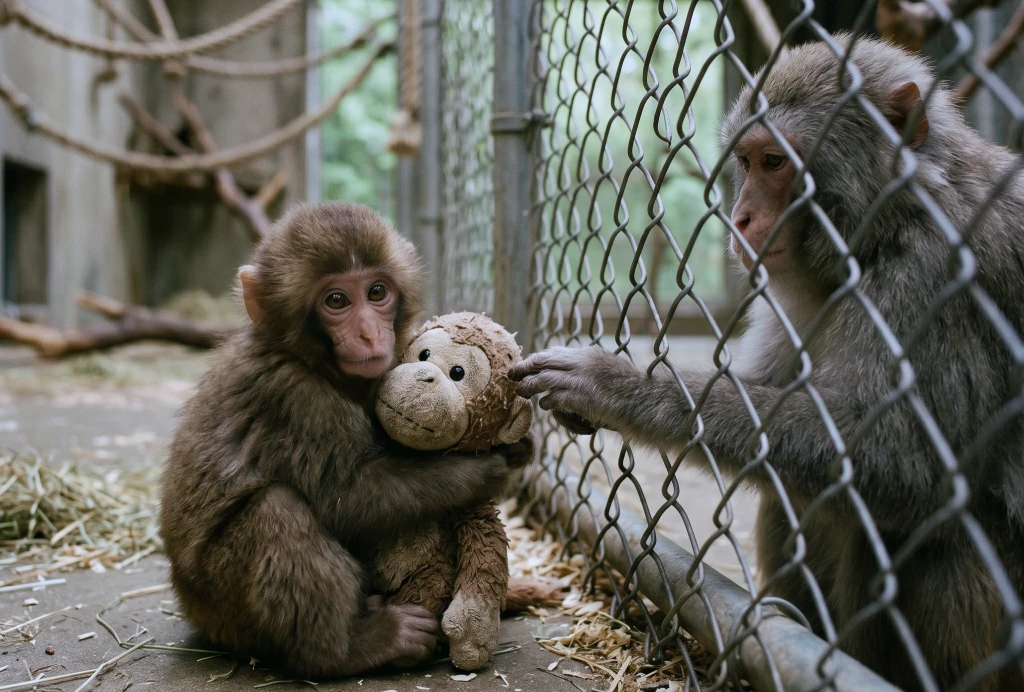
It came from the far corner of the Japanese macaque enclosure, where the concrete held the night’s cold longer than the rest of the room. Dan stopped with one hand on the latch and listened again. A small, broken squeak rose and faded, then came again, weaker the second time.
“Oh, no,” he said under his breath.
He moved slowly at first, because sudden movement in a primate house could turn one problem into three. Roxy, the young female who had delivered sometime before dawn, sat on the opposite side of the enclosure with her back against a climbing log. Her arms were folded close to her chest. Her dark eyes flicked toward Dan, then away.
The baby was not with her.
He was curled near the wall, no bigger than a doubled pair of work gloves, his skin still creased from birth, his fur damp in thin patches. His fingers opened and closed against nothing. Every few seconds he lifted his head as if searching for a body that should have been there.
Dan radioed before he touched the gate.
“Primate nursery,” he said, keeping his voice even. “I need Dr. Shah in macaques. Newborn rejected. Hypothermia risk.”
There was a burst of static, then a woman’s voice. “I’m on my way.”
Dan waited only long enough to make sure the shift door was secure. Roxy watched him enter but did not come forward. She was young, a first-time mother, and there was no anger in her face that Dan could read. Only tension. Fear, maybe. Confusion. The hard blankness that sometimes came over an animal when instinct failed to arrive on time.
“It’s all right, girl,” he murmured. “Nobody’s taking anything from you.”
But the baby was already alone.
Dan lifted him with a warmed fleece towel from the emergency bin and felt almost no weight at all. The little body fit inside his palm and wrist. One black hand caught the cuff of his work shirt, clinging with a force that made Dan close his eyes for half a second.
He had not planned to name him. Keepers were told not to do that too quickly, especially with newborns who might not survive the first day. Names made paperwork harder. Names made loss heavier. Dan knew that better than most.
Still, when the baby’s mouth opened against the towel and made that small, indignant sound again, Dan heard himself whisper, “Hang on, Pip.”
Dr. Priya Shah came in with her hair twisted up, her coat half-buttoned, and a transport warmer already in her hands. She did not waste time with comfort. She checked temperature, gum color, reflex, breathing. She gave quick orders to Maya Reynolds, the new junior keeper who had been assigned to primates only six weeks earlier and now stood at the gate with wide, focused eyes.
“Warm formula. Scale. Nursery log. Tell Grant I need the small incubator powered now.”
Maya nodded and ran.
Dan kept the towel cupped around the baby as Dr. Shah worked. Roxy stayed where she was, scratching at the log with one hand. Once, the infant squeaked loudly enough that she turned her head. For one second, Dan thought she might come. Her shoulders shifted. Her gaze sharpened.
Then one of the older females barked from above, and Roxy flinched away.
Dr. Shah saw it too. “She’s overwhelmed.”
“She hasn’t touched him?”
“Doesn’t look like it.” Priya slid the stethoscope under the towel, her mouth tightening as she listened. “He’s cold, but he’s fighting.”
That was how the first day began: with a rejected baby in a warmed plastic box, a mother who would not retrieve him, and Dan Mercer standing in the nursery long after his shift ended because the infant’s hand kept closing whenever he tried to step away.
By noon, the staff knew the baby’s odds were uncertain. By evening, Pip had taken half an ounce of formula from a tiny nipple and fallen asleep pressed against a rolled towel meant to imitate the curve of a body. By midnight, Dan was still there, sitting in the chair by the incubator, writing times and temperatures in the nursery log with handwriting that grew worse each hour.
At 2:40 a.m., Ellen Mercer called him.
“Tell me you’re not still at the park,” she said.
Dan looked at the baby through the clear side of the incubator. Pip’s fingers twitched against the towel as if he were climbing in a dream.
“I’m still at the park.”
Ellen exhaled. After forty years of marriage, she could put a full argument into one breath. “Dan.”
“He wouldn’t settle for the night crew.”
“Did they say that, or did you decide it for them?”
He rubbed at the bridge of his nose. “Both.”
There was a pause. He could picture her in their kitchen, barefoot on the tile, one hand on the old wall phone she refused to replace because it still worked. Their three children were grown now. The house was quieter than it had ever been, and Ellen had learned to sleep through Dan’s early alarms, late calls, and animal emergencies. She had not learned to stop worrying about the way he carried them home inside himself.
“You can’t do this again,” she said, softer now.
Dan knew which one she meant. Milo. A capuchin infant from eleven years earlier. Too weak, too young, pushed too fast because the team had believed the troop would adjust. Dan had signed off on the plan. He still kept the old photo in the back of his locker, turned face down behind spare gloves.
“This one’s not Milo,” he said.
“No,” Ellen replied. “But you’re still you.”
Pip survived the first night.
Then the second.
By the end of the first week, the nursery schedule had become a kind of shared madness. Dan took the worst hours without being asked. Maya learned to mix formula with the exact motion Dr. Shah preferred, rolling the bottle between her hands instead of shaking it. Ellen began sending Dan to work with thermoses of coffee and containers of soup, pretending not to notice when he came home with formula stains on his sleeves.
On the eighth night, she showed up at Cedar Ridge herself with a grocery bag and a look that dared him to comment.
“You forgot dinner,” she said.
“I ate.”
“A vending machine cracker doesn’t count.”
She set the bag on the nursery counter, then looked into the incubator. Pip was awake, his face turned toward the sound of her voice. He blinked slowly, then reached one hand toward the clear wall.
Ellen’s expression changed before she could stop it.
“He’s smaller than I thought,” she said.
“He’s bigger than he was.”
“That’s not the same thing.”
“No,” Dan said. “It isn’t.”
She watched while he fed the baby. Pip clung to Dan’s thumb with one hand and the bottle with the other, his whole body working for each swallow. When the formula was gone, Dan tucked him against the rolled towel and waited for the restless movements to slow.
Ellen leaned her shoulder against the counter. “You named him.”
“The staff did.”
“Daniel.”
He looked down. “Pip.”
She tried not to smile and failed. “Of course you did.”
For six weeks, Pip grew in ounces, then in confidence. He learned the sound of Dan’s boots. He learned to grip the front of Dan’s fleece vest during supervised nursery handling, pressing his narrow chest against the place where a mother’s warmth should have been. He learned to make a sharp little complaint when the bottle was late and a satisfied clicking sound when Maya scratched gently between his shoulders.
Visitors never saw those nights. They saw only a small note on the primate house door: New infant under veterinary care. Thank you for giving our staff space. They did not see Dan warming towels in the dryer or Maya falling asleep with the nursery log open on her lap. They did not see Dr. Shah weigh Pip every morning and let herself smile only after the number rose.
At nine weeks, Pip began trying to climb Dan.
At eleven weeks, he stole a grape from a training bowl and looked so surprised by his own success that Maya laughed loud enough to startle two tamarins down the hall.
At twelve weeks, Dr. Grant Whitaker called a meeting.
The director of Cedar Ridge had the kind of careful voice that made disagreement feel childish before it was spoken. He was not cruel. That was part of what made him difficult. Grant loved the park in the way administrators loved institutions: through budgets, accreditation reports, safety plans, and the belief that one emotional exception could become tomorrow’s dangerous precedent.
“He’s healthy enough to begin troop integration,” Grant said, folding his hands on the conference table.
Dan did not answer right away. Through the small office window, he could see part of the outdoor macaque habitat. The trees had gone gold around the edges, and two juveniles chased each other across the rope bridge.
“He isn’t ready,” Dan said.
Dr. Shah glanced at him but did not interrupt.
Grant’s expression stayed neutral. “He’s a macaque, Dan.”
“I know what he is.”
“Then you know he can’t be raised as a nursery animal indefinitely. The longer he bonds primarily with people, the harder this gets.”
“He doesn’t have the social skills yet. He doesn’t know how to read half the signals in that group.”
“That’s why we start slowly.”
Dan leaned back, jaw working. “Roxy still won’t approach him.”
“Roxy doesn’t have to be the solution,” Grant said. “The troop does.”
Maya, seated near the wall with a notebook in her lap, looked up. “What if the troop rejects him too?”
Grant turned to her. His tone was not unkind, but it reminded everyone that she was the newest person in the room. “Then we adjust. But we don’t decide he has failed before we give the species-appropriate plan a chance.”
Species-appropriate. Dan hated the phrase because it was true.
The first introduction was scheduled for a quiet Tuesday morning before the park opened. They used the side yard, not the main habitat, and kept the shift door ready. Roxy was there, along with two younger females and a mid-ranking male named Jasper who usually tolerated juveniles as long as they kept out of his food.
Pip rode into the introduction crate clinging to the towel from the nursery. Dan crouched beside him, two fingers through the mesh.
“You don’t have to be brave all at once,” he said.
Maya stood behind him with the checklist. Dr. Shah watched from the observation window, one hand near the radio at her shoulder. Grant stood farther back, his face unreadable.
When the crate door opened, Pip did not move. He blinked into the yard, then made a soft contact call. No one answered.
Roxy looked at him and looked away.
Dan felt Maya shift beside him.
Pip stepped out. The towel dragged behind him. He took three uncertain steps toward the nearest female, lifting one hand in a small, hopeful reach. She bared her teeth and shoved him away before he touched her.
The movement was not hard enough to injure him. It was hard enough to tell him he had no place there.
Pip scrambled back, tripped over the towel, and cried out. Jasper barked from the rope perch. Another female lunged just close enough to send Pip racing toward the far corner, where he pressed himself against the wall and made a sound Dan had not heard since the first morning.
Dan was already moving.
“Pull him,” he said.
Grant lifted a hand. “Give them a minute.”
“He’s terrified.”
“They’re establishing distance.”
“They’re rejecting him.”
The words came out sharper than Dan intended. Dr. Shah looked from Pip to the group and then to Grant. A second later, Jasper dropped from the perch and crossed the yard too quickly. Pip froze.
“Now,” Priya said.
Maya opened the shift panel. Dan reached through the access point with the towel, and Pip launched toward it as if the cloth itself had called him. He clung to Dan’s sleeve through the mesh, shaking so hard the fabric trembled.
Grant said nothing for a long moment. Then he closed his folder.
“We’ll reassess tomorrow.”
Dan did not trust himself to answer.
That afternoon, Pip stayed in the holding area beside the main habitat, separated from the troop by mesh. He would not eat. He would not take the enrichment ball Maya rolled toward him. He sat with the nursery towel pulled against his chest, his eyes tracking every movement of the animals on the other side.
Near closing, Dan returned alone to check the latch and found someone watching from the neighboring enclosure.
Hazel, the oldest female macaque at Cedar Ridge, stood at the far side of her yard with both hands wrapped around the wire. She had lived alone for nearly four years because every attempt to pair her had ended in screaming, lunging, or bloodless but unmistakable warnings. Her gray muzzle pressed close to the mesh now, and her eyes were fixed not on Dan, not on the food cart, but on the baby trembling in the corner.
Pip made one thin sound.
Hazel did not bark. She did not bare her teeth. She lifted one hand from the wire and extended her fingers toward the space between them, slowly, as if reaching for something she was afraid might vanish. Dan stopped breathing for a beat. Because Hazel had not reached for another living thing in years…
To read the rest of the story – CLICK the NEXT button 👇👇👇