


Leah Avery had been married for less than four hours when her father-in-law locked her bedroom door from the inside and threw forty thousand dollars onto the writing desk. Eight tight bank-wrapped stacks landed one after another beside the little vase of white roses from the reception. Frank Avery did not look at the money. He went straight to the window, lifted the curtain with two fingers, and stared down into the dark yard as if he expected it to stare back.
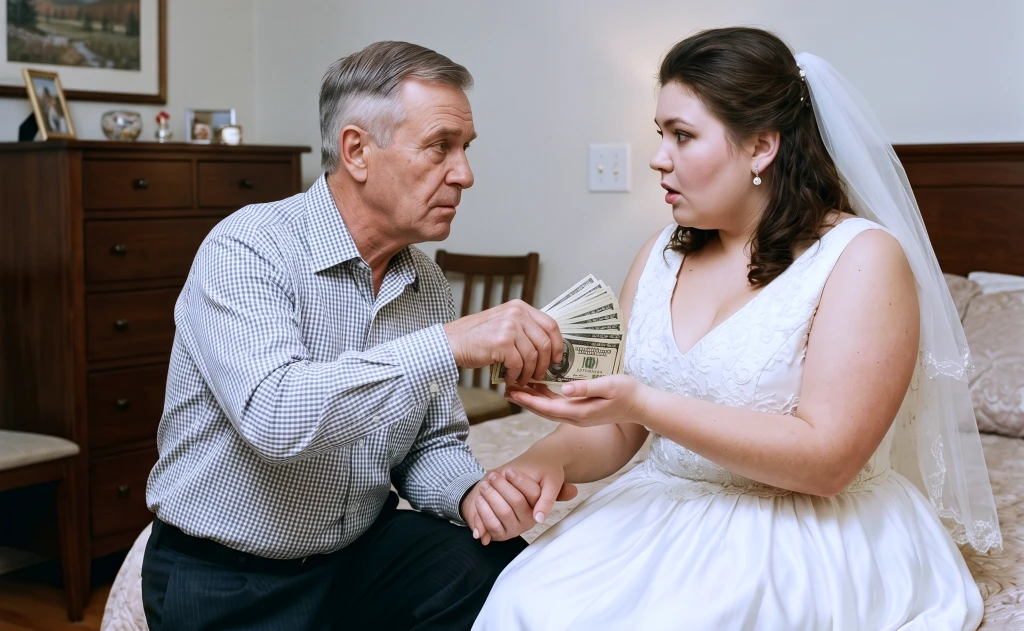
Leah stood barefoot beside the bed, half out of her wedding dress, the pearl buttons still undone down her spine. She had been smiling when the door opened. She thought Noah had finally come upstairs after walking his last aunt to her car.
But Noah was not in the doorway.
Frank was.
He was sixty-four, broad through the shoulders, with silver hair cut close and hands that looked more suited to fence posts and engine blocks than flower arrangements and champagne glasses. All day he had moved through the wedding quietly, shaking hands, checking on the caterers, telling Leah twice that she looked beautiful without making it sound like a performance.
Now his face had gone the color of old paper.
“Put on real clothes,” he said. His voice was low, but there was nothing gentle in it. “Jeans. Hoodie. Sneakers. Bottom drawer of the dresser. Don’t ask me why.”
Leah pulled the loose front of her dress against herself. “Frank, what’s going on?”
He turned the key again, as if one lock were not enough. Then he crossed the room, took a canvas shoulder bag from behind the chair, and set it beside the cash. “Your ID is in there. Your Social Security card. Your marriage certificate. The burner phone stays off unless Earl tells you otherwise.”
“Earl?” The name meant nothing to her. “Where’s Noah?”
Frank looked back at the window. Outside, beyond the big white tent sagging in the grass and the strings of café lights still glowing over empty tables, tires crunched over the gravel drive.
Not one car.
Several.
Leah felt the sound move through her body before she understood it. The reception had ended after midnight. The last guests were gone. No one should have been arriving now.
Frank dropped the curtain. “They’re here.”
“Who’s here?”
“Listen to me.” He came toward her so quickly she stepped back, but he stopped before he frightened her more than he already had. “You go down the back stairs. Through the pantry. Out the mudroom door. Cross the vegetable garden. There’s a gate behind the shed. Earl Tate will be waiting past the tree line in an old blue pickup.”
“You’re scaring me.”
“Good,” he said, and his jaw tightened. “Then maybe you’ll move fast enough.”
For one wild second, Leah wondered if this was some terrible family tradition, some cruel joke played on new brides by men who had drunk too much bourbon and watched too many old movies. But Frank Avery was not laughing. His eyes were the same clear gray as Noah’s, and they were full of a fear so old and deep it made her own panic feel almost childish.
Downstairs, a door opened. Male voices rolled through the house, not loud enough to make out words, but hard enough to raise the hair on her arms.
“Frank.” She heard the shake in her voice and hated it. “Tell me where my husband is.”
“I can’t tell you everything. Not tonight.” He grabbed the hoodie from the drawer himself and shoved it into her hands. “Noah would have come if he could. I need you to believe that much.”
“If he could?”
“Leah.” Frank’s voice broke on her name. He looked toward the hallway, then back at her. “You grew up without anyone standing between you and the world. I know that. But tonight I’m standing there. Let me.”
That landed harder than the money, harder than the locked door, harder than the voices below. Leah had spent childhood learning not to expect protection. First in a county group home outside Toledo, then in the Morgans’ neat little house where she had been fed, clothed, and reminded often that gratitude was easier to live with than need. She had met Noah at twenty-five and married him at twenty-seven, still suspicious of easy kindness.
Frank had never asked her to explain that suspicion. He had simply made room for it.
A heavy fist struck the front door downstairs.
“Mr. Avery,” a man called. “Open up. We know she’s here.”
Leah stopped breathing.
Frank did not.
He moved like a man who had rehearsed this moment in his mind so many times that panic could not slow him. He turned away while she stripped out of the dress and pulled on the jeans with shaking hands. The hoodie smelled faintly of cedar and motor oil. The sneakers were too big, but she shoved her feet into them anyway.
“Take the money,” he said.
“I can’t take this.”
“You can and you will.”
“What about you?”
He looked at her then, and whatever argument she had left died in her throat. “I’ve had more life than you have. Don’t waste time trying to make that fair.”
The voices downstairs grew sharper. A crash sounded from the entry hall, glass or porcelain breaking against hardwood. Leah flinched, but Frank only pressed the canvas bag against her chest and closed her fingers around the strap.
At the bedroom door, he paused with his hand on the key. For the first time since he had entered, his face softened.
“If you hear something behind you,” he said, “don’t turn around. Not for me. Not for Noah. Not for anything.”
Leah’s eyes burned. “Frank, please.”
He opened the door just wide enough to check the hall. “Run, sweetheart.”
The back stairs were narrow and steep, built for staff long before the Avery farmhouse had been renovated into the kind of place that could host a hundred guests under a rented tent. Frank went first, his big body almost silent on the steps. Leah followed with the bag banging against her hip and the loose laces of her sneakers slapping the floor.
At the bottom, the pantry smelled of apples, cardboard, and the wedding cake nobody had remembered to put away. Frank shoved aside a stack of folding chairs and opened a low service door that led into the August night.
The garden beyond was black and wet with dew.
“Straight through,” he whispered. “Past the tomatoes, past the shed, gate on the left. Earl knows where to take you.”
Leah caught his sleeve. “Come with me.”
For half a second, he let himself look like he wanted to. Then he covered her hand with his, rough palm over cold fingers, and squeezed once.
“If I go, they chase. If I stay, they search the house first.” He leaned close enough that she could smell the coffee on his breath from hours earlier. “You are not the wrong person in the wrong place. Remember that when the truth starts hurting.”
Before she could ask what he meant, Frank pushed her through the service door and closed it behind her.
Leah ran.
She ran through the vegetable rows, crushing basil and mint under her borrowed sneakers. Tomato stakes caught at her hoodie. Wet leaves slapped her ankles. Behind her, inside the house where she had danced with Noah only hours earlier, men shouted Frank’s name.
She did not turn around.
At the back fence, her hands fumbled over the latch until one fingernail tore and pain shot up her finger. She bit down on a sound, yanked the gate open, and stumbled onto a narrow dirt road bordered by dark fields. Twenty yards away, an old blue Ford sat with its lights off.
A man in a ball cap stood beside it, smoking.
“Leah Avery?” he asked.
She almost said Morgan. Then she looked down at the ring on her hand. “Yes.”
“Get in.”
The truck started rolling before her door was fully shut. The man—Earl Tate, she guessed—drove without headlights until the farmhouse had disappeared behind them. Only when they reached a paved county road did he switch them on, and the sudden wash of light over the pavement made Leah blink like she had surfaced from underwater.
She twisted around in the seat.
Far behind them, the Avery house glowed room by room. Upstairs windows lit, then the porch, then the kitchen. More headlights turned into the drive, bright and patient and wrong.
“Don’t watch,” Earl said.
“That’s my husband’s home.”
“That’s why you shouldn’t watch.”
Leah faced forward, clutching the canvas bag so hard the strap dug into her palm. The white manicure from the wedding looked absurd now, chipped and streaked with dirt. “Who are those men?”
“Bad men.”
She laughed once, sharp and humorless. “That’s not an answer.”
“It’s the only one I’ve got permission to give.”
“I just ran from my own wedding night through a garden with forty thousand dollars in a bag. I think I’ve earned more than permission.”
Earl kept both hands on the wheel. He was not young, but he was not old either, a compact man with a weathered face and the calm of somebody who had seen trouble up close and learned not to waste words around it.
“Frank said to get you safe,” he said. “That’s my part.”
“And Noah?”
Earl’s mouth moved, not quite a grimace. “I don’t know.”
The answer was worse because she believed it.
They drove for more than an hour through rural Ohio roads that looked the same in the dark: cornfields, mailboxes, barns, the occasional gas station closed for the night. Leah’s phone was gone. Her purse was gone. Her wedding dress was lying on a bedroom floor in a house full of strangers.
Her husband might be alive.
Her husband might not be.
Earl finally turned down a gravel lane so overgrown that branches brushed both sides of the truck. At the end stood a little white farmhouse with peeling paint, a sagging porch, and one kitchen window glowing yellow behind lace curtains.
A woman opened the door before Earl knocked.
She was in her late sixties, round-faced, with gray hair twisted into a knot and a cardigan buttoned crooked over a nightgown. She looked Leah over once, taking in the oversized hoodie, the dirty sneakers, the smeared bridal makeup.
“Oh, honey,” she said softly. “Come in before you fall down.”
Her name was Ruth Bell. She made tea without asking whether Leah wanted it and set a plate of toast in front of her with butter melting into the corners. Leah tried to say she could not eat. Ruth told her she did not have to want food for her body to need it.
That was when Leah started crying.
Not prettily. Not the delicate kind of crying brides were supposed to do during toasts and father-daughter dances. She folded over the kitchen table and cried until her ribs hurt, until mascara and dirt streaked her hands, until Ruth sat beside her and rubbed slow circles between her shoulders.
“I don’t know what I did,” Leah whispered.
Ruth’s hand paused only for a moment. “You lived. That’s all you did tonight.”
Near dawn, Earl’s phone rang.
He answered in the mudroom, but the house was too small to keep his voice hidden. Leah heard only pieces at first—when, how many, no, don’t call this number again. Then Earl came back into the kitchen, and one look at his face made Ruth lower herself into the nearest chair.
“They took Frank,” Earl said.
Leah stood so fast the chair legs screamed against the floor. “Took him where?”
“I don’t know.”
“Is he alive?”
“For now.”
The room tilted. Leah put one hand on the table to steady herself. “This happened because he helped me.”
“This happened because men like that don’t forgive anybody who says no.”
Leah reached for the canvas bag. She needed something to do with her hands before fear tore her open from the inside. She dumped the contents on the table: her documents, the cash, a cheap prepaid phone, a folded sweatshirt, a small bottle of water, and a county map marked with pencil circles.
Earl stared at the bag instead of the money.
“Did you check the inside pocket?” he asked.
Leah looked at him. “What inside pocket?”
He nodded toward the lining. “Frank said you might miss it.”
Her fingers found a zipper hidden in the seam. Inside was a flat envelope she had not felt before, sealed and unmarked except for her first name written across the front in black ink.
Leah.
She knew the handwriting. Frank had written the place cards for the rehearsal dinner himself because he hated paying people to do things he could still do with his own hands.
She opened the envelope carefully, but her fingers shook so badly she tore the corner of the page inside. The letter had been ripped from a yellow legal pad and folded twice. The first word stopped her cold. Daughter…
To read the rest of the story – CLICK the NEXT button 👇👇👇