


The first time anyone at Ridgeway Junction tried to move the black dog, she stepped over the yellow safety line and sat down facing the tracks. The 6:17 from Pittsburgh was already coming in. Ray Coleman, the station security guard, had been carrying a folded blanket in one hand and half a turkey sandwich in the other, talking to her the way people talk to frightened animals and small children. Easy now. Come on, girl. Let’s not do this today. The dog had watched him from beside the third bench on Track Three, her ears pinned just enough to warn him, her white chest marking bright against the wet October platform. Then the horn sounded…
The dog turned before anyone else did. She moved toward the tracks with a suddenness that made Linda Marsh drop the roll of tickets she had been counting inside the booth.
“Ray,” Linda shouted through the glass.
He reached for the dog, and she slipped away from him, not running, not barking, just walking straight to the painted line as if the arriving train had called her by name. Wind shoved loose newspapers down the platform. The rails began to hum. Ray stopped three feet behind her because he knew a bite warning when he heard one, and the low sound in her throat was not rage.
It was a plea to leave her where she was.
The train slowed with a metallic shriek, brakes sighing, doors sliding open one by one. People stepped down with backpacks, coffee cups, tired faces, phones pressed to ears. The dog rose on her toes and searched each person as if she had a list in her head and was checking it carefully. Men in work jackets. A college girl with a suitcase. An old couple holding hands. A father carrying a sleeping child.
Her body tightened at every opening door, then folded in on itself when the last passenger walked past.
When the train pulled away, she returned to the third bench and crawled underneath it.
That was how everyone at Ridgeway Junction learned the rule. The dog could be fed, spoken to, and watched over from a distance. Nobody touched her. Nobody moved her. And at 6:17 every evening, no matter how cold it was or how hard the rain came down, she would leave the shelter of the bench and look for someone who never stepped off the train.
By the fourth day, she belonged to the station in the sad, unofficial way lost things sometimes do. Linda set a paper plate of scrambled eggs near the vending machines before the morning rush. Ray brought kibble in a plastic container his wife had labeled in black marker: For the platform girl. Denise from maintenance placed a bowl of water behind the trash can so no commuter would kick it over.
The dog accepted some of it. Not all. Never when anyone watched too closely.
“She’s waiting on somebody,” Ray said one afternoon, standing just inside the station doors while rain streaked the glass.
Linda looked out at the small black shape beneath the bench. “Or somebody made her think waiting was the only thing she had left.”
Ridgeway Junction was not a big station. Two tracks, one ticket booth, a coffee counter that closed too early, a bus bay on the east side, and a waiting room that smelled faintly of old heat and burnt coffee. By the end of the first week, everybody had an opinion. A student said the dog must have followed someone off a train. A man who sold newspapers said she had probably been dumped. Denise said no dumped dog watched doors like that.
Then the station manager taped a notice to the inside of Linda’s booth.
If the animal remains on property after Friday, county animal control must be notified.
The paper was written in ordinary office language, but Linda read it three times as if the words might soften. County animal control was not a villain. Everyone knew that. They dealt with scared dogs, loose dogs, injured dogs, dangerous dogs. But everyone also knew what happened when shelters filled up, when no foster homes answered, when a dog with a warning growl and no paperwork was called “unadoptable” before anyone learned her name.
Linda took a picture of the dog that afternoon. She had to zoom in through the ticket window because the dog did not like cameras any more than hands. The image came out grainy: black fur, narrow shoulders, white patch on the chest shaped almost like a child’s handprint. Behind her, the tracks ran silver under the gray sky.
Linda posted it in a local rescue group with one sentence.
Does anyone know who this dog belongs to? She’s been waiting at Ridgeway Junction for over a week.
Claire Bennett saw the post at 11:42 p.m., sitting at her kitchen table with a mug of tea gone cold beside a stack of unpaid vet invoices. She ran a small rescue out of a converted garage behind her house, though “ran” made it sound more organized than it was. Most days it felt like triage with dog hair on every surface.
She had three senior beagles asleep in her laundry room, a one-eyed shepherd mix recovering from surgery in the den, and a foster application she should have answered two days earlier. She was tired enough to scroll past almost anything.
But not that photograph.
There were dogs who looked lost in pictures. There were dogs who looked afraid. This one looked anchored to a place that had hurt her.
Claire read the comments. Poor baby. Someone take her home. People are monsters. Did anyone scan for a chip? Call animal control. I would take her but my lease won’t let me. The usual chorus of sympathy, anger, helplessness, and distance. Then she saw Linda’s reply buried under the thread.
She won’t let anyone near her. She comes out for the 6:17 train every evening.
Claire put the mug down.
The next morning, she drove forty-two miles to Ridgeway Junction with boiled chicken in a cooler, a slip lead in her coat pocket, and a rule she had learned the hard way: never trust the story people tell you before the animal has told you its part.
At noon, the station was quiet. A few travelers sat in the waiting room. The coffee counter was closed, its metal gate pulled halfway down. Claire spotted the dog almost immediately because every person who walked onto Track Three glanced toward the third bench, then away again, as if trying not to disturb someone grieving in public.
The dog was smaller than she had looked in the photo, maybe thirty-five pounds, with a narrow face and intelligent brown eyes. Her coat had gone dull from weather and stress. One side of her body carried stiffness Claire noticed even from a distance; she shifted weight off her left hip when she stood, then tucked herself back down.
Claire did not approach her.
She sat on the next bench over, turned slightly away, and opened her thermos. Steam rose between her hands. The dog watched her for three seconds, decided she was not useful or dangerous, and returned her gaze to the tracks.
Linda came out of the ticket booth during a lull. She wore a blue cardigan over her uniform shirt and the worried expression of someone who had already fed an animal too many times to call it “not my problem.”
“You’re Claire?” she asked quietly.
Claire nodded. “Don’t look at her while we talk.”
Linda’s eyes flicked guiltily away from the bench. “Sorry.”
“It’s all right. Everybody looks. That’s part of the problem.”
Linda lowered her voice. “They gave us until Friday.”
“I saw.”
“She hasn’t snapped at anybody. She just warns people.”
“That’s still a bite risk on paper,” Claire said. She kept her tone gentle because Linda already knew it. “Has she left the property at all?”
“Only to go behind the station at night, near the bus bays. But she comes back before morning. Always to that bench.”
“And the 6:17?”
Linda looked toward the tracks. “Every day. I’ve never seen anything like it.”
Claire had. That was the trouble. She had seen loyalty survive neglect, confusion, hunger, and pain. She had seen dogs wait outside apartments after families moved, sleep beside mailboxes, refuse to leave porches where no one had opened a door for them in weeks. People liked to call it devotion because devotion sounded beautiful. Claire had learned that sometimes it was trauma wearing a prettier word.
She stayed for two hours that first day and did almost nothing. She dropped a piece of chicken on the concrete halfway between the benches and returned to her seat. The dog ignored it until Claire looked away. Then there was the soft click of nails, the small wet sound of food disappearing, and the scrape of paws retreating.
On the second day, Claire came at the same hour. On the third, she sat through a cold drizzle that soaked her jeans and turned the dog’s fur into black spikes. The dog took chicken from the ground, then from a paper towel, then from the edge of the bench. Her eyes never softened, but her warning growl grew shorter.
On Thursday, Ray joined Claire by the station doors while the dog ate six feet away.
“She got a name yet?” he asked.
“Not one she’s given me.”
“My wife’s calling her Shadow.”
“She doesn’t look like a Shadow.”
“What does she look like?”
Claire watched the dog lick chicken from the concrete with careful dignity, as if hunger embarrassed her. “Like somebody loved her once.”
Ray was quiet for a moment. “That makes it worse.”
“It usually does.”
The 6:17 came in under a bruised purple sky. Claire stayed close enough to observe and far enough not to interfere. The dog rose from the bench before the horn sounded, body aimed toward the far end of the platform. She watched every door. When a tall man in a brown canvas jacket stepped down with a duffel bag over his shoulder, she took one sharp step forward.
The man turned toward the parking lot.
The dog’s ears fell.
Claire felt the small, private pain of witnessing hope make a mistake.
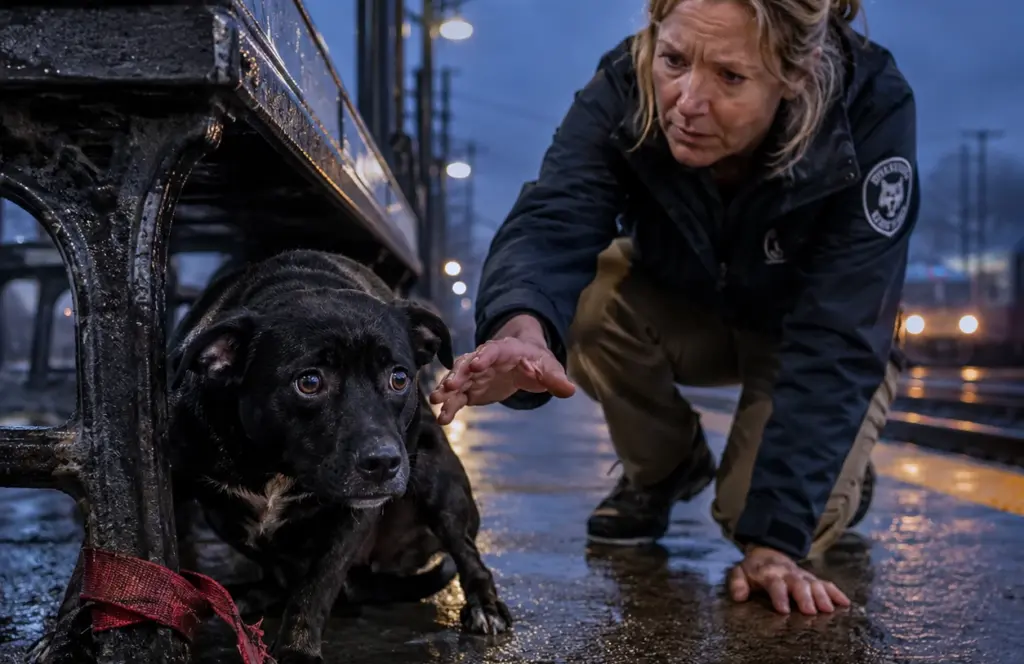
The platform emptied. Ray locked the maintenance closet. Linda shut down her booth. The dog crawled beneath the bench again, but this time Claire noticed something she had missed before. A strip of red nylon was wrapped around the back leg of the bench, half hidden by dirt and dead leaves. It had blended into the rusted metal in the dim light.
Claire waited until the dog lowered her head. Then she moved slowly off her bench and crouched.
The dog’s eyes opened.
“I see it,” Claire whispered. “That’s all. I’m not taking anything from you.”
She reached toward the red strip.
The growl came low and immediate. Not loud. Not wild. The dog pushed herself forward until her white chest covered the thing beneath the bench, and for the first time since Claire had met her, she looked away from the tracks and straight into Claire’s face. That was when Claire understood. The dog had not chosen the third bench at random. Something had happened there…
To read the rest of the story – CLICK the NEXT button 👇👇👇