


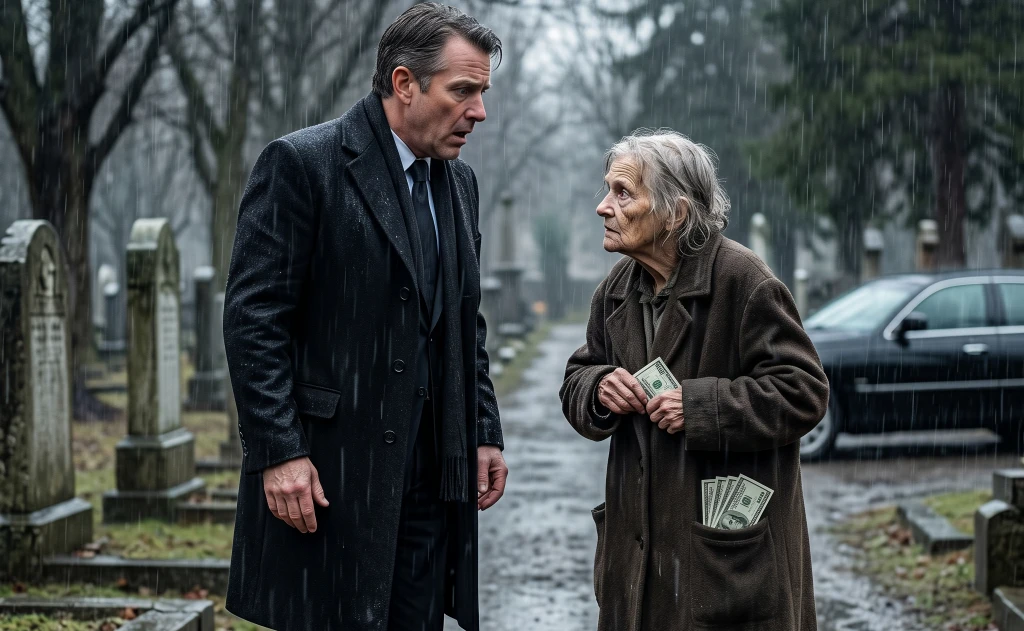
The woman at the cemetery gate waited until the last shovel of dirt hit Olivia Whitaker’s coffin. Only then did she lift her face from beneath a soaked black scarf and ask Andrew Whitaker what he planned to tell his daughter. Andrew didn’t answer at first. He was standing twenty yards away, rain sliding down the collar of his wool coat, his shoes sinking into the soft ground beside the grave where his wife had just been buried. For a moment, he thought grief had bent the words into something impossible.
Daughter.
He had buried that word long before he buried Olivia.
People were still leaving in small, careful groups. Business partners. Neighbors. Women from Olivia’s charity board. Two cousins Andrew barely recognized. They passed him with lowered voices and expensive umbrellas, touching his arm as if grief were contagious and they were brave for coming close.
“Andrew,” his driver said quietly behind him. “Car’s right up front.”
Sam had worked for him for eleven years. He knew when to speak and when to stand silently with the engine running. Andrew nodded without moving. The fresh mound of earth looked wrong with the lilies on top of it. Olivia had loved white lilies. Their house had smelled like them every Easter, every anniversary, every time she wanted to pretend spring could fix what the doctors could not.
They had been married twenty-eight years. For five of those years, cancer had slowly taken her from the inside out, leaving behind a thinner, quieter woman who still apologized when nurses had to adjust her pillows. Andrew had paid for every specialist, every trial, every flight to every clinic that offered even a cruel little sliver of hope.
Money had stretched her pain into years.
It had not saved her.
He stared at the grave and tried to remember Olivia before the hospital bed, before the scarves, before the careful smiles she gave him when he entered the room. He wanted the young woman from the lake house, the one with wind-tangled hair and a laugh that could turn heads in restaurants. Instead, his mind kept giving him the last version of her: pale, dry-lipped, asking whether he had eaten.
“Sir,” Sam said again. “You’re soaked through.”
Andrew finally turned away.
The walk to the cemetery gate felt longer than the walk behind the coffin. Rain gathered in the gravel ruts and darkened the hems of black coats. A few people lingered near the entrance, pretending they weren’t looking at him. Andrew had spent thirty years becoming the kind of man people watched from a distance. Founder of Whitaker Northline. Owner of industrial parks, freight yards, construction companies, and warehouses that stretched across half of Ohio. A man whose name appeared on hospital wings and campaign donor lists and plaques bolted into polished marble.
On that afternoon, none of it held any weight. It all felt like paper left out in the rain.
Near the gate, under the narrow shelter of an old bus stop, the woman sat with her hands folded in her lap. Andrew had noticed her earlier but had not looked closely. People came to cemeteries for many reasons. Some brought flowers. Some brought guilt. Some came because mourners were generous when their hearts had been cracked open.
She was small, maybe seventy, maybe eighty. Her coat had lost its shape years ago, and the scarf around her head was faded at the edges. A plastic grocery bag sat at her feet. Her shoes were men’s shoes, too large for her, the laces tied in hard little knots.
Andrew reached into his coat and pulled out his wallet. He didn’t count the bills. He drew out several hundreds and held them toward her.
“For my wife,” he said, his voice rough from the service. “Her name was Olivia. Say a prayer for her, if you pray.”
The woman took the money, but she did not look at it. Her fingers were thin and crooked, and they closed around the bills with surprising steadiness. Then she lifted her eyes to him.
They were pale blue, almost clear. Not cloudy with age. Sharp. Watching.
“I already said one for Olivia,” she said.
Andrew went still.
Sam, standing by the black town car with the rear door open, looked up. A gust of wind blew rain under the shelter, and the woman tucked the money somewhere inside her coat without taking her eyes off Andrew.
“You knew my wife?” Andrew asked.
“No,” she said. “Not really.”
“Then how do you know her name?”
The woman gave him a look that was almost pity. “Whole county knows her name today.”
That should have been enough. The obituary had been in the paper. The funeral arrangements had been posted online. His wife’s name was no secret. Still, something in the woman’s tone settled under his skin.
Andrew started to turn away.
That was when she said it.
“What are you going to tell your daughter?”
The rain seemed to drop harder all at once. Andrew looked back slowly. “Excuse me?”
“Your daughter,” the woman said. “When she looks at you. When she asks where you were.”
Andrew heard Sam close the car door behind him. He heard tires hissing on the road outside the cemetery wall. He heard a crow somewhere in the dripping trees. What he did not hear was his own breathing.
“I don’t have a daughter,” he said.
The woman’s mouth softened, but her eyes did not. “You do.”
“No.” The word came out too quickly. “My wife and I never had children.”
“I know.”
There was no cruelty in her voice. That made it worse.
Andrew stepped closer. “Who are you?”
The woman looked past him toward Olivia’s grave, now blurred by rain and distance. “A messenger, I suppose. Though I’m too old and tired for that kind of thing.”
“Is this about money?” Andrew asked. “Because if someone sent you—”
“Nobody sent me for money.” She tapped the front of her coat, where the bills had disappeared. “You already gave enough for the dead. This is for the living.”
Sam moved closer, his expression tight. “Mr. Whitaker?”
Andrew raised one hand without looking at him.
The woman shifted on the bench, and the plastic bag at her feet crinkled. “Andrew Michael Whitaker. Married Olivia Anne Whitaker, born Miles. Owner of Whitaker Northline, among other things. No children listed anywhere that matters to lawyers.” She paused, and her gaze returned to his face. “But blood doesn’t care what your lawyers know.”
For the first time that day, Andrew felt something colder than rain.
He had heard threats before. Real ones. Sophisticated ones. Men had tried to extort him with forged documents, fake injuries, invented business claims, hidden cameras, old photographs taken out of context. He had built an empire with a legal department sharp enough to cut bone.
But this woman did not sound like a criminal. She sounded like someone carrying a burden she had waited too long to put down.
“My wife died two days ago,” he said, each word held carefully. “I buried her ten minutes ago. If this is some kind of game, you picked a bad day.”
“I know what day I picked.”
“What do you want?”
“For you to stop pretending one night can’t follow a man for thirty years.”
The words slipped between his ribs.
A memory flickered so fast he almost rejected it before it formed: a narrow apartment hallway in summer heat, a box fan humming in a window, a young woman with fair hair standing barefoot outside his door because the power had gone out on the whole third floor. Annie. That was her name. Annie Parker. Quiet voice. Gray eyes. A laugh she tried to hide behind her hand.
Andrew had not spoken that name aloud in decades.
The woman saw the change in his face. Her own expression did not triumph. It only grew heavier.
“You remember,” she said.
Andrew swallowed. The cemetery seemed to tilt. “What do you know about Annie?”
“Enough.”
“Where is she?”
The woman’s eyes moved away.
It was a small movement, but Andrew understood it before she spoke.
“No,” he said.
“She’s gone,” the woman answered. “Eight years now.”
Andrew looked down at the wet pavement. He had known Annie for one summer. Less than that, really. A handful of hallway conversations, one dinner at a diner after they both worked late, and one night he had spent the rest of his life not examining. He had been engaged to Olivia then. Olivia had gone to Michigan to help her mother after surgery. Andrew was twenty-four, ambitious, lonely, and convinced that one betrayal could be sealed shut if he never looked at it again.
He had married Olivia in September.
He had never called Annie.
“Did she tell you I was the father?” he asked, and hated himself for how defensive it sounded.
The woman stood. She was shorter than he had expected, but the movement had dignity in it. She held the shelter pole with one hand, not because she was weak, but because the pavement was slick.
“She didn’t have to,” she said. “That girl had your face by the time she was five.”
Andrew’s throat closed.
Sam stepped beside him now. “Sir, we should go.”
Andrew ignored him. “Where is she? This woman you’re calling my daughter.”
The old woman shook her head. “Not yet.”
“Not yet?” Anger sparked through the numbness. “You come to my wife’s funeral, tell me I have a daughter, and then you decide what I’m allowed to know?”
“If I give you her address right now, you’ll do what men like you always do. You’ll show up with a check, a lawyer, and that ruined look rich men wear when guilt finally gets expensive.” Her voice did not rise, but every word struck cleanly. “She doesn’t need a rescue she didn’t ask for.”
Andrew stared at her. “Then why tell me at all?”
“Because her grandmother is dying. Because Annie carried the truth alone for too long. Because your daughter is running out of people who know where she came from.” The woman pulled the scarf tighter beneath her chin. “And because Olivia is gone now, God rest her. There’s no marriage left for the truth to hurt.”
The mention of Olivia made Andrew flinch. For years, he had believed their childlessness was the deepest sorrow in their marriage. The doctors had said Olivia could not carry a child. Andrew had watched her fold baby blankets they never used and give away christening gifts people had bought too early. He had held her after every failed treatment, every specialist’s careful apology, every mother’s day that made her quieter than usual.
Now a stranger was telling him that somewhere, while Olivia mourned children they would never have, another child had grown up with his eyes.
“Who are you?” he asked again.
The woman picked up the plastic bag. “Ruth Parker.”
The last name hit him. “Parker.”
“Annie was my niece.”
Andrew reached for the shelter pole without meaning to. The iron was cold under his palm.
Ruth looked toward the road beyond the cemetery gate, where a city bus was grinding toward the stop. “Go to Maple Ridge Care Center on the west side. Ask for Margaret Parker. Don’t send an assistant. Don’t call first. Go yourself.”
“Margaret,” he repeated.
“Annie’s mother.”
Andrew took one step after her as she moved toward the curb. “Why didn’t Annie tell me?”
Ruth stopped with her back to him. Rain ran off the edge of her scarf in thin streams.
“That’s the question, isn’t it?” she said. “But it’s not the first one you should ask.”
“What is?”
She turned then, and for the first time, Andrew saw anger beneath all that sadness. Not loud anger. Old anger, worn smooth from being held too long.
“Ask Margaret why your daughter learned to stop waiting for a father before she learned long division.”
The bus hissed to the curb. Ruth climbed aboard with her plastic bag and men’s shoes and wet scarf. Andrew stood in the rain, unable to move, as the doors folded shut.
Just before the bus pulled away, Ruth looked at him through the streaked window and lifted one hand—not a wave, not forgiveness, only a final instruction.
“April twelfth,” she mouthed through the glass.
Andrew did not understand until the bus was already disappearing through the rain. Then he heard her voice in his head again. Your daughter’s birthday…
To read the rest of the story – CLICK the NEXT button 👇👇👇