


Hank Whitaker saw the baby carrier before he saw his niece. It was sitting crooked on the back seat of his SUV, still wrapped in the tissue paper from the boutique downtown, with a tiny gray bear stitched into the headrest and a receipt he had not bothered to look at. Beside it were two bags of newborn clothes, a box of diapers, and a bouquet of white roses so large the florist had laughed and asked if he was picking up a baby or proposing to the whole maternity ward.
He was three blocks from Harrison Women’s Center when traffic slowed near the hospital entrance. Snow skated sideways across the pavement, dry and sharp in the December wind. The dashboard said twelve degrees, but inside the SUV it was warm enough that the windows had begun to fog at the edges.
Hank smiled at the roses in the passenger seat, then at his own reflection in the rearview mirror. For the first time in years, his face looked softer than he expected.
His niece had given birth to a boy.
Thomas Henry Caldwell, six pounds fourteen ounces, loud lungs, dark hair, named after Hank’s father. Claire had texted him a photo at dawn: a wrinkled pink face under a striped hospital hat, one tiny fist pressed against his cheek as if he had already decided the world owed him something. Hank had sat at his kitchen table staring at that picture until his coffee went cold.
He found a spot near the drop-off lane, put the SUV in park, and reached for the roses. The hospital entrance was dressed for Christmas: plastic garland around the automatic doors, silver snowflakes taped to the glass, a small fake tree glowing blue beside the security desk. New fathers wandered in and out with balloons. Grandmothers fussed with gift bags. Nurses hurried past with lanyards bouncing against their scrubs.
Then Hank looked left.
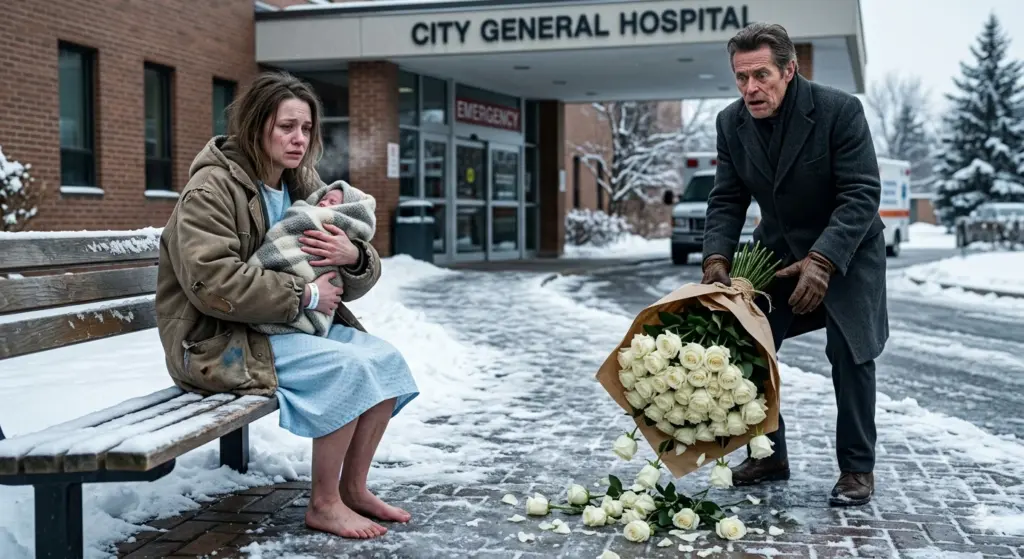
At first, he thought someone had left a bundle of laundry on the bench near the side doors. A dark shape under a dusting of snow, hunched forward, motionless except for a faint shiver. He almost kept walking. Plenty of people slept in hospital entrances during winter, and Hank had learned not to assume every sorrow on a sidewalk was his to fix.
But then the bundle moved.
A pale foot slipped from beneath the hem of an oversized coat and touched the icy slats of the bench. Bare skin. No sock. No shoe. The foot jerked back, then went still again.
Hank stopped so suddenly that one of the rose stems snapped against the paper.
He crossed the sidewalk in four hard steps. The woman on the bench was young. Too young to be sleeping there, too thin to be sitting in that weather, dressed in a hospital gown under a faded brown coat that hung off her shoulders like it belonged to someone twice her size. Her wet hair clung to her cheeks in dark strings. Both arms were wrapped around a small blanket pressed tight to her chest.
“Ma’am?” Hank said.
She lifted her head.
For one second, his mind refused to name her. Blue lips. White cheeks. Snow caught in her lashes. Eyes too wide, pupils blown with cold and fear.
Then she whispered, “Uncle Hank.”
The roses fell out of his hand.
“Claire?”
She tried to stand, but her knees buckled before she got halfway up. Hank caught her by the shoulders, and the shock of her skin through the thin hospital fabric went straight through him. She was colder than the metal railing beside the bench.
“What happened?” he said. “Where are your shoes? Where’s Ryan?”
Claire opened her mouth, but only a rasp came out. She tightened her hold around the blanket.
“The baby,” she breathed. “Please. Check Tommy.”
Hank did not ask another question. He pulled off his wool overcoat and wrapped it around her, then eased back the edge of the baby blanket with fingers that had gone clumsy. A tiny face appeared, flushed and warm against Claire’s chest. The baby slept with his mouth open, making faint little clicking sounds with every breath.
“He’s breathing,” Hank said, forcing his voice steady. “He’s all right. You kept him warm.”
Claire’s eyes closed for a moment, as if that was the only answer that mattered.
Hank lifted her in his arms as carefully as he could, baby and all. She weighed almost nothing. The coat slid around her, and he saw the hospital bracelet still on her wrist, the dried blood near the tape from an IV, the cheap rubber flip-flops dangling from one hand by a strap. Her feet were bare because the flip-flops were not meant for snow, and at some point she must have taken them off to keep from slipping.
He carried her to the SUV while people stared from the drop-off lane. A man with balloons took one step forward, then stopped. A nurse near the entrance looked through the glass, frowned, and disappeared into the lobby. Nobody reached them before Hank got Claire into the back seat.
He turned the heat as high as it would go, then climbed in beside her. He wrapped his sweater around her feet, rubbing carefully at the white, waxy skin. Claire made a small broken sound but did not pull away.
“How long were you out there?” he asked.
“I don’t know.”
“Claire.”
“I don’t know,” she said again, and her voice cracked. “Maybe an hour. Maybe more. Security wouldn’t let me back in. They said I’d been discharged.”
Hank looked toward the hospital doors. Through the glass, he could see a security guard speaking to a nurse, both of them glancing toward his SUV and then away.
“Why didn’t you call me?”
“I did.” Her teeth clicked between the words. “Three times.”
Hank grabbed his phone from the front console. Three missed calls from Claire. All within the last hour. He had been in the shower for the first one, buttoning his shirt for the second, and driving with Christmas music too loud for the third.
The guilt hit fast enough to steal his breath.
“I’m sorry,” he said. “Honey, I’m so sorry.”
Claire shook her head, a tiny motion. “I didn’t know where else to go.”
“Where else to go?” Hank repeated. “You were supposed to be going home. Ryan was supposed to pick you up.”
At her husband’s name, Claire’s whole face changed. Not tears. Not anger. Something smaller and worse, like she had been trying not to look at a wound and he had touched it.
“He sent a rideshare,” she whispered.
Hank waited.
“He said he couldn’t get away from work. The driver took me to the condo. When I got there, my things were outside.”
The heat roared from the vents. Snow melted into the floor mats. Tommy slept against his mother, unaware of the world that had nearly ended around him before he was four days old.
“What do you mean, outside?” Hank asked.
“Trash bags.” Claire stared at the back of the front seat. “Black trash bags by the curb. My clothes. My books. The baby things. The locks were changed. Mrs. Hensley from downstairs saw me and gave me this coat. She tried to call me a cab, but I didn’t know where to go.”
“You should’ve told her to call me.”
“I didn’t think you’d come.”
The sentence landed harder than the cold.
Hank looked at his niece, and for a moment he saw her at sixteen, standing beside two closed caskets in a black dress that was too short because grief had no patience for shopping. He had taken her home that night with no plan beyond one simple decision: his sister’s child would not be alone in the world. He had packed lunches, sat through parent-teacher conferences, taught her to drive in an empty grocery store lot, and waited in the kitchen on nights when she came home from college trying to pretend she had not been crying.
Then Ryan Caldwell had appeared with his smooth smile and his careful manners, and slowly, Claire had drifted away.
Too busy for Sunday dinner. Too tired to answer calls. Too grown-up, Ryan said, to let her uncle keep treating her like a child.
Hank should have fought harder. He knew that now.
Claire’s fingers trembled as she reached into the pocket of the borrowed coat. “He sent this after I got back to the hospital.”
She handed him her phone.
The text was still open.
The condo belongs to Mom now. Your stuff is outside. Don’t bother filing for support — on paper I make almost nothing. Happy New Year.
Hank read it once.
Then again.
A third time, slower, because rage made words blur.
“That condo is yours,” he said.
Claire swallowed. “Not anymore.”
“What does that mean?”
She looked down at Tommy. A tear slid off her chin and landed on the baby blanket. “Drew came to the hospital when I was still having contractions. Ryan’s brother. He said there were forms for insurance and the baby’s address, and I needed to sign before discharge. I was scared, and there were nurses coming in and out, and he kept saying Ryan had already read everything.”
Hank went very still.
“Claire,” he said carefully, “what did you sign?”
“I don’t know.” Her face crumpled, but she did not cry loudly. She seemed too cold for that, too exhausted to spare the strength. “I think I signed the condo to Patricia.”
Patricia Caldwell. Ryan’s mother. Retired county records clerk, church committee officer, charity-luncheon queen, a woman who had looked at Claire on her wedding day as if the bride were something tracked in on clean carpet.
Hank held the phone until the screen went dark.
“They said if I fought, they’d say I abandoned the baby,” Claire whispered. “Patricia knows people. She said she could call Child Services and have Tommy taken before I even found a lawyer.”
Hank lifted his eyes to the hospital entrance. The fake Christmas tree blinked blue and silver through the glass. People were still carrying flowers inside.
He reached into the front seat for his phone.
“Uncle Hank,” Claire said, and fear sharpened her voice. “Please don’t do anything dangerous.”
He looked back at her. “I’m going to do something necessary.”
Then he called a number he had not used in fourteen years. The man answered on the fourth ring, voice rough with sleep or age. “Who is this?” “It’s Hank Whitaker.” Silence. Hank watched snow gather on the windshield and spoke quietly, because Claire was listening and because Tommy was sleeping against her heart. “Marty,” he said, “you still owe me a favor…”
To read the rest of the story – CLICK the NEXT button 👇👇👇