


The first thing Mason Hale saw was the yellow sticker on the kennel door. It was not a medical tag. It was not an adoption label. He had seen that color used before, years ago, on evidence lockers and impounded vehicles that were headed for disposal once the county had finished pretending they still mattered.
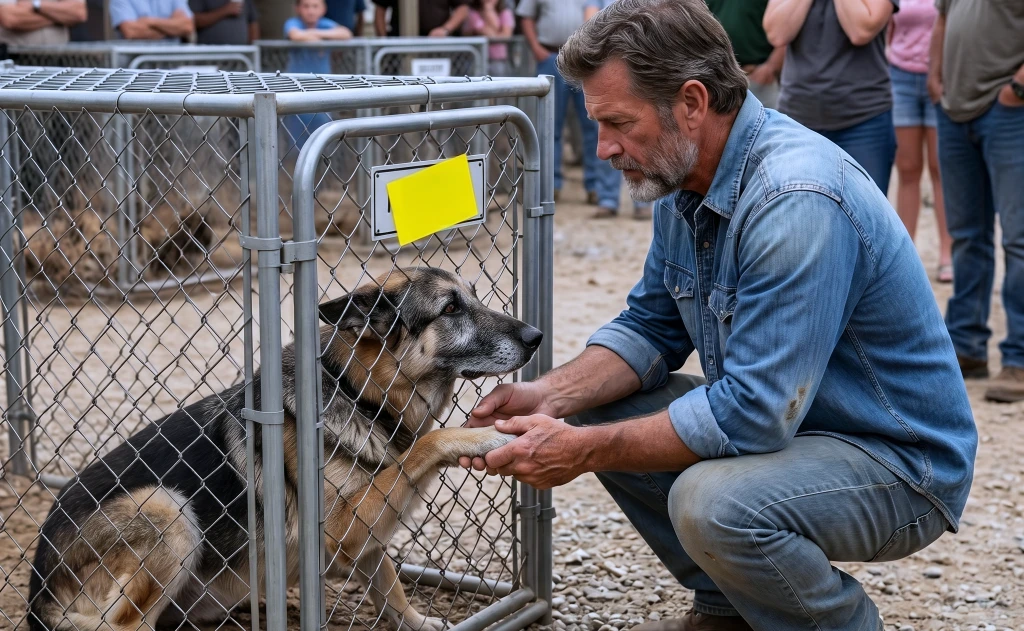
This one had been slapped crooked over the corner of a police dog’s name card.
RANGER — MALE GSD — FORMER K-9 UNIT
RECORDS RESTRICTED
TRANSFER ONLY
The dog behind the wire did not lift his head when a man in a straw hat bent down to look at his teeth. He did not bark when a woman asked whether he came with “obedience paperwork.” He did not even flinch when the auctioneer’s microphone popped loud enough to make three other dogs jerk against their kennel doors.
Ranger lay with his body tucked into the back corner of the crate, one paw over his muzzle, as if he had learned that staying small was the only choice left.
Mason stopped so abruptly that a man behind him bumped his shoulder.
“Watch it,” the man muttered.
Mason barely heard him. His eyes were still on the name card, on the yellow sticker, on the dull brass county tag hanging from the crate latch like a price tag on something already half thrown away.
Ranger had not been county property to Mason. Ranger had been Luke Mercer’s partner.
And Luke Mercer was buried beneath a white stone on the hill behind St. Anne’s, where every deputy in Hartwell County had stood in dress uniform three summers earlier while Ranger whined from the back of a patrol SUV until the sound made grown men look at the ground.
Mason stepped closer to the kennel.
The dog’s ears moved first.
Not much. Just a small shift beneath the gray that had spread too soon across his face. Then Ranger raised his head and stared through the chain-link door with eyes Mason knew better than he wanted to. The years had thinned him, taken the shine out of his coat and the clean strength out of his shoulders, but the look was the same.
Recognition. Fear. A question no animal should have had to ask.
“Hey, Ranger,” Mason said softly.
The dog’s mouth trembled. He pushed himself up, unsteady at first, then came forward until his nose touched the wire. Mason crouched in the dust, slipped two fingers through the narrow gap by the latch, and felt Ranger press his muzzle against them like he was checking whether Mason was real.
Around them, the county training yard carried on like none of this was obscene.
The sale had been set up on the back side of the Hartwell County Sheriff’s Office, past the firing range and the old vehicle shed. Folding tables sat under rented canopies. A plywood sign near the gate read RETIRED K-9 TRANSFER AUCTION in black block letters that had already begun to run in the heat. Beyond the tables, a row of portable kennels had been arranged against the fence, each with a dog inside and a bidder number hanging from the door.
People had come because the county had called it public surplus.
Some looked curious. Some looked excited. A few looked ashamed once they heard the dogs whining behind the wire. Mason saw a private security trainer inspecting legs from a distance, two breeders comparing notes, and a man in a feed-store cap asking whether any of the dogs still had “real bite drive.” There were families too, drawn by the word retired, maybe imagining gentle old heroes ready for porches and children.
The closer they got, the less anyone smiled.
These were not dogs easing into retirement. They watched every uniform, every radio crackle, every engine in the parking lot. Titan stood stiffly at the front of his kennel, chest pressed against the door as though waiting for a command that never came. Echo paced three steps, turned, paced three steps again. Mack lay with one hind leg stretched at a bad angle, breathing too fast in the shade.
Mason knew them all.
He had trained beside Titan in winter rain until both handlers were soaked through. He had watched Echo find a missing boy under an overturned canoe near Lake Wendell. He had seen Mack put himself between a panicked suspect and a rookie deputy who had frozen in a hallway. These dogs had entered houses before humans knew what waited inside them. They had followed voices into smoke, river fog, drug houses, dark sheds, broken glass.
Now they were lined up under a canopy while strangers asked about discounts.
“Mason Hale,” someone called from the front platform. “Didn’t expect you today.”
Mason stood but kept one hand on Ranger’s crate.
The auctioneer, Wade Collier, climbed down from a flatbed trailer that had been turned into a stage. Wade ran estate sales, livestock auctions, county equipment liquidations, and anything else with a microphone and a fee attached. He wore a white short-sleeved shirt tucked too tightly into pressed jeans, and the smile on his face looked practiced enough to survive most bad rooms.
It did not survive Mason’s expression.
“I got a text saying the K-9s were being auctioned,” Mason said. “I thought it was a bad joke.”
Wade spread his hands. “It’s an authorized transfer process. County’s trying to do things clean.”
“Clean?” Mason looked down the row of kennels. “Where are the handlers?”
Wade’s smile tightened. “Former handlers were notified according to policy.”
“That’s not what I asked.”
A deputy standing near the gate looked away. Mason recognized him then: Eli Brooks, fifteen years on patrol, twice decorated, the kind of man who had once slept in his cruiser outside a hospitalized partner’s house because the partner’s wife was scared. Eli’s jaw flexed when Mason met his eyes, but he did not speak.
That told Mason more than he wanted to know.
Ranger nudged the wire again. Mason crouched once more, letting the dog smell his wrist. He had not touched Ranger in nearly a year. The department had moved the dog after Luke’s death, first to a temporary handler, then to a training unit, then somewhere Mason could never get a straight answer about. Every time he asked, someone said liability, transition, paperwork, or one of those other words people used when they hoped grief would get tired and stop knocking.
“You were supposed to be safe,” Mason whispered.
Ranger lifted one paw and wedged it under the kennel door.
Mason caught it with both hands.
The paw shook against his palm. Not from excitement. Not the way a working dog trembled when waiting to launch. This was deep and jagged, a tremor that seemed to travel through Ranger’s bones before it reached Mason’s fingers.
A woman near the next kennel covered her mouth. The man in the feed-store cap stepped back.
Wade cleared his throat. “Deputy Hale, I need you to keep clear of the animals unless you’re registered to bid.”
Mason rose slowly. “Detective Hale now. And I want the records.”
“That won’t be possible.”
“Then I want whoever signed this.”
“You can contact county administration during business hours.”
Mason looked at the yellow sticker again. “It is business hours.”
The yard grew quieter in patches. People sensed trouble the way dogs sensed storms. A few phones came out. Eli shifted near the gate, one hand on his belt, not threatening, not comfortable either.
Wade walked closer with a clipboard hugged against his side. “Mason, I know you have history with the unit. Everybody respects that. But this sale is already posted, approved, and underway. The dogs are being transferred out because of new service standards and budget restructuring.”
“Ranger was Luke’s dog.”
“I’m aware.”
“No,” Mason said, his voice flat enough that Wade’s eyes flicked away. “You’re aware of a line on a form. You don’t know what that dog did.”
Wade’s mouth hardened. “The county owns the animals.”
Behind Mason, Ranger made a sound so small it almost vanished under the hum of the canopy fans.
Mason turned toward Eli. “Did you know he was here?”
Eli’s gaze dropped to the gravel.
“Eli.”
“Not like this,” Eli said quietly.
“Then how?”
“Don’t make me answer in the middle of the yard.”
Mason took one step toward him. “They put Luke Mercer’s dog in a disposal crate and invited strangers to bid on him. The middle of the yard is exactly where you’re going to answer.”
Wade moved between them before Eli could respond. “All right, folks, we’re going to begin with the terms of sale.”
The microphone squealed when Wade lifted it. Several dogs jerked at the sound. Mack tried to get up, failed once, then pushed himself upright with his bad leg tucked beneath him. Titan’s claws tapped the kennel floor. Echo stopped pacing and stared at Mason with an intensity that made the hairs along his arms rise.
“County terms are straightforward,” Wade said, reading from the clipboard. “All animals are transferred as-is. Hartwell County assumes no civil, medical, or behavioral liability after purchase.”
Someone near the back said, “Do we get vet files?”
Wade kept reading. “Medical and service histories are restricted under active county review. Buyers accept full responsibility upon transfer.”
The murmurs started immediately.
Mason stepped forward. “You can’t sell working dogs without medical history.”
Wade did not look at him. “Term two: no current county employee, former handler, or party associated with prior K-9 operations may purchase, adopt, house, or otherwise take possession of any animal listed in today’s transfer.”
Mason felt the words land before he understood them.
Across the yard, Eli closed his eyes.
Wade read faster. “Term three: any animal not transferred by close of sale will be transported to an approved behavioral processing facility for final review and disposition.”
No one spoke after that.
The language had been designed to slide by. It sounded official, harmless, procedural. But Mason had spent too many years reading county reports to miss what lived beneath softened words. Final review meant someone had already decided these dogs could be marked dangerous, unadoptable, unclaimed. Disposition meant the county wanted options it did not want to say in front of families.
Ranger pressed his paw under the door again.
Mason walked toward the platform. He did not raise his voice. He did not need to.
“Say it plainly.”
Wade lowered the clipboard. “I read the terms.”
“Say what happens to the dogs nobody buys.”
“That will be handled by the facility.”
“Say what kind of facility.”
Wade’s face flushed. “You’re interrupting a lawful county transfer.”
“This isn’t a transfer.”
“Mason—”
“This is a dump job with a microphone.”
The crowd shifted. A mother pulled her little boy back from Titan’s crate. A security contractor folded his bidder sheet in half and tucked it into his pocket. Even the people who had come to bargain looked less certain now, as if the dogs had stopped being inventory and become witnesses.
Wade set the clipboard on the podium. “If you want to participate, register like everyone else.”
“I will.”
That caught him. “What?”
Mason reached for his wallet. “Register me.”
Eli’s head came up.
Wade gave a short laugh, but there was no humor in it. “You heard the terms.”
“I heard illegal nonsense dressed up as county policy. Register me.”
“You’re an active employee.”
“I’m off duty.”
“That’s not what the rule says.”
“Then I’ll resign before the first bid.”
The words left Mason before he knew he had decided them. Once spoken, they felt less reckless than inevitable. He had worn the badge for fourteen years, but every oath he had ever taken had been aimed at a moment like this one, not at protecting a line item from public embarrassment.
Wade stared at him. So did Eli. The dogs had gone silent in their crates, as if waiting for the next command.
Then Wade flipped through the clipboard with a hand that had begun to sweat.
“You still can’t bid,” he said.
Mason held out his hand. “Show me.”
For a second Wade looked as though he might refuse. Then perhaps he remembered the phones pointed at them, the bidders listening, the deputies trying not to breathe too loudly. He turned the clipboard around.
There was a typed exclusion list beneath the policy language. Current employees. Former handlers. Immediate family members of handlers. Volunteers affiliated with K-9 care. Anyone associated with prior deployment review.
At the bottom, in blue ink, someone had added one more line.
MASON HALE — CONFLICT RISK
Mason stared at his own name until the yard seemed to narrow around the page.
Ranger whined behind him, low and broken, and Mason finally understood. This rule had not been written to protect the county from liability. It had been written because someone knew he might come…
To read the rest of the story – CLICK the NEXT button 👇👇👇