


Dr. Owen Caldwell stopped outside the quarantine room because the little bear had gone silent. At Redbud Ridge Wildlife Center, silence usually meant trouble. The recovering fox kits barked at breakfast like offended toddlers. The barred owl in the corner flight cage clicked his beak at anyone carrying a towel. Even the old groundhog in the education wing had an opinion about the timing of morning rounds.
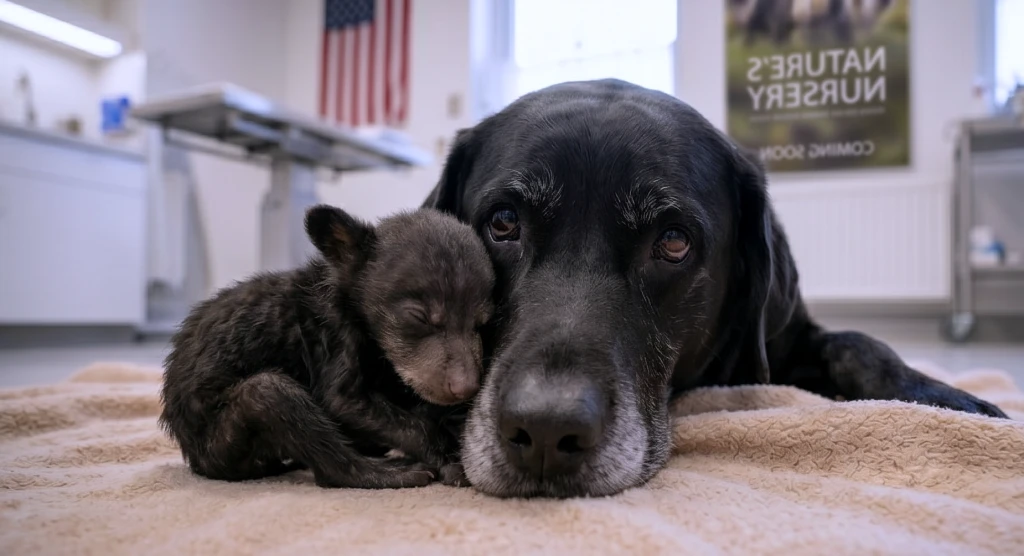
But behind the green quarantine door at the end of the hall, there was nothing. No scratching in the straw. No thin, angry cry. No small body shifting under the heat lamp.
Owen stood with his fingers on the latch and listened until the cold from the concrete floor crept through the soles of his boots. It was late October in the hills of eastern Kentucky, and the fog outside had pressed itself against every window. His coffee sat untouched on the supply cart, cooling beside a box of syringes and a clipboard no one wanted to update.
Inside that room was a black bear cub they had named Cinder.
He had arrived six days earlier in the arms of a state wildlife officer who looked as if he had not slept since the call came in. The cub had been found tucked against his dead mother near a washed-out logging road, too weak to crawl away and too young to understand that warmth did not always mean safety. He was barely three weeks old, not much bigger than a house cat, with fur that clung to his bones in dull, damp patches.
A healthy cub that age should have been round, loud, hungry, and offended by every inconvenience. Cinder had been quiet from the start. His eyes, ruined by infection before anyone found him, were filmed over and swollen shut. The fever had broken after two days of antibiotics and fluids, but the damage remained. He would never see the world that had already taken his mother from him.
Owen opened the door carefully.
Tessa Brooks was sitting cross-legged on the floor beside the bedding, a bottle of warmed formula cupped inside both hands. She had been at Redbud Ridge for sixteen years and could outwait almost any frightened animal. That morning, even she looked worn down.
“He turned away again,” she said.
Owen crouched a few feet from the bedding. Cinder was curled so tightly that his paws hid his nose. The heating pad glowed under the straw, and the heat lamp painted the concrete in a red circle, but the cub still trembled with a fine, exhausting shiver.
“How long did you try?”
“Forty minutes.” Tessa kept her voice low, though the cub could hear every breath they took. “He smelled it. He knew what it was. Then he tucked in like this.”
Owen did not reach for him right away. In wildlife medicine, hands could save, but they could also frighten, and the difference depended on a hundred things no chart could teach. He watched the cub’s ear instead. One rounded ear lifted toward Tessa’s voice, then sank back flat against his head.
“Any swallowing overnight?”
“Two drops. Maybe three.” Tessa glanced at the bottle, then at Owen. “I’m not sure I should even count them.”
He nodded because pretending was the fastest way to lose an animal. They had stabilized Cinder’s temperature. They had lowered the fever. They had pushed fluids into a body that seemed too small to hold them. On paper, some of the numbers had improved.
The cub himself had not.
Tessa tried one more time. She touched the nipple to the edge of Cinder’s mouth and waited, her other hand resting in the straw instead of on his body. The room smelled of disinfectant, warm milk, and the faint iron scent of a frightened animal. For a moment, Cinder’s nostrils moved. He knew the formula was there.
Then he folded deeper into himself.
Tessa lowered the bottle. Her jaw worked once, but she did not speak. Owen understood the motion. It was the place between anger and grief, where people who saved animals for a living tried not to blame themselves for what the world had done before the animal reached their hands.
By 8:30 a.m., Owen had the senior staff in the break room with Cinder’s chart spread open on the table. The room was too small for the conversation. It smelled like wet jackets, stale coffee, and bleach.
Naomi Rivera, the center’s operations director, stood by the sink with her arms crossed. Sam Whitaker, who had bottle-raised deer, foxes, raccoons, and one famously hateful bobcat kitten, sat with his elbows on his knees. Tessa stayed near the door, as if being closer to quarantine might change something.
Naomi was the first to say what no one else wanted to put in the air.
“He’s fading, Owen.”
“I know.”
“His glucose is dropping again. He’s not regulating his temperature without constant support. If he won’t take nutrition, fluids are only buying hours.” She tapped the chart once, not hard. “At some point, keeping him alive becomes something we’re doing to him, not for him.”
The word she did not say moved through the room anyway.
Euthanasia.
Owen had made that decision before. He had made it for animals crushed by cars, broken by traps, poisoned by people who had never thought past their own convenience. Mercy was part of the job, and he believed in it too strongly to pretend otherwise.
But Cinder’s heart was still working. Too fast, too fragile, but working. That small, stubborn beat stayed with him every time he closed his eyes.
“Give me forty-eight hours,” he said.
Tessa looked at him sharply. Naomi did not.
“For what?” Naomi asked.
“I don’t know yet.”
“That’s not an answer.”
“It’s the only honest one I have.” Owen pushed the chart back toward her. “No force-feeding. No restraint that sends him into shock. No procedure just because we’re desperate. But give me two days before we make the call.”
Sam rubbed his hands over his face. Tessa stared at the floor tiles. Naomi held Owen’s gaze long enough to make sure he understood what he was asking of them.
“Two days,” she said finally. “But if he keeps declining, you sign the order. Not Tessa. Not me.”
Owen nodded. “I’ll sign it.”
The rest of the morning moved around him without fully reaching him. He cleaned and bandaged a turtle with a cracked shell. He checked the wing wrap on a red-shouldered hawk that tried to punish him for being helpful. He took a call from a sheriff’s deputy about an injured coyote near the interstate and told the deputy how to keep traffic away until a transporter arrived.
Every task ended the same way: with his thoughts returning to a blind cub refusing the only thing that could keep him alive.
By late afternoon, Owen had not solved anything. He had only remembered a phone call from the week before, one he had pushed aside because Cinder’s emergency had swallowed the clinic whole.
A dog at the county shelter. Older black Lab. Wounded. Grieving. Not eating well.
At 5:20 p.m., instead of driving home, Owen turned his truck toward Holloway County Animal Services. The shelter sat behind the public works garage, a low cinder-block building with a chain-link yard and donated quilts draped over the railing to dry. Owen had stitched dogs there, vaccinated litters of kittens, and brought pain meds when the county budget ran thin. The staff knew him well enough to open the side door after hours without asking many questions.
Beth Carson met him in the hallway wearing rubber boots and a sweatshirt with a faded paw print on the front.
“You look like you lost a fight with a week,” she said.
“Good evening to you too.”
She leaned against the wall and studied him. “This about the little bear?”
“Partly.” Owen glanced toward the kennel room, where the evening barking rose and fell in waves. “You called me about a Lab.”
Beth’s face changed. “Hank.”
“That’s his name?”
“That’s what Walt called him.” She pushed open the kennel door, and the noise rushed at them. Dogs jumped against gates, tails hammered metal, voices bounced off the block walls. Beth walked past the loud rows to the quieter room in the back, where they kept injured animals and the ones too frightened to handle the main kennel.
“Walt Harper lived up on Mine Fork Road,” she said. “Seventy-two. Retired lineman. Kept chickens, fixed everybody’s lawn mowers, wouldn’t let anybody shovel his walk because he said it made them feel too helpful.”
Owen followed her past a sleeping beagle and a terrier with a cone around his neck. “What happened?”
“Something got into the coop after midnight. Wildlife officer thinks feral hog, maybe one of the big ones people have been seeing east of the river. Walt went out with a flashlight, and Hank went with him.” Beth stopped at the last kennel. “By the time Walt’s nephew found them in the morning, Walt was gone. Heart, most likely. Hank was torn up and lying across his legs.”
Inside the kennel, a large black Lab rested on a folded blue comforter. Gray fur spread across his muzzle and around both eyes. Two shaved patches showed where wounds had been cleaned and stitched along his shoulder and ribs. He did not bark when Owen crouched near the gate.
Only his eyes moved.
They did not search Owen’s face. They stayed fixed on the doorway behind him, listening for footsteps that were not coming.
“He let us treat him once we got him out,” Beth said. “No aggression after that. He’s healing better than I expected, physically. But he won’t play. Barely walks unless I put the leash on and ask like I mean it. He’ll take food from my hand sometimes, then leave the rest.”
Hank’s tail moved once against the blanket. Not a wag, exactly. More like an old habit his body had not given up.
“He still waits for Walt?” Owen asked.
Beth nodded. “Every time a man comes through that hall in work boots, he lifts his head. Every time it isn’t Walt, he lies back down.”
Owen sat back on his heels. The parallel was so plain that he mistrusted it at first. A wild cub curled under a heat lamp, listening for a mother whose body had already gone cold. A domestic dog in a shelter kennel, waiting for a man whose truck would never turn into the lot. Two animals separated by species, by training, by every rule humans had drawn around them, and both had retreated to the same place.
Alive, but not reaching.
Beth watched him. “You have that look.”
“What look?”
“The one that makes me want to hide my keys.”
Owen did not smile. Hank had shifted his nose toward the gate, and for the first time, the dog seemed to take in Owen’s scent: clinic disinfectant, cold coffee, wet leaves, and beneath all of it, the faint trace of bear cub clinging to his jacket.
Hank inhaled slowly.
His ears lifted. Not sharply, not with alarm. He only pulled the air in again, deeper this time, and a low sound moved through his chest. It was not a growl. It was rough, tired, and almost questioning.
Owen looked at the dog, then at Beth.
“Beth,” he said carefully, “could I borrow him in the morning?”
Her hand tightened around the clipboard. “Borrow him for what?”
Hank’s nose was still pressed toward Owen’s sleeve, searching through the smell of the clinic until he found the one thing Owen had not expected him to notice. Owen thought of Cinder under the red heat lamp, blind face hidden beneath his paws, and of Hank listening for boots in a hallway that would never bring Walt back. – “For a visit,” Owen said. “With a cub who may be waiting for someone too…”
To read the rest of the story – CLICK the NEXT button 👇👇👇