


At 3:37 a.m., Grace Bennett answered a call from a veterinarian who had already filled out the wrong form. She knew it before Dr. Aaron Keller said a word. There was a certain kind of quiet in a clinic at that hour, a quiet that settled into the spaces between sentences and made every breath sound like a decision. Grace had heard it too many times in twenty-two years of taking in miniature horses nobody else knew what to do with.
“Grace,” Dr. Keller said, and stopped.
She sat up in bed. Beside her, Rosie, her old French bulldog, lifted her square head from the quilt and blinked as if the world had personally offended her. Across the room, June gave one soft warning bark, then went still.
“What is it?” Grace asked.
“There’s a foal here,” he said. “Newborn. Miniature. The mare rejected him right away. He couldn’t nurse, and by the time they brought him in, he was already cold.”
Grace reached blindly for the lamp. The yellow light made the bedroom look too ordinary for what she could hear in his voice: the folded laundry on the chair, the boots by the door, the little framed photo of her daughter Emily at twelve years old, sunburned and grinning beside a rescue pony with crooked knees.
“How small?” Grace asked.
Dr. Keller exhaled once. “Small enough that I had one of my techs weigh him twice because I thought the scale was wrong.”
That was when Grace got out of bed.
“I’m coming,” she said, already pulling jeans from the chair.
“Listen to me first.”
“No. You listen. Don’t do anything until I get there.”
A longer silence moved through the phone. Dr. Keller was a careful man, not cold, and that made his pauses worse. Grace had known him for nearly a decade. He had stitched split eyelids, set tiny legs, sat on overturned buckets in her barn at midnight while a rescued mare labored under a heat lamp. He did not scare easily. He also did not call at 3:37 in the morning unless he believed time had become smaller than mercy.
“There’s a euthanasia form on the counter,” he said quietly. “I haven’t signed off on it. But Grace, I need you to understand what you’re driving toward.”
“I understand.”
“I don’t think you do.”
She stood in the middle of her bedroom with one sock on, one bare foot on the cold floor, and suddenly she was not fifty-one years old in a little ranch house outside Fallbrook, California. She was forty-five again, standing under fluorescent lights at the same clinic, holding a blue foal halter that had never been worn. Juniper had been smaller than she should have been too. Not this small, but small enough. Weak enough. Gentle enough to make every professional in the room speak softly.
Grace closed her eyes.
“Grace?” Dr. Keller said.
“I said I’m coming.”
She hung up before he could give her another reason not to.
The rescue sat on five dry acres at the end of a dirt road, tucked between avocado groves and weathered fence lines. Little Lantern Miniature Horse Rescue was not much to look at from the outside: a faded sign, a barn with patched siding, a feed shed with a roof that complained during Santa Ana winds. But inside those fences lived the animals other people had called useless, expensive, too damaged, too strange, too much trouble.
Grace moved through the house by memory. Thermos. Jacket. Keys. Phone charger. The old canvas emergency bag she kept under the mudroom bench. She added three clean towels, a fleece baby blanket someone had donated years ago, a digital thermometer, and the smallest bottle nipple she owned, meant for orphaned kittens.
Rosie waddled into the mudroom and stared at the bag.
“No,” Grace told her. “You’re staying.”
Rosie huffed, which was her usual answer to any injustice. June, younger and softer, sat near the door with her ears pinned back, watching Grace with the anxious intelligence that made her seem almost too human. Grace touched the top of June’s head for half a second, then slipped out before either dog could make the leaving harder.
The night outside was chilly for Southern California, damp and black around the edges. Grace’s truck coughed once before the engine caught. She backed out past the barn, where the horses shifted in their stalls and one old mare nickered as if asking why a human would willingly leave a warm bed before dawn.
Because somewhere thirty-six miles south, a newborn life was being measured against a piece of paper.
Grace kept both hands tight on the wheel. The highway was nearly empty, just long ribbons of headlights and the occasional trucker drifting through the dark. Her phone sat in the cup holder, screen lit with a route she did not need. She had driven to North County Equine Clinic in storms, wildfires, heat waves, and once behind an animal-control trailer carrying six neglected minis whose hooves curled like old wood. She could have found it with her eyes closed.
Still, the road felt longer that morning.
At a red light in Escondido, she caught her reflection in the dark window: gray-threaded hair shoved under a baseball cap, no makeup, eyes too wide. She looked like a woman running toward a memory she had sworn she had buried.
Juniper had lived thirty-one hours.
Grace had done everything then too. Warm towels. Colostrum. Oxygen. Whispered bargaining with a body that had never learned how to stay. In the end, Dr. Keller had said the kindest thing was to stop. Grace had nodded because she trusted him, and because exhaustion can disguise itself as wisdom. For years afterward, she told herself she had made the humane choice.
Most days she believed it.
The clinic’s sign glowed pale blue when she pulled into the gravel lot. One truck stood near the side entrance, and behind the building a security light buzzed over the empty corrals. Grace parked crooked, grabbed her bag, and was halfway to the door before Dr. Keller opened it.
He wore a navy scrub top under an unzipped jacket. His hair, usually neat, had been flattened on one side by a hand he had clearly dragged through it more than once.
“You drove fast,” he said.
“You called like you meant it.”
He did not smile. “I did.”
Inside, the clinic smelled of disinfectant, hay, coffee gone bitter in a pot, and something else Grace always noticed but could never name: fear held politely at arm’s length. A young vet tech stood at the counter with her arms folded, her eyes red at the rims. She looked relieved when she saw Grace, then guilty for being relieved.
“Where is he?” Grace asked.
Dr. Keller glanced toward the back hall. “Before you see him, I need to say this clearly. His jaw is undershot. His spine is not normal. His legs are weak, maybe too weak. He may not be able to regulate his temperature, and I don’t know yet whether his vision and hearing are normal. He didn’t get enough colostrum. That alone puts him at risk.”
“Is he in pain?”
“Not obvious pain. But he is struggling.”
“Then show me.”
He hesitated.
Grace looked at him then, really looked, and saw something beneath the professional caution. Not judgment. Not impatience. Grief, already arriving early so it could be useful.
“Don’t protect me from seeing him,” she said.
“I’m not protecting you.”
“Then what are you doing?”
Dr. Keller’s mouth tightened. “Trying to make sure you’re not trying to save Juniper.”
The name landed between them so hard that the young tech looked down at the floor.
Grace did not answer. She could have told him he had no right to say that, except he did. She could have told him this was different, except she did not know that yet. So she adjusted the strap of the canvas bag on her shoulder and waited.
Finally, he nodded toward the hallway. “He’s in treatment room two.”
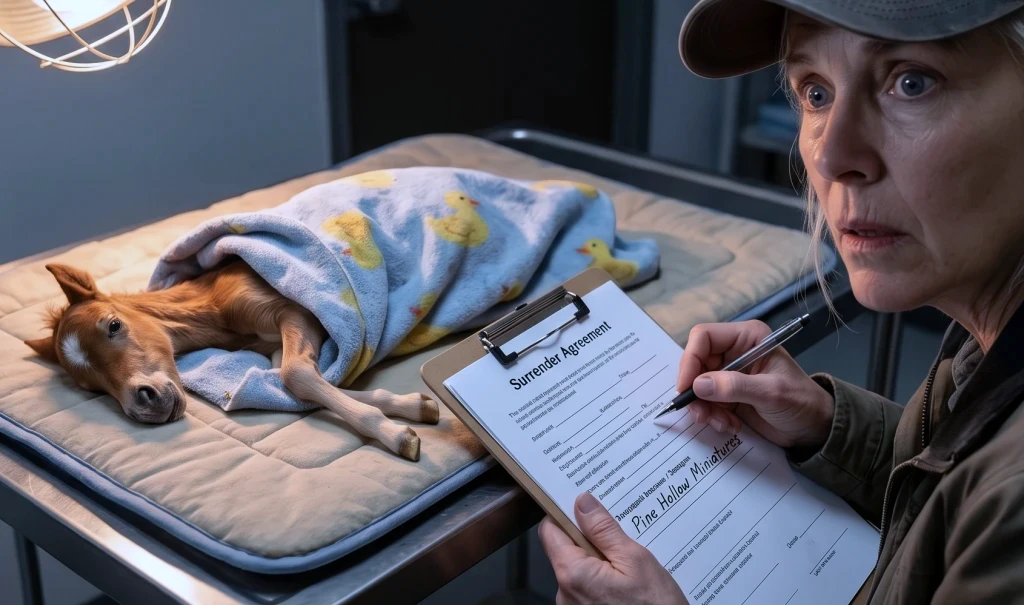
The room was warmer than the rest of the clinic. A heat lamp glowed over a low padded mat on the exam table, and beneath it, wrapped in a towel printed with faded yellow ducks, lay something so small Grace’s mind refused to name it at first.
Then the foal moved.
His head was too large for the rest of him, his muzzle fine as carved walnut, his ears no bigger than rose leaves. A thin stripe of white ran crookedly down his face. His legs, folded awkwardly beneath him, looked less like legs than questions someone had not finished asking. He was a horse, unmistakably, but he fit inside that towel as if he had arrived in the wrong scale.
Grace set her bag down without looking away.
“Oh, baby,” she whispered.
The foal’s sides fluttered with every breath. He did not lift his head, but one ear twitched toward her voice. That tiny movement did more damage to Grace than crying would have. Crying belonged to creatures with enough strength to protest. This little thing had barely enough strength to notice.
“What does he weigh?” she asked.
“Seven pounds, four ounces.”
Grace looked back at Dr. Keller.
“I know,” he said.
Seven pounds. Less than some house cats. Less than Rosie after she discovered the feed room and had to be put on a humiliating diet. Less than the saddle pads Grace used for her smallest therapy minis.
The tech spoke softly from the doorway. “He tried to suck on my finger once. Just for a second.”
Grace washed her hands at the sink, dried them, and approached the table. She moved slowly, giving him time to understand she was there, though she had no idea what he understood. When she touched the white stripe on his forehead with two fingers, his skin felt warm from the lamp but fragile underneath, as if warmth were something laid over him rather than something made inside him.
The foal opened his eyes.
They were dark, cloudy at the edges, and astonishingly steady.
Grace had seen panic in newborn animals. She had seen the glassy distance of shock and the dulled stare of pain. This was neither. The foal looked at her as though she had interrupted him in the middle of a decision.
Then, with a trembling effort that made the tech cover her mouth, he pushed his muzzle against Grace’s fingers.
Not hard. Not even successfully.
But he reached.
Grace felt the answer rise in her before she had permission to speak it.
Dr. Keller saw it too. His shoulders dropped, not in surrender but in sadness. “Grace.”
“He’s asking.”
“He’s reflexively rooting.”
“Maybe. But he’s asking.”
“You can call it that if you need to,” he said. “I’m telling you what the facts are. He may not survive the ride to your place. If he does, he may not survive the first night. If he survives that, you may spend weeks learning he can’t stand, can’t nurse, can’t live without constant intervention.”
Grace kept her fingers against the foal’s forehead. “And if I leave him?”
Dr. Keller did not look away. “I make him warm. I make him comfortable. I don’t let him spend his whole short life fighting a body that can’t carry him.”
That was the cruelty of good people, Grace thought. They made the hard thing sound merciful because sometimes it was.
She bent closer, close enough that the foal’s breath touched her wrist. His nostrils worked. His tiny mouth moved once, searching the air.
“What’s his name?” she asked.
“The owner didn’t give one.”
“Then he needs one.”
“Grace, a name doesn’t change prognosis.”
“No,” she said. “But it changes how we speak to him.”
The room settled around that. The tech wiped one cheek with the heel of her hand. Dr. Keller looked tired enough to be angry, and kind enough not to use it.
Grace studied the foal’s narrow face, the ridiculous smallness of his hooves, the crooked white line that seemed almost too bold for him. She had named hundreds of animals over the years, some after wildflowers, some after old country singers, some after the first thing they knocked over after arrival. But this one needed a name that did not pretend he was bigger than he was.
“Pip,” she said.
The foal’s ear twitched again.
Grace smiled despite herself. “That’s right. Pip.”
Dr. Keller turned toward the counter. There were two clipboards there. Grace noticed them for the first time. One held the euthanasia form he had mentioned. The other held a surrender agreement, medical notes, and a thin intake sheet with the owner’s information handwritten in black ink.
“Before you sign anything,” Dr. Keller said, “you need to make me a promise.”
Grace’s smile faded.
“If you take him, this can’t be about proving me wrong. It can’t be about social media. It can’t be about the one you lost. If he’s suffering and there’s no reasonable path forward, you bring him back, and we have the conversation again.”
Grace wanted to argue. Instead, she looked at Pip. His eyes were half closed now, but his muzzle still rested against the place her fingers had been.
“I’ll do what’s kind,” she said.
“Kind and hopeful aren’t always the same thing.”
“I know.”
He handed her the surrender clipboard first.
Grace took the pen. Her hand was steady until she saw the line marked Previous Owner / Breeder.
Pine Hollow Miniatures.
For a moment, the warm treatment room, the heat lamp, the tech by the door, even Pip’s small shivering breaths slipped away from her. The name on the paper pulled open a drawer in her memory she had not touched in years: a blue halter, a foal who never stood, a bill paid in installments, a ranch owner who said these things happened sometimes.
Dr. Keller watched her face change.
“Grace?” he asked.
She stared at the handwriting. Pine Hollow Miniatures was the same ranch that had brought Juniper in six years ago…
To read the rest of the story – CLICK the NEXT button 👇👇👇