


The first thing I saw through the observation glass was Samson’s left hand spread across Tom Bennett’s chest. Not striking him. Not shoving him. Holding him.
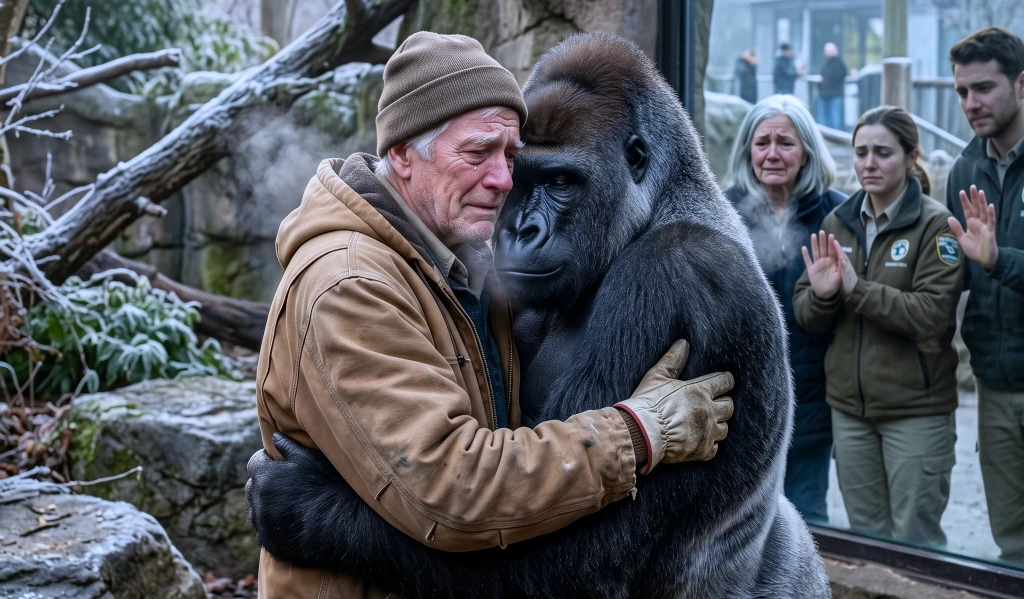
Tom stood in the lower yard of the gorilla habitat with rainwater darkening the shoulders of his canvas jacket, one boot planted in the mud and the other half-turned toward the keeper door. Samson, Winding Creek Wildlife Center’s oldest silverback, crouched behind him with one arm around his ribs and the other braced low across his waist, anchoring him with a steadiness that made every person in the observation room forget to breathe.
If Samson had been angry, the decision would have been simple. We had protocols for aggression. We had radios, barriers, emergency procedures, and enough trained staff to move quickly without pretending any of us were braver than the animals were strong.
But Samson was not angry.
That was the problem.
His shoulders were loose. His mouth was closed. He wasn’t barking, displaying, or slapping the ground. He sat behind Tom as if the old keeper might tip out of the world unless someone powerful enough kept him there.
Beside me, Eli Foster stood with a damp behavior log clutched in both hands. Eli was twenty-seven, still young enough to apologize to animals when breakfast ran late, and old enough now to know that love inside a dangerous-animal building did not make anything less dangerous.
“He did it before lunch, too,” Eli said.
“How long?” I asked.
“This time?” He glanced at the stopwatch in my hand. “Almost five minutes.”
I kept watching the yard. Samson shifted his weight, and Tom’s face tightened, not from pain but from embarrassment. He did not look toward the observation glass. He knew we were up there, which meant the humiliation had witnesses, and Tom Bennett had never been a man who knew what to do with being helped.
For thirty years, Tom had worked the primate building like it belonged to him in the way a church might belong to an old janitor. He knew the faulty hinges, the stubborn drain covers, the female gorilla who would accept grapes only if you rolled them, the juvenile who stole brushes and hid them in the same hollow log every Wednesday. He knew which keepers talked too loudly in the morning and which donors should never be allowed past the staff line.
More than anything, he knew Samson.
The silverback had come to Winding Creek as a young male from a private facility that closed after years of complaints. Back then, Samson had been all muscle and warning. He charged the mesh whenever boots sounded in the service corridor. He snapped branches in half and threw them at anyone who lingered. Tom had never called him mean. He said fear had a way of looking like bad manners when nobody bothered to read it correctly.
For months, Tom sat outside Samson’s holding area on an upside-down feed bucket and read maintenance manuals aloud in his slow Ohio drawl. He did not sweet-talk him. He did not ask for affection. He simply became predictable.
Years later, when the public saw Samson resting near Tom during training sessions, they called it a bond. People liked that word because it sounded soft. The staff knew better. It was trust, and trust with a silverback was not soft. It was earned in inches and protected by rules.
Down in the yard, Tom lifted one hand and patted Samson’s forearm. The gesture would have looked tender to a visitor. From the observation room, it looked more like a man asking permission to move.
“Come on, big man,” Tom said, his voice faint through the speaker. “I’m all right.”
Samson did not let go.
Eli looked sick. “He only does this with Tom.”
“Never with you?”
“No. He’ll come close if I’m carrying browse, but he doesn’t block me. He doesn’t shadow Marcy or Dan, either.” Eli swallowed and held the log toward me. “I started writing it down because I thought maybe I was making too much of it.”
The first entries were neat, cautious, and spaced several days apart. Samson approached Tom at east door. Samson maintained body contact for ninety seconds. Samson placed hand on Tom’s boot during cleaning. By the middle of October, the page had turned dense. Same behavior. Longer duration. More frequent. In the margin beside one entry, Eli had written one sentence so small I almost missed it.
Tom looked lost before Samson moved.
I read it twice. “What does that mean?”
Eli rubbed his thumb along the clipboard edge until the paper buckled. “You know Tom. He’ll make a joke before he admits anything hurts.”
“That isn’t an answer.”
“He’s been forgetting steps.” Eli kept his voice low, although the observation room was closed. “Nothing visitors would notice. A bucket in the wrong prep room. The wrong diet sheet clipped to the wrong cart. He called me Jason last week, and I don’t think we’ve ever had a Jason in primates.”
In the yard, Samson finally loosened his grip. Tom took a slow step forward, and the silverback immediately moved with him, knuckles pressing into the wet leaves, shoulder close enough to brush Tom’s thigh. Tom stopped. Samson stopped. The space between them was no longer space at all.
“When did it start?” I asked.
“The forgetting?”
“Yes.”
Eli looked toward the public windows. Beyond the habitat, a school group had gathered by the lemur exhibit, bright raincoats bobbing behind the glass. They could not see what was happening in the staff yard. That felt like mercy.
“Summer, maybe,” he said. “He told everyone he was tired. Then he said his blood pressure meds were off. Then his wife called HR after Labor Day.”
I turned toward him. “Linda called HR?”
“She asked about medical leave. Pension stuff. She didn’t mean for me to hear.” His face tightened with the shame of knowing something he had not been supposed to know. “Early-onset Alzheimer’s. That’s what she said.”
The words settled into the room without sound.
Below us, Tom had reached the keeper door. He patted his jacket pockets, frowning. His keys hung from the retractable clip on his belt, the metal ring bright against his work pants. For a moment, he seemed irritated that his hands had betrayed him by searching where there was nothing to find.
Samson watched the keys.
I pressed the radio button. “Tom, hold where you are.”
He looked up at the speaker, blinking through the rain. “I’m just coming out.”
“I know. Wait for Eli.”
Tom’s jaw set. There was the man everyone knew: proud, tired, annoyed at being managed. “I’ve opened that door longer than Eli’s been alive.”
“I know,” I said again.
Eli was already moving for the stairs, but before he reached the corridor, Tom unclipped the keys. He held the ring too close to his face, turning it as if the right key might announce itself. Samson rose higher behind him, his dark eyes fixed on Tom’s hand.
“Tom,” I said into the radio, sharper now. “Stop.”
He did stop, but not because I had told him to. His whole body had gone still. The keys trembled once, lightly, making a thin sound the overhead microphone caught and carried up to us.
Then his hand moved toward the lock.
At first, my mind filled in what it expected to see. Keeper exit. Blue tag. Standard route out of the yard. A task Tom Bennett had done so many thousands of times that his muscles should have known it even if the rest of him faltered.
But his hand passed the blue tag.
The key drifted toward the red-marked transfer lock beside it, the one that controlled the shift gate between the lower yard and the indoor holding area. It was not a door any keeper opened while standing where Tom stood. It was not a mistake the building forgave.
Eli saw it from the service corridor and broke into a run.
Samson moved first.
The silverback reached across Tom’s body, folded one arm over his chest, and pulled him back with a careful, immovable force. The keys slipped from Tom’s fingers and dropped into the mud. Tom stared at the red tag, then at Samson’s arm, and the color drained slowly from his face as understanding came back to him too late.
From the observation room, the whole truth changed shape in front of me. Samson was not keeping Tom from leaving. He was keeping him from opening the wrong door…
To read the rest of the story – CLICK the NEXT button 👇👇👇