


The radio call came in just after 3:00 p.m., while the rain was turning the visitor paths at Riverbend Wildlife Park the color of wet cardboard.
“Behavior team to primates,” Eli’s voice said. “Now, please.”
No code. No explanation. Just those three words, clipped and breathless in a way that made every keeper in the hallway look up from what they were doing. In a zoo, panic had its own sound. It did not always arrive as shouting. Sometimes it came disguised as somebody trying very hard not to frighten everyone else.
I was in the veterinary wing reviewing diet notes when the call came through. By the time I reached the gorilla building, my boots were slick with mud and my radio was still hissing against my shoulder. Eli Bennett met me at the observation door with his face gone pale under the brim of his knit cap.
“He’s got Hank again,” he said.
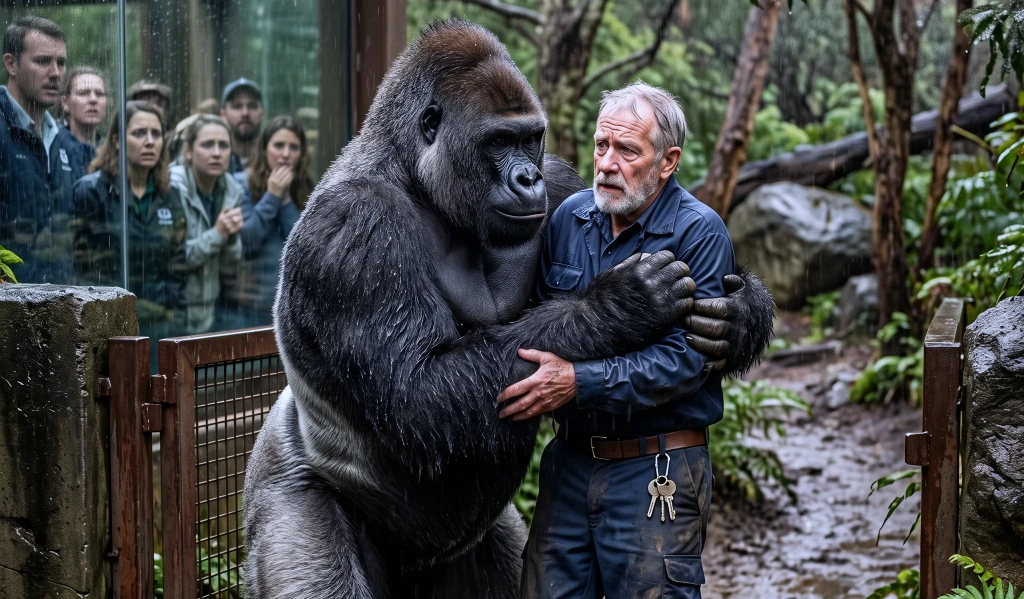
Through the glass, the public habitat looked almost peaceful. Rain trembled in the last brown leaves of the sycamores. The moat was dark and full, and the climbing logs shone black with water. Near the service entrance, Solomon sat in the mud with one arm locked around Hank Dawson’s ribs and the other curved across his stomach.
Solomon was our oldest silverback, nearly four hundred pounds and carrying the kind of power that made people lower their voices without knowing why. He was not roaring. He was not displaying. There was no slap of hands against his chest, no baring of teeth, no charge toward the windows where visitors might gather.
That was the part that made my stomach tighten.
Hank was not being attacked. He was being held.
He was fifty-six years old, though the work had aged his body in uneven ways. His shoulders were still broad from years of hauling feed tubs and repairing gates, but his back had begun to bend forward, as if he were listening for something the rest of us could not hear. For nearly three decades, Hank had worked the primate house with the steady patience of a man who did not need anyone to notice how much he loved what he did.
Solomon had one huge hand flattened over the front of Hank’s jacket. The gesture was careful, almost tender, but careful did not mean safe. A silverback could crush ribs by accident. A frightened keeper could make one wrong movement and turn a quiet emergency into a tragedy before anyone upstairs found the right key.
“How long?” I asked.
Eli looked at the timer on his phone. “Six minutes.”
“Has Hank said anything?”
“He keeps telling him he’s fine.”
Down below, Hank shifted his weight, and Solomon shifted with him. The gorilla’s shoulder pressed against Hank’s hip, blocking him from the narrow service door. Hank put a hand on Solomon’s forearm the way a man might steady himself against a railing.
“I’m all right, Sol,” Hank said. His voice came faintly through the observation room speaker, thin under the rain. “Easy now. I’m right here.”
Solomon did not loosen his grip.
I watched Hank’s free hand move toward his belt. His keys hung there on a brass ring, bright against his faded work pants. He touched them, frowned, then let his hand drift to the pocket of his jacket. He checked that pocket twice. Then he patted his shirtfront, slow and puzzled.
Eli saw it, too. He swallowed hard beside me.
“Hank,” I said into the habitat speaker, keeping my voice low. “Don’t reach for the lock. Stay where you are.”
Hank lifted his face toward the observation window. For one clear second, irritation flashed across it. He had trained half the staff in that building. He had taught us when to wait, when to move, when to stop pretending affection could replace protocol. Being told to stand still in his own habitat must have burned.
Then the irritation passed, and something else moved into his eyes.
Confusion.
Not the ordinary kind that came from stress or distraction. Not a man irritated because a younger colleague had interrupted him. This was emptier than that. Hank looked at the door in front of him as if someone had changed it while his back was turned.
Solomon made a low breath through his nose and tightened his arm.
“There,” Eli whispered.
I did not take my eyes off Hank. “There what?”
“That’s what he does.”
Hank lowered his hand. The keys swung against his thigh, making a small metallic sound the microphones barely caught. Solomon leaned closer until Hank’s cheek almost touched the dark hair along the gorilla’s shoulder.
For another full minute, no one moved.
Then Hank did something that made the room feel colder than the rain outside. He closed his eyes and let his forehead rest against Solomon’s arm.
“I know,” he whispered. “I know, big man.”
Only then did Solomon ease his grip. He did not step away. He lowered himself on all fours and placed his body between Hank and the door, close enough that Hank could not pass without touching him.
I turned to Eli. “Start at the beginning.”
He did not ask what beginning I meant. He was twenty-seven, new enough to still look wounded by every hard decision, but not so new that he failed to recognize one. He carried a clipboard tucked under his jacket, and when he pulled it out, the paper had been softened by weeks of damp air and worried hands.
“We noticed in September,” he said.
“You noticed Solomon holding Hank?”
“At first it wasn’t holding. It was following. Hank would enter the transfer corridor, and Solomon would come down from the ridge. If Hank stopped, Solomon stopped. If Hank turned toward the wrong gate, Solomon would block him. We thought it was possessive behavior, maybe a dominance thing, but it was only with Hank.”
I took the clipboard from him. The log was too neat to be casual. Date, time, staff present, location, behavior, duration. The first entries were spaced days apart. Then every other day. By October, they came in clusters, two or three on the same shift.
“Who else has seen this?”
“Marcy. Joel. Me.” Eli rubbed the side of his jaw, leaving a faint mud streak behind. “We told Hank he needed to report it.”
“And?”
“He said Solomon was getting old and clingy.”
From the habitat speaker came the scrape of Hank’s boots on wet concrete. He had taken one step toward the service door, and Solomon had moved with him. Not aggressively. Not anxiously. Simply there, impossible to ignore.
“What changed with Hank?” I asked.
Eli stared through the glass. “You have to understand, Hank hates being fussed over.”
“That isn’t an answer.”
“I know.” He folded his arms over himself, then unfolded them, as if he could not decide what to do with his hands. “He’s been mixing things up.”
“What kind of things?”
“At first? Nothing you could prove was dangerous. He put the banana crate in dry storage. He left a radio on top of the washer. He called me Jake for a week, and nobody here is named Jake. He laughed it off. We all did, because it was Hank and because he made it easy to laugh.”
I kept reading the log. The entries changed tone in mid-October. What had started as “Solomon remained within three feet of keeper” became “Solomon physically blocked keeper from Gate 2.” Then, “Solomon initiated contact when keeper appeared disoriented.” Then, yesterday: “Solomon held keeper against west wall for four minutes after keeper attempted wrong latch sequence.”
The words had the sterile, careful sound of people trying not to write what they were afraid of.
“What happened yesterday?” I asked.
Eli’s throat moved. “Hank opened the first service gate and reached for the second before the first one was secured.”
I looked up.
“He caught himself,” Eli said quickly. “I mean, Solomon caught him. He put his hand through the mesh and hit the panel hard enough to startle Hank back. I was thirty feet away, coming around the feed room. I didn’t even see Hank touch the wrong latch until I checked the footage.”
A keeper who forgot a radio could be helped. A keeper who forgot a name could be covered for by kind people with good intentions. A keeper who forgot a gate sequence in a great ape building was standing at the edge of something no apology could repair.
“Does Marcy know?”
“Some of it.”
“Does Randall?” I asked, meaning the primate supervisor.
Eli shook his head once. “Hank asked us not to make a thing out of it.”
The answer made anger rise in me, sharp and useless. Hank had spent his career teaching younger keepers that safety rules were written in plain language because tragedy loved exceptions. Yet here we were, watching a silverback gorilla enforce a boundary humans had been too loyal, too frightened, or too ashamed to name.
Down below, Hank reached the door again. This time he did not touch the lock. He looked up toward the observation glass, and even from that distance I could see the effort it took him to stand still under our concern.
“Eli,” I said, “call Randall and tell him no one enters the gorilla side without my approval. Not Hank, not anyone. Then get security to send me every camera angle from this building for the last eight weeks.”
Eli nodded, but he did not move.
“What else?” I asked.
He reached into his back pocket and pulled out a folded piece of blue painter’s tape stuck to a small square of backing paper. The tape was creased and dirty along the edges, as if it had been peeled from a hidden place and carried around by someone who could not decide whether showing it would be betrayal.
“I found this inside Hank’s locker door,” he said.
I took it from him.
Written across the tape in Hank’s blocky handwriting were three lines:
WEST PIN FIRST.
CHECK RED LIGHT.
DO NOT TRUST MEMORY.
For a moment, the rain on the glass was the only sound in the room.
I had seen keepers write reminders for complicated diets, medication schedules, enrichment rotations, all the small details that made animal care more exacting than visitors realized. This was not that. This was a man leaving warnings for himself in a building where a warning could come too late.
Below us, Solomon had guided Hank away from the service door and into the lee of the climbing wall, where the rain could not reach them as easily. Hank’s shoulders sagged. Solomon sat beside him, one hand resting over the toe of Hank’s boot like a weight keeping him in the world.
Eli wiped his nose with the sleeve of his jacket. “Hank’s wife called HR last month. I wasn’t supposed to know, but Marcy heard Randall talking after the safety meeting. There was a neurologist in St. Louis. Tests. Something about accommodations.”
“What diagnosis?”
“I don’t know.” His voice cracked on the last word, and he hated himself for it. “He wouldn’t tell me.”
I looked at the tape again. Do not trust memory.
The words felt less like a note than a confession.
That evening, after the building closed and the public paths emptied under the storm, security sent the first batch of footage to the veterinary conference room. The file names filled my laptop screen in neat gray rows. Corridor camera. Yard camera. Transfer hall. Indoor dayroom. Feed prep.
I opened the earliest clip, expecting to find the moment when Solomon’s behavior began to change.
Instead, I watched Hank Dawson walk into the transfer corridor alone, stop with his hand halfway to the wrong latch, and stare at the steel door like a man waking up in a place he should have known by heart.
Solomon was at the far end of the adjoining stall, his back turned.
Then, before Hank called for help, before Eli appeared in the hallway, before any human being understood that Hank had gone missing inside himself, Solomon lifted his head and started moving…
To read the rest of the story – CLICK the NEXT button 👇👇👇