


The bottle was still full. Dr. Daniel Mercer noticed it before he noticed the silence, before he noticed the way Mara Lewis had one hand pressed flat against the quarantine-room door as if she could hold a life in place by not moving. The formula had been warmed twenty minutes ago. A strip of tape on the side marked the starting line in black Sharpie. Nothing had changed. Inside the small room, under a red heat lamp and two layers of fleece, the bear cub had stopped arguing with the world.
At Laurel Bend Wildlife Center, noise usually meant hope. Baby raccoons screeched like machinery at feeding time. Fox kits snapped at syringes with all the outrage their tiny teeth could manage. The injured barred owl in the flight room clicked her beak whenever Daniel walked by, as if keeping a personal record of every human failure.
But the cub they had named Ash made no sound at all.
Daniel stood beside Mara and listened. The October rain had turned the service yard to slick red mud, and fog lay low over the Blue Ridge foothills beyond the windows. Somewhere down the hall, a dryer thumped unevenly with towels inside. In quarantine, nothing scratched in the straw. Nothing shifted against the heating pad. Nothing reached for the one thing keeping it alive.
Mara finally looked at him. She had been raising orphaned wildlife longer than Daniel had been licensed to treat it, and he trusted her face almost as much as he trusted lab work. That morning, her face had gone careful in the worst way.
“He smelled it,” she said. “He knew the bottle was there. Then he turned his head into the blanket.”
Daniel took the bottle from her and felt the warmth through the plastic. “How long did you try?”
“Thirty-five minutes. Maybe forty.” Her voice was steady, but only because she had made it that way. “I didn’t force him.”
“I know.”
“I touched it to his mouth, waited, backed off, tried again. He swallowed one drop. Maybe.” She looked through the small square window in the door. “I don’t even know if that counts.”
Daniel opened the door slowly.
The room smelled of disinfectant, warm milk, damp fleece, and frightened animal. Ash lay curled on his side, not much bigger than a house cat, though his paws hinted at the size he might have become if the world had met him more kindly. His fur was dull black, patchy where dehydration and infection had thinned it. His eyes were closed under swollen lids, both ruined before anyone found him.
A wildlife officer had brought him in six days earlier wrapped in a thermal blanket, her uniform wet to the elbows. The cub had been discovered beside his mother near a washed-out logging trail after a storm. The sow was dead. Ash was alive, barely, pressed against her cooling body and too young to understand why warmth had stopped answering him.
He had been three weeks old. Too weak to cry for long. Too blind now to ever see the woods that had taken his mother from him.
Daniel crouched near the bedding but did not reach in. With wild animals, hands could mean rescue or terror, and the difference was not always up to the person holding them out. He watched Ash’s ear instead. At the sound of Mara’s breathing, one rounded ear lifted, trembled, and settled again.
“He’s colder than he should be,” Mara said.
Daniel touched the edge of the fleece, not the cub. “Temperature?”
“Still dropping unless the pad stays high. Glucose is down again too.”
He nodded, because false comfort was disrespectful in a room like this. They had brought Ash through fever. They had pushed fluids into a body that seemed too small to hold them. They had cleaned his eyes, started antibiotics, adjusted heat, counted every swallow, and written every number down as if numbers could persuade a baby animal to keep wanting morning.
Some numbers had improved.
Ash had not.
Mara knelt beside him and tried once more. She touched the nipple to the edge of his mouth, then waited with the patience of someone who had learned that fear could not be rushed out of a body. Ash’s nostrils moved. He smelled the formula. Hunger should have pulled him toward it.
Instead, the cub tucked his blind face deeper into the fleece.
Mara lowered the bottle. She turned her head slightly, looking away from Daniel, and he pretended not to see the way her mouth tightened. People thought wildlife work was all soft blankets and second chances. They did not see the rooms where second chances got smaller by the hour.
At 8:45 a.m., Daniel called the senior staff into the break room.
Renee Park, the operations director, came in with Ash’s chart tucked under one arm and rain still shining on her jacket. Luis Ortega, who could bottle-feed three squirrels while answering a phone, sat with his elbows on the table and said nothing. Mara stood by the counter, arms folded, her gaze fixed on the hallway that led back to quarantine.
Renee laid the chart open. “We need to talk honestly.”
Daniel rubbed the bridge of his nose. “I know.”
“No, I need you to hear the whole sentence.” Renee’s voice was not cold. That made it harder. “He’s not stabilizing. He won’t eat. His temperature support is constant. If his glucose keeps falling, we are going to reach a point where keeping him alive is something we’re doing to him.”
Luis looked down at his hands. Mara did not move.
Nobody said the word at first. It entered the room anyway, familiar and hated.
Euthanasia.
Daniel had signed those orders before. He had signed them for deer broken beyond repair, hawks with injuries no wing could come back from, raccoons poisoned by human carelessness, and one red fox caught in a trap so long mercy was the only kindness left. He believed in mercy. Believing in it did not make the pen easier to hold.
Ash was still breathing. Too fast, too shallow, but breathing. His heart was still trying to do the work of a life that had not yet learned there was anything beyond loss.
“Give me forty-eight hours,” Daniel said.
Mara looked up quickly. Renee’s expression did not change.
“For what?” Renee asked.
Daniel wished he had something better than the truth. “I don’t know yet.”
“That’s not a treatment plan.”
“No. It’s time to find one.” He pushed the chart back toward her. “No force-feeding. No restraint that terrifies him into collapse. No heroic procedure because we’re the ones afraid to quit. If he declines hard, I’ll stop. But give me two days before we decide that his story ends under a heat lamp.”
Luis leaned back and exhaled. Mara pressed her fingers against the counter so hard her knuckles paled.
Renee watched Daniel for a long moment. “If those two days make him suffer, that’s on you.”
“I know.”
“And if the decision has to be made, you sign it. Not Mara.”
Daniel nodded. “I’ll sign it.”
The day kept moving because animals did not pause for anyone’s grief. Daniel cleaned a turtle’s shell fracture, checked the splint on a juvenile hawk that disliked gratitude, and talked a deputy through blocking traffic around an injured coyote near the interstate. He answered emails, changed gloves, washed his hands until the skin across his knuckles stung, and returned to quarantine between every task.
Ash stayed curled in the same place.
By late afternoon, Daniel’s mind was no closer to an answer. Then, while he was standing beside the supply cabinet staring at a shelf of syringes he did not need, he remembered a call he had set aside the week Ash arrived.
Haw Creek County Animal Services. Older black Lab. Injured. Grieving. Barely eating.
At 5:30 p.m., Daniel drove past the turnoff to his house and kept going.
The county shelter sat behind the public works garage, a low cinder-block building with peeling blue trim and a row of kennels facing a narrow gravel yard. Daniel had been there often enough that the staff unlocked the side door after hours without making him explain himself first. He had stitched dogs on folding tables there, vaccinated litters of kittens, and dropped off donated pain medication when the county budget came up short.
Ruth Bennett met him in the hall wearing rubber boots and a gray sweatshirt with paw prints faded across the front. She took one look at him and frowned.
“You look like you slept in your truck.”
“I didn’t.”
“That wasn’t a compliment.” She wiped her hands on a towel. “This about your bear cub?”
“Maybe.” Daniel glanced toward the kennel room, where barking rose and fell like weather. “You called me about an old Lab.”
Ruth’s face softened into something heavier. “Murphy.”
“That’s his name?”
“That’s what Earl called him.”
She led him through the loud front kennels into the smaller medical room at the back. The noise dimmed behind the door. A terrier in a cone watched them from one run. A beagle slept under a quilt someone had donated from a church rummage sale.
“Earl Whitcomb lived up on Pine Knife Road,” Ruth said. “Seventy-four. Retired electrician. Fixed everybody’s porch lights, argued with the mail carrier, grew tomatoes he pretended not to give away.”
“What happened?”
“Something tore into his chicken coop after midnight. Wildlife officer thinks a wild hog, maybe one of the big ones people have been reporting down by the creek bottoms. Earl went out with a flashlight. Murphy went with him.” Ruth stopped at the last kennel. “By morning, Earl was gone. Heart attack, most likely. Murphy was lying across him, bleeding all over that old man’s boots.”
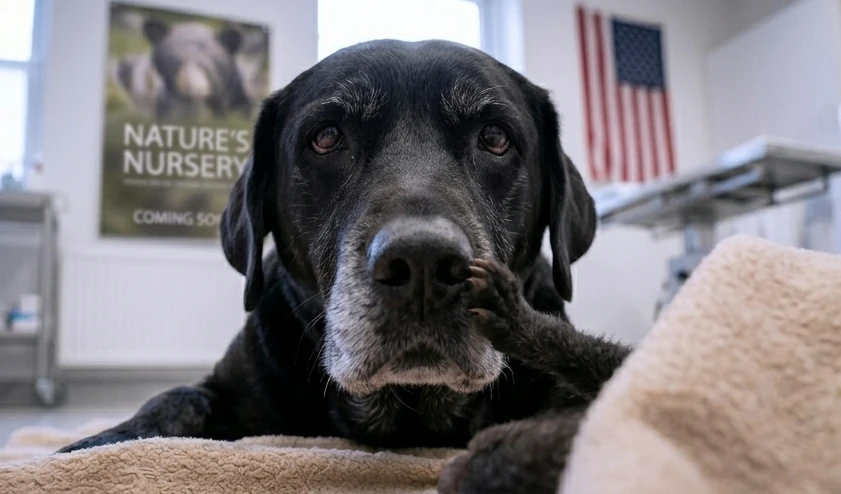
Inside the kennel, a large black Lab rested on a folded green comforter. Gray covered his muzzle and feathered around his eyes. Two shaved patches showed where wounds had been cleaned and stitched along his shoulder and ribs. He did not bark when Daniel crouched near the gate.
Only his eyes moved.
They were not fixed on Daniel. They were fixed on the hallway, listening past every living person for one set of footsteps that would never come again.
“He lets us treat him,” Ruth said. “He’s gentle as rain. But he won’t settle. Doesn’t want toys. Doesn’t care about the yard. He’ll eat a bite if I hand-feed him, then he looks at the door like he’s embarrassed to be hungry without Earl here.”
Murphy’s tail shifted once against the quilt. It was not quite a wag. More like the memory of one.
Daniel rested one hand on the outside of the gate. “He still thinks Earl is coming?”
“Every time a man walks back here in work boots, Murphy lifts his head. Every time it isn’t him, he lies down again.”
Daniel looked at the old dog and felt the shape of the idea before he trusted it.
A blind cub curled under a heat lamp, waiting for a mother whose body had already gone cold. A wounded Lab in a county kennel, listening for the man he had tried to protect after help came too late. Two animals divided by species, by instinct, by every rule a responsible veterinarian was supposed to respect.
Both alive.
Both unreachable.
Ruth watched him. “Daniel.”
“What?”
“You’ve got that look that costs me paperwork.”
He might have smiled on another day. Instead, he shifted closer to the gate, and Murphy’s nose moved for the first time. The dog breathed in, slow and deliberate. Clinic disinfectant clung to Daniel’s jacket. So did rain, mud, coffee, and the faint, warm, wild scent of the cub from quarantine.
Murphy lifted his head.
It was not fear. It was not prey drive. His ears rose a fraction, and a rough sound moved low in his chest, tired and uncertain, almost like a question he did not know how to ask.
Daniel looked from Murphy to Ruth.
“Could I bring him to Laurel Bend tomorrow?”
Ruth’s hand tightened on the latch. “For what?”
Murphy was still leaning toward Daniel’s sleeve, searching through the smell of the clinic until he found the smallest trace of the cub Daniel had not known he carried. Daniel thought of Ash with his face hidden beneath his paws, and of Murphy waiting in a hallway grief had emptied out.
“For a visit,” Daniel said. “With a little bear who may be waiting for someone too…”
To read the rest of the story – CLICK the NEXT button 👇👇👇