


The key ring fell out of Eddie Hart’s hand at 2:17 on a Tuesday afternoon, and Samson caught him before anyone in the observation room could move. From behind the glass, it looked impossible to understand. A four-hundred-pound silverback had one arm locked around a keeper’s ribs and the other braced across his back, holding him in the wet leaves beside the service door. Eddie’s boots had sunk half an inch into the mud. His face was turned toward the lock as if the door had suddenly become a language he could no longer read.
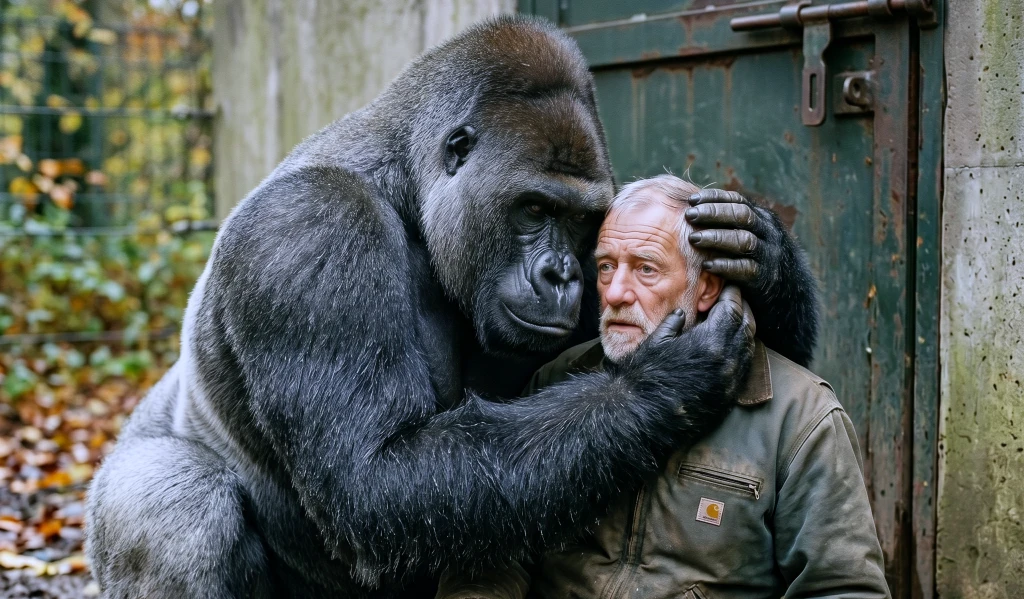
No alarm had sounded. No keeper had shouted. Samson was not displaying, not barking, not beating the ground with his fists. That was what made my hands go cold. Rage was loud. Fear was loud. This was quiet, careful, and deliberate.
Samson was keeping Eddie from the door.
“Third time today,” Caleb Reed said beside me.
Caleb was still young enough to believe good work could save everyone if you just did enough of it. He held a behavior log against his chest, the pages bent from damp fingers and rushed notes. His eyes stayed fixed on the habitat below, where Eddie had gone perfectly still inside the silverback’s grip.
I looked at the clock on the wall, then at the stopwatch running on my phone. “How long this time?”
“Four minutes,” Caleb said. “A little over.”
“Has Eddie tried to pull away?”
“He did the first time.” Caleb swallowed. “Not this one.”
Below us, Eddie’s left hand rested on Samson’s wrist. He was fifty-six, with a heavy workman’s build, a sun-browned face, and knees that had hated stairs for at least ten years. Most visitors never noticed him unless he was pushing a cart or hosing down a drain. To the animals at Redbud Creek Wildlife Center, he was part of the building itself.
For thirty-one years, Eddie had been the first person through the primate wing in the morning. He knew which hinge sang in cold weather, which drain backed up after a storm, which female gorilla would refuse grapes if they had been washed in water that smelled too strongly of chlorine. He could tell from the hallway whether the troop had slept well. He could tell from one glance whether Samson was testing a boundary or asking for space.
That was why none of us wanted to name what we were seeing.
Samson loosened his grip at last, but he did not leave Eddie’s side. He shifted on his knuckles, placed his body between Eddie and the service door, and watched the keeper’s hands. When Eddie moved, Samson moved. When Eddie stopped, Samson stopped. It was not affection exactly. It was not possession. It was the kind of attention animals give to weakness when weakness appears inside the group.
I turned toward Caleb. “When did this start?”
He did not answer right away. The question had been waiting for him, and he still looked ashamed that it had caught up.
“Caleb.”
“We started writing it down in September,” he said.
“That isn’t what I asked.”
He slid the log toward me. The first pages were neat, almost apologetic. Samson followed E.H. to east gate. Samson blocked E.H. from lower corridor. Samson maintained contact with E.H. during feeding shift. A few entries a week at first, then nearly every shift. By late October, the notes had changed shape. The handwriting grew tighter. Durations got longer. The same words appeared again and again.
Blocking. Contact. Guiding. Preventing exit.
“Does he do this with anyone else?” I asked.
Caleb shook his head. “No. He watches us. He’ll come close if somebody has breakfast late or if the hose scares the juveniles. But he doesn’t put hands on us. Not like this.”
“Only Eddie?”
“Only Eddie.”
Outside, Eddie finally seemed to remember the key ring in the mud. He bent for it too quickly, and Samson lowered one massive hand against his shoulder. Eddie stopped before his knees could betray him. For one suspended second, his face carried a look I had seen in hospital hallways and parking lots and kitchens after bad phone calls.
It was not fear of Samson.
It was fear of himself.
Caleb’s voice dropped. “He’s been having spells.”
I watched Eddie pick up the keys. His fingers sorted through them, passed the correct one once, then twice, then returned to it with forced concentration. Samson leaned closer, every inch of him focused on the keeper’s face.
“What kind of spells?”
“Forgetful at first. Normal stuff, or that’s what he said.” Caleb rubbed his thumb along the metal clip on the log. “He’d leave a feed bucket in the wrong prep room. Put the radio in the freezer. Call Jenna ‘Lisa,’ except nobody named Lisa works here. Then last month I found him in the transfer hall with his hand on the safety pin. He was just staring at it.”
I looked at him.
“He said he was tired,” Caleb added. “He said he’d been up half the night because his wife was snoring. Eddie makes jokes when he wants you to stop worrying.”
“Did you stop?”
Caleb’s face tightened. “No.”
Below us, Eddie lifted the key toward the lock and paused again. The key hovered half an inch from the cylinder. His shoulders rose. Samson’s arm came around him before the pause became a full freeze.
Eddie closed his eyes. Through the thick glass, we could not hear the words, but his mouth moved against the dark fur near Samson’s shoulder.
“What does he say to him?” I asked.
Caleb looked miserable. “Usually, he says, ‘I’m right here, Sam.’”
The sentence should have comforted me. It did the opposite.
I had worked with animals long enough to distrust pretty explanations. People wanted every strange behavior to mean love, grief, gratitude, forgiveness. Sometimes it did. More often, it meant stress, confusion, hunger, injury, fear, territory, learned patterns, or a hundred other things humans dressed up because the truth was less flattering.
But Samson was not confused.
He was watching Eddie the way Eddie used to watch him.
“Has Eddie seen a doctor?” I asked.
Caleb took too long to breathe. “His wife took him to a neurologist in St. Louis after Labor Day.”
“And?”
He looked through the glass. Eddie had leaned one hand on Samson’s forearm. The silverback let him. “Early-onset Alzheimer’s. That’s what Marilyn told HR. She asked about medical leave, retirement, pension stuff. Eddie doesn’t know I know.”
The words settled into the observation room with the soft finality of a door closing somewhere far away.
Outside, the October light had already begun to thin. Leaves slid across the moat and collected in brown drifts near the concrete lip. Eddie finally got the key into the lock, but his hand shook so badly the ring rattled against the metal. Samson placed a hand over his wrist, not hard enough to restrain him this time. Just enough to still him.
Eddie lowered his head.
The speakers carried in a faint sound from the habitat microphones, too quiet for visitors to notice but clear enough for us. Eddie laughed once. It was a broken little sound.
“All right,” he whispered. “You win.”
Samson did not move until Caleb went down and opened the service door from the safe side. Even then, the silverback walked Eddie all the way to the threshold. He stopped only when the barrier stood between them, then pressed his fingers against the mesh near Eddie’s sleeve.
Eddie touched those fingers with two of his own.
No one in the observation room spoke until the door shut behind him.
By four o’clock, I had asked security for every camera angle from the primate wing going back eight weeks. By five, my laptop was drowning under file names: east-corridor, habitat-lower, night-house-one, transfer-B, protected-contact-panel. I carried the footage into the veterinary conference room and sat down with Dr. Nora Kim, our consulting neurologist, while the last families left the park with gift-shop bags and half-finished hot chocolate.
We started with the clip Caleb had marked in red.
On the screen, Eddie entered the transfer corridor alone. He moved with a hose nozzle in one hand and the key ring clipped to his belt, doing a sequence he had done thousands of times. Gate closed. Latch checked. Pin lifted. Secondary slide. Pause.
Not a normal pause.
A full stop.
His hand hovered in the air. His head turned slowly, first toward one wall, then the other, as if the corridor had changed while he was standing inside it. Through the mesh of the adjoining night room, Samson had been sitting with his back turned.
Then Eddie’s sleeve slipped up.
Nora leaned forward. Black marker covered the inside of Eddie’s forearm in block letters, the ink half-smeared from sweat and washing. It was not a phone number. It was not a reminder about lunch or medication. It was the gate sequence. And before Eddie looked down to read it, Samson was already moving…
To read the rest of the story – CLICK the NEXT button 👇👇👇