


The first thing Grant Whitaker noticed was not the boy standing at his son’s grave. It was the necklace. A thin black cord hung against the child’s throat, dark with rain, and from it swung a small steel baseball charm so scraped and burned around the edges that no stranger would have looked twice. Grant did look twice. Then he stopped walking altogether, one hand closing around the stems of the red roses he had brought because Mason had always hated white flowers at funerals.
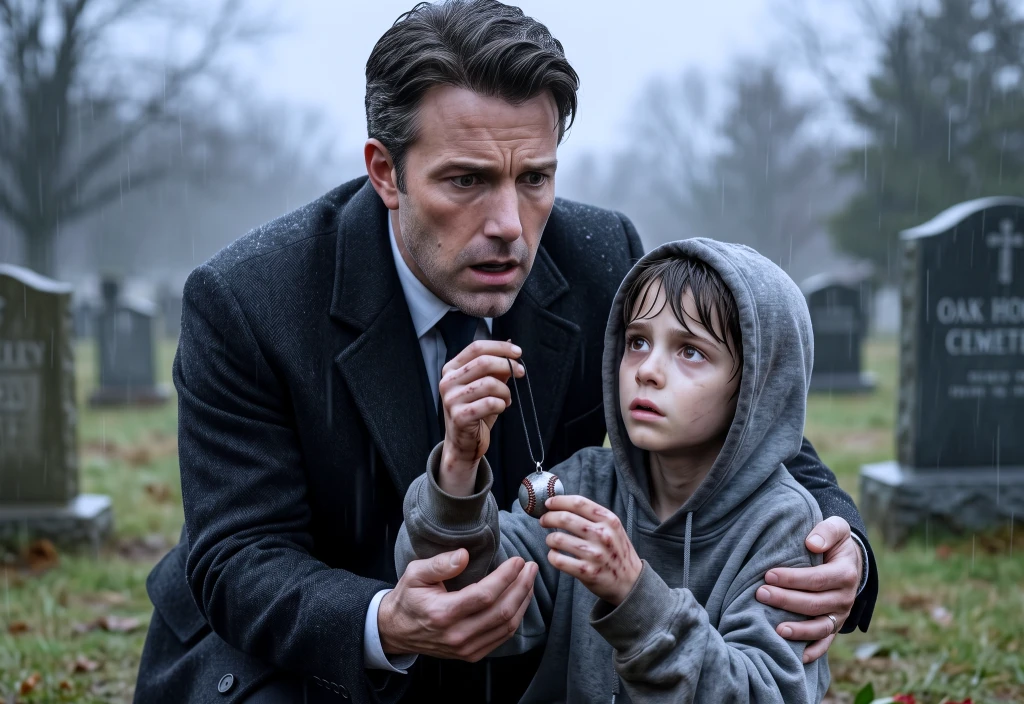
The rain had turned Oak Hollow Cemetery into a field of black umbrellas and silver puddles, except there were no umbrellas that Tuesday afternoon. No mourners. No family. Just Grant, six months after the charter bus crash, standing twenty feet from the grave where he had buried his twelve-year-old son.
And a boy who should not have been there.
The child had his back to him. He was too thin for his age, swallowed by a soaked gray hoodie that hung off one shoulder. One hand gripped a homemade wooden crutch, the kind somebody might carve out of desperation rather than buy from a drugstore. His right leg twisted inward beneath him, forcing his whole body to lean when he shifted his weight.
Grant told himself to keep moving. Kids cut through cemeteries sometimes. Grieving people saw patterns that were not there. He knew that better than anyone. In the first month after the funeral, he had heard Mason’s laugh in grocery store aisles, seen his son’s reflection in car windows, woken up to the shape of a boy in the doorway only to find a jacket hanging from a chair.
But the necklace moved when the boy turned, and Grant’s breath caught so sharply it hurt.
The charm spun once against the boy’s wet skin.
A baseball.
Number twelve.
Grant had bought one just like it at a mall kiosk after Mason hit his first real home run, a crooked line drive that barely cleared the left-field fence but had made the kid run the bases like he had just won the World Series. On the back, Grant had asked the woman behind the counter to engrave four words so small he had needed to squint to read them.
Dad’s champ. Always.
The necklace had vanished in the fire.
That was what they told him. The backpack, the phone, the permission slip, the baseball charm, everything had burned. Grant had accepted it because people accept the impossible when enough officials say it gently enough.
Now the boy at Mason’s grave turned fully toward him.
His face was not Mason’s. That was Grant’s first desperate relief. It was a ruined face, narrow from hunger and pulled unevenly by scar tissue. A pale ridge ran from the corner of his left eye to his jaw. Patches of hair grew in uneven tufts beneath the hood, as if the fire had chosen where to leave mercy and where not to bother.
But then the boy looked at him.
The eyes were Mason’s.
Brown, wide-set, too serious when he was scared. The same eyes that used to stare over the edge of the couch during scary movies, pretending not to be frightened. The same eyes that had followed Grant down the driveway the morning of the field trip when Mason had shouted, “Don’t forget, Dad. You promised batting cages Saturday.”
Grant had forgotten nothing since the crash. Forgetting would have been a kindness, and grief had not been kind to him.
“Dad,” the boy said.
The roses slipped lower in Grant’s hand.
The word did not sound like a stranger trying out a lie. It sounded thin and cracked and terrified, but beneath that, there was a shape Grant knew. A small lift at the end. A habit of hope, even when hope made no sense.
“No,” Grant said.
The boy flinched.
Grant heard the hardness in his own voice and hated it, but he held on to it because there was nothing else to hold. He had spent six months being torn open by sympathy, by casseroles left on his porch, by reporters parked at the curb, by people online inventing conspiracies about the crash. Three separate strangers had already called his office claiming Mason was alive. One had asked for money. Another had said God told her where the boy was buried. The third had been a man from Florida who sounded drunk and cried harder than Grant did.
He could not survive another cruelty.
“Who are you?” Grant asked.
The boy swallowed. His fingers tightened around the crutch, and the movement made him sway. “Please don’t yell.”
“Who sent you?”
“Nobody.”
“Did someone give you that necklace?” Grant took one step forward before he could stop himself. “Answer me.”
The boy backed up too quickly. The crutch sank into the mud, and his bad leg buckled. For a second he was falling, and Grant moved on instinct, dropping the roses in the grass as he caught the child under both arms.
The boy weighed almost nothing.
That was the first thing that broke something in Grant. Not the face. Not the limp. The weight. Mason had been wiry, always moving, all elbows and knees, but he had been solid with life. This child felt like a bundle of wet clothes and bones.
Grant let go as soon as the boy steadied himself, stepping back as if touch alone might make him believe too much.
“Don’t,” he said, though he did not know whether he was speaking to the boy or to himself.
The boy’s lower lip trembled. Rain gathered on his lashes and slipped down the scar on his cheek. “You used to say that when I cried too hard.”
Grant stared at him.
“You’d say, ‘Don’t, champ. Breathe first. Panic after.’” The boy tried to smile, but the scar pulled it crooked. “I hated that. I said panic didn’t wait its turn.”
Grant’s mouth went dry.
That line had never been in a news story. It had never been in a memorial video or an interview or a prayer card. It belonged to the hallway outside Mason’s bedroom, to nights when homework turned into tears and Grant tried to be patient even when work emails lit up his phone.
“Stop,” Grant said.
“I know you think I’m lying.”
“Stop talking.”
“The summer before fifth grade, I broke Mrs. Ellison’s birdbath with a baseball, and you told her it was you because Mom would’ve grounded me for a month.” The boy’s voice came faster now, frightened by Grant’s face but unable to stop. “You made me pay you back by washing your car every Saturday, except I only did it twice because it rained, and then you said I had terrible labor ethics.”
Grant looked down at his hands. They were shaking.
“Anybody could’ve found things out,” he said, but the sentence had no strength in it.
“Not that.”
“People read. People talk.”
“Then ask me something.”
Grant hated him for saying it. He hated the hope that rose up like a sickness. He hated the cemetery, the rain, the stone with Mason’s name carved too cleanly into it. He hated the small grave behind the boy and the long months when he had sat beside it, apologizing to a child who could not answer.
He forced himself to look at the headstone.
MASON ELI WHITAKER
2012–2025
Beloved Son. Forever Our Light.
The date still looked wrong. Mason had been born in June, during a thunderstorm, after twenty-two hours of labor and one emergency C-section that Claire still mentioned whenever Mason complained about chores. He had died in October, on a mountain road outside Beckett County, when the bus carrying his seventh-grade class back from the Riverbend Science Center slid through a guardrail and caught fire.
Grant knew the facts because the facts had been given to him again and again. By deputies. By doctors. By the county coroner. By lawyers. By the school superintendent with hands folded on a conference table and a voice so careful it made Grant want to throw a chair through the window.
The facts had buried his son.
“Ask me,” the boy whispered.
Grant turned back. “What did Mason call the dog?”
“Scout,” the boy said immediately. “But only when Mom was around. When it was just us, I called him Sir Barks-a-Lot because he barked at the mailman even after Mr. Keene retired and a woman took the route.”
Grant’s throat closed.
The boy shifted, wincing as his leg dragged in the mud. “You told me not to call him that because if Mom heard it, she’d start using it too, and then Scout would have a legal name change.”
Grant pressed his fingers against his eyes.
No. No, no, no.
“What was in the top drawer of my nightstand?” Grant asked.
The boy blinked, confused by the question. Then his expression changed, and for one second, scarred and starved as he was, he looked embarrassed in exactly the way Mason used to look when he had been caught knowing something he was not supposed to know.
“Your emergency candy,” he said. “Peanut butter cups. You said they were for low blood sugar, but Mom said your blood sugar was fine and your self-control was the medical emergency.”
Grant made a sound that was not a laugh. It hurt too much to be a laugh.
The boy took one limping step toward him. “Dad, I tried to come home.”
Grant stiffened. “Don’t call me that.”
“I tried.”
“Mason is dead.”
“I’m not.”
“I buried my son.”
The boy’s eyes dropped to the grave behind him. For the first time, Grant saw what the child had been doing before he turned around. There was a small object on the wet grass beside the headstone: a folded paper boat, made from lined notebook paper, its edges already softening in the rain.
Mason used to make those at restaurants out of kids’ menus, straw wrappers, receipts, anything. Claire would tell him to stop making a mess, and Grant would secretly slide him another napkin under the table.
The boy followed his gaze. “I didn’t know what else to bring.”
Grant stepped back.
The cemetery seemed to tilt under his feet. For six months, he had imagined seeing Mason again in every impossible form. A hospital call. A witness mistake. A dream he could choose not to wake from. But imagination was safe because it belonged to grief. It did not stand in the rain with a ruined leg and a homemade crutch. It did not remember hidden candy and paper boats.
It did not wear the necklace Grant had put around his son’s neck with his own hands.
“Where did you get that?” Grant asked.
The boy looked down at the charm. He touched it with two fingers, almost protectively. Up close, Grant could see the cord was not the original chain. It was a shoelace, knotted clumsily at the back of the boy’s neck. The steel charm itself was blackened on one edge, but the engraved words were still there, faint beneath the damage.
Dad’s champ. Always.
Grant reached for it, then stopped before his fingers touched the boy’s skin.
The boy did not move away this time.
“You gave it to me,” he said. “After I hit the ball over the left-field fence at Miller Park. You said it didn’t matter that the fence was short because nobody asked how tall the fence was in the record books.”
Grant’s breath came once, hard. The boy lifted his eyes. – “I wore it on the bus…”
To read the rest of the story – CLICK the NEXT button 👇👇👇