


The call came over my radio at 2:17 p.m., quiet enough that the visitors on the other side of the glass never looked up.
“Behavior team to Great Apes,” Tyler said. “Maya, you need to see this.”
I was halfway through checking enrichment notes for the orangutans when I heard the strain under his voice. Tyler Reed was new enough to still sound polite during emergencies, but not new enough to scare easily. I left the clipboard on the counter and took the back corridor at a fast walk, past the prep kitchen, past the laundry bins, past the row of wet rubber boots by the staff door.
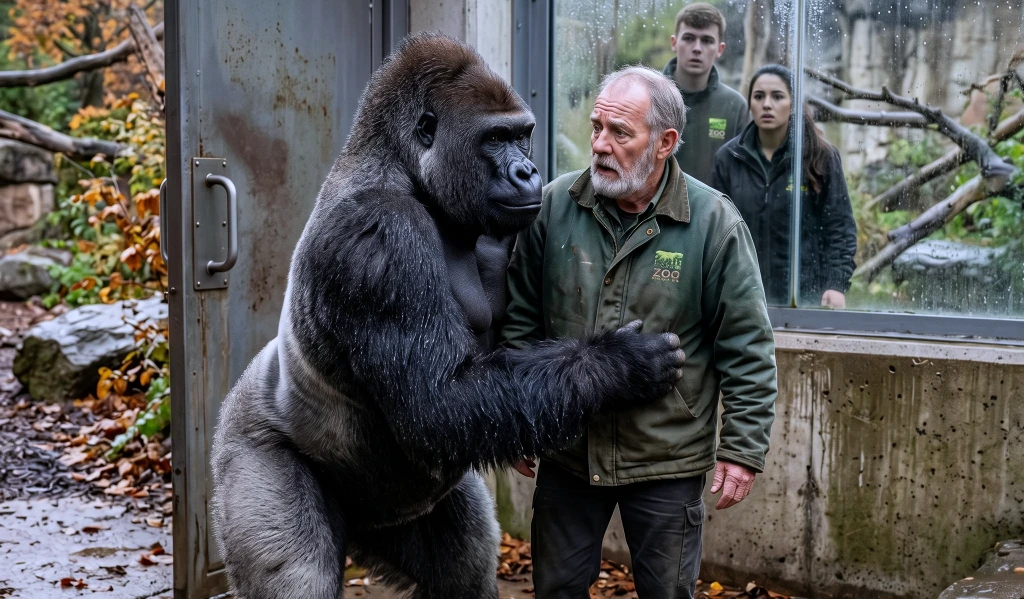
By the time I reached the observation room at Maple Ridge Wildlife Center, Boone had been holding Sam Whitaker for five minutes.
Boone was a western lowland silverback, close to four hundred pounds, with a silver saddle across his back and hands large enough to cover a dinner plate. Sam was fifty-four, broad and weathered, with a permanent stoop from thirty years of hauling feed, fixing latches, changing straw, and kneeling beside animals when nobody else could get close. He was not a small man, but inside Boone’s arms, he looked suddenly breakable.
Below us, in the gorilla yard, wet October leaves clung to the concrete ledge near the moat. Boone sat with his back against the climbing log, one arm locked across Sam’s chest and the other around his waist. He was not displaying. He was not roaring. He had not bared his teeth or struck the ground.
That was what made it worse.
A silverback in a rage was frightening, but at least rage had a shape. This was different. Boone’s grip was controlled, steady, and careful in the way a storm is careful when it decides not to break the tree yet.
“Third time today,” Tyler said beside me.
I kept my eyes on the habitat. “How long?”
“This one? Five minutes and forty seconds now.” He swallowed. “First one was after breakfast. Second was in the transfer hall before lunch.”
Below the glass, Sam shifted his weight. Boone tightened one arm just enough to stop him. Sam did not fight. His left hand rested on Boone’s wrist, fingers moving lightly through the coarse black hair there, and his mouth formed words we could not hear from the room above.
“Has he hurt him?” I asked.
“No. That’s the thing.” Tyler’s clipboard was tucked against his ribs like he had forgotten he was holding it. “He isn’t hurting him. He just won’t let him go.”
Sam turned his head toward the service door. Boone followed the movement, watching Sam’s face with an attention that felt almost unbearable. When Sam leaned forward, Boone leaned with him. When Sam stopped, Boone stopped. The animal had placed himself between Sam and the exit, not in panic but with purpose.
I lowered the binoculars I had not realized I’d lifted. “Show me the logs.”
Tyler handed them over before I finished asking. The pages were damp at the corners and smudged with mud from someone’s thumb. At the top, in Tyler’s neat block letters, the behavior had been labeled “repeated close contact with keeper.” The phrase was careful, neutral, and useless. It said nothing about the way Boone’s body curved around Sam as if the keeper were something precious slipping out of reach.
The first entries were from late July. One or two a week. Boone followed Sam into the indoor dayroom. Boone blocked Sam from the service gate. Boone placed hand on Sam’s shoulder during stall cleaning. By September, the notes were nearly daily. By October, Tyler had started writing the duration down to the second.
“Does he do this with you?” I asked.
Tyler shook his head. “He watches me. Sometimes he comes down if I’m carrying browse. If I’m late with the yams, he lets me know. But he doesn’t touch me unless I ask for protected contact.”
“What about Nina? Mark?”
“Same. Normal behavior.” Tyler looked down at Sam again. “It’s only him.”
Sam had gotten one foot under himself now. Boone loosened his hold but did not leave. He rose with Sam, knuckle-walking close enough that his shoulder brushed Sam’s thigh. Sam reached for the key ring clipped to his belt, patted the wrong pocket first, then the other one, then stopped with his hand still pressed flat to his jacket.
The movement was small. Anyone watching from the public viewing area would have missed it.
I did not.
Sam stared at the service door as if it had changed while he was looking at it. The key ring hung against his hip, bright metal against faded canvas. His hand hovered near it and then dropped.
Boone watched the hand fall.
“What changed?” I asked.
Tyler did not answer quickly enough.
I turned from the glass. “Tyler.”
He rubbed one thumb over the edge of the clipboard. “He’s been forgetting things.”
“Since when?”
“Spring, maybe. At first it was nothing. He left a hose running in Prep Two. Called me Travis twice, and there’s no Travis on staff. Put romaine in the freezer and laughed like he meant to do it.” Tyler’s eyes stayed on the yard. “Everybody jokes about forgetting stuff. Sam joked louder than anyone.”
“And now?”
“Now I found him in the south transfer corridor last week with his hand on the release pin, just standing there.” Tyler’s voice dropped. “He taught me that sequence. I’ve watched him do it blindfolded during drills. But that day, he looked at the latch like he had never seen metal before.”
In the yard, Sam bent slowly and picked something out of the mud. His fingers closed around the key ring at last. For a second, he held it in both hands, not using it, just holding on.
Boone moved in front of him.
The silverback did not shove or strike. He simply placed his body between Sam and the door, then lowered himself until his head was level with Sam’s chest. One massive hand came up and pressed against Sam’s sternum with the flat, unmistakable command of a creature who did not need language.
Stay.
Sam closed his eyes.
Tyler made a sound beside me and stopped himself. He was twenty-six, maybe twenty-seven, all elbows and worry, the kind of young keeper who came in on his days off because an animal had sneezed the wrong way. Sam had trained him. Sam had trained half the building.
“His wife made him see a neurologist in Columbus,” Tyler said. “After Labor Day.”
I already knew the answer, but I made him say it. “And?”
“Early-onset Alzheimer’s.” His mouth twisted around the word. “Fast-moving, they think. Linda called HR asking about medical leave and pension options. Sam told us he was just tired.”
There are places in a zoo where sentiment can become dangerous if you let it stand in for judgment. I knew that. Every keeper knew that. Love did not make steel doors less important. Trust did not turn a silverback into a nurse. An animal could mean to protect you and still injure you by accident.
Still, watching Boone hold Sam there, I felt something in my chest turn heavy and cold.
Sam opened his eyes and looked down at Boone. His lips moved. This time, because the yard microphone was on, a thin piece of his voice came through the speaker above the observation console.
“I’m here, Boone.”
The silverback stayed still.
“I’m still here,” Sam whispered.
Boone’s fingers curled lightly in the front of Sam’s jacket, and for a long moment neither of them moved.
By four o’clock, we had cleared the public gallery, secured the building, and moved Sam out through a supervised gate with Tyler handling the locks. Sam told us he was fine. He said it twice, and the second time he was angry enough that nobody answered. Boone stood at the mesh until Sam disappeared from the corridor.
That evening, I asked security for every camera angle from Great Apes since midsummer.
The first folder crashed my laptop. The second took almost twenty minutes to load. I sat alone in the small veterinary conference room with cold coffee, a legal pad, and six weeks of footage stacked in digital rows. Outside, the park emptied into darkness. Inside, the cameras played back a private disaster none of us had wanted to see.
At 8:43 p.m., I found the clip that made me stop taking notes.
It was from August 12, long before Tyler had started writing detailed behavior logs. Sam entered the transfer corridor alone, carrying a coil of hose and the same key ring. Boone was visible through the mesh in the adjoining stall, sitting with his back turned. Sam shut one gate behind him, reached for the secondary latch, and froze.
Not paused.
Froze.
His shoulders lifted. His head turned left, then right. The corridor was the one he had walked for decades, cream-painted concrete, warning signs, steel tracks, drain grate near the corner. But on the screen, Sam looked like a man who had stepped into a room after the walls had moved.
Boone turned before Sam made a sound.
He came to the mesh fast, not in a charge, not in a threat. He pressed his hand against the barrier near Sam’s shoulder. Sam flinched, then looked toward him, and for a few seconds the two of them stayed like that with steel between them.
I turned up the audio.
The corridor microphone crackled. Sam’s voice came through rough and low, so small I had to rewind it twice before the words settled. – “Don’t let me through the wrong door…”
To read the rest of the story – CLICK the NEXT button 👇👇👇