


The grizzly’s first strike landed six inches from my throat. Its claws hit the climbing rope instead of my neck, and the whole western larch shuddered behind me. Bark filled my collar. I tasted blood and realized, with a clarity that felt almost calm, that someone had tied me upright for an animal to find.
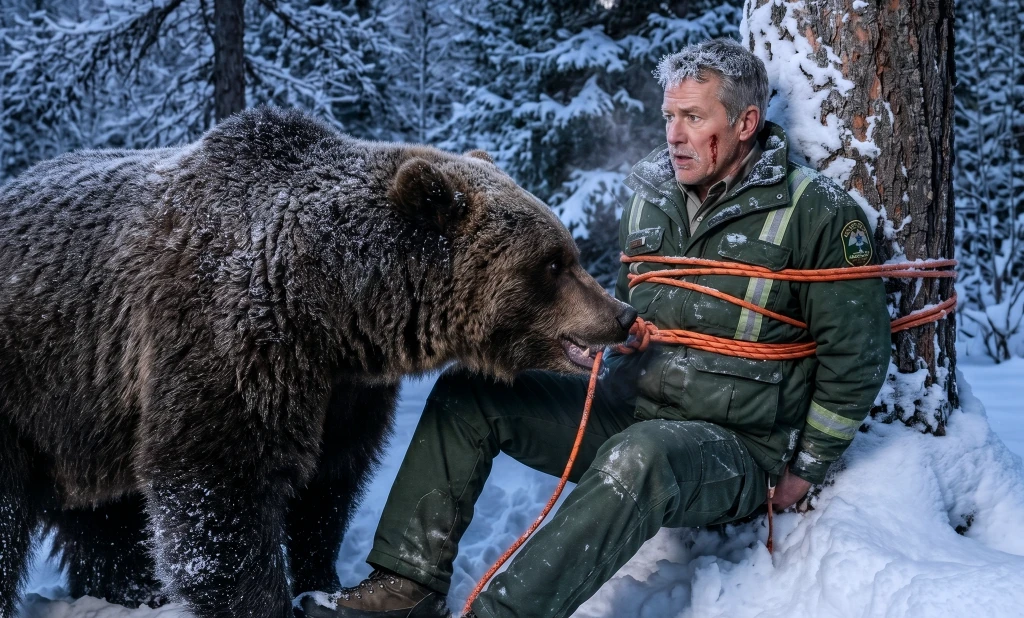
I had been conscious for maybe three seconds. My wrists were pinned behind the trunk, my ankles lashed together, and three turns of rope crossed my ribs so tightly that every breath stopped halfway in. My radio, phone, and service belt were gone. A warm line slid from the cut behind my left ear and cooled along my jaw.
The bear dropped back onto all fours.
He stood close enough that I could see mud pressed into the grooves of his front claws. He was a full-grown male, dark across the shoulders and broad enough to block the thin evening light between two firs. His nose moved constantly, sorting blood, sweat, rope, pine pitch, and whatever else the clearing had told him before I opened my eyes.
I stopped pulling against the knots. Eighteen years as a state conservation officer had taught me that panic is useful only when it moves you toward an exit. I had no exit. I had a tree at my back, a grizzly in front of me, and barely enough air to keep my vision from narrowing.
“Easy,” I said.
The word came out rough and small. One of the bear’s ears tipped forward, then turned toward the woods again. He did not charge. He did not retreat, either.
My name is Ethan Hale. In Pinewater County, people knew me as the officer who checked coolers after dark, counted every tagged elk, and remembered tire tread better than faces. That reputation had never made me popular with men who treated public land like a private warehouse. Until that afternoon, I had believed it had at least made me predictable enough to stay alive.
Cal Warren and Jesse Nolan had known me long before the badge. We learned to swim in the same cold reservoir, stole apples from the same abandoned orchard, and stood together at my mother’s burial when none of us was old enough to know what grief did after everyone went home. Cal could make a room lean toward him when he laughed. Jesse was the one who noticed who had been left out and moved over on the bench.
For most of my life, I would have trusted either man with the keys to my house.
Eight months earlier, antlers began moving through the county without the animals attached to them. A taxidermist called about a rack that did not match the harvest tag. Then a butcher found two freezers full of meat no one could explain. Trail cameras disappeared from closed drainages, and a black-market buyer across the state line mentioned a middleman from our side of the mountains.
Cal’s name surfaced first. Jesse’s came two weeks later.
I did not want the information to be true, which made me slower than I should have been. I checked it twice, then a third time. I watched trucks. I copied dates. I told myself there might be another explanation for Cal’s fuel receipts, Jesse’s late-night trips, and the photos of trophy animals that never appeared in legal records.
By October, there was no other explanation left.
That afternoon, fresh tracks cut around a locked gate above Kestrel Pass. Snow had not settled yet, but the ground was stiff with frost, and the mud held the block pattern of Cal’s rear tires as clearly as a signature. A hundred yards beyond the gate, I found blood sprayed across huckleberry leaves and a drag mark leading uphill.
I called my location in before the signal broke apart. I should have waited for another officer. Instead, I followed the drag line into the timber because the light was going and because I had spent too much of my life believing that knowing a man made him less dangerous.
The elk lay in a shallow cut below an old logging landing. Its head was gone. Most of the meat had been left where it fell.
Cal’s truck sat above it with the tailgate down. Jesse was wrapping something in a blue tarp while Cal wiped his hands on a shop rag. When they saw me, nobody reached for a weapon. That almost convinced me the worst thing in the clearing was the dead elk.
“Ethan,” Jesse said. His face had gone gray. “You came alone?”
Cal looked past me toward the road. “Of course he did.”
I kept my right hand near my holster without touching it. “Step away from the truck.”
For a moment, all three of us were boys again, waiting to see who would jump first from the quarry ledge. Then Cal smiled, and the years between us closed in the wrong direction.
“You always did like telling people what to do,” he said.
Jesse whispered his name. It sounded like a warning, but not one meant for me.
The blow came from behind. Later, I understood there must have been a tire iron on the ground near the truck. In the moment, there was only white light inside my skull, Cal’s boot against my ribs, and Jesse saying, “This wasn’t the deal,” over and over as if repetition could turn him into someone who was not helping.
When I surfaced once, they were dragging me by the jacket. Cal complained about my weight. Jesse asked whether I was breathing. Neither of them stopped.
I came awake again while rope passed beneath my arms. The sky above the larch had narrowed to a strip of gray, and Cal was telling Jesse that exposure would do the rest before morning. Jesse said they could leave me near the road and claim they had found me after a fall. Cal answered that my notebook, my radio log, and the elk below the landing made an accident too difficult to sell.
“Then we call somebody,” Jesse said.
Cal pulled the knot tighter. “You call somebody, you go down with me.”
Jesse looked at my open eyes. He had time to stop. That was the part my mind returned to later—not the blow, not the rope, but the two seconds in which he saw me watching and chose to turn away.
Now the bear stood where they had left me.
He moved closer, one deliberate step at a time. His coat was rough with burrs, and a notch cut the rim of his right ear. He lowered his head until his nose hovered near my boot, then followed the line of my leg upward, breathing in short, wet pulls.
I knew better than to read kindness into curiosity. A bear investigates with the same body it uses to break open logs, turn stones, and defend a carcass. The fact that he had not hurt me yet was not a promise.
His muzzle reached the rope across my chest. He sniffed the bright orange braid, opened his mouth, and closed his teeth around it.
The knot tightened so sharply that pain shot through my ribs. I grunted before I could stop myself. The bear released the rope at once and lifted his head, watching my face.
That pause frightened me more than the bite.
He touched his nose to the torn shoulder of my uniform jacket. His breath was hot against my neck, carrying the smell of damp earth and something sweet, maybe old berries. I could hear every shift of his tongue behind his teeth. I could also see a pale line beneath the fur along his left side, half-hidden until he leaned past me.
The scar began just behind the shoulder and curved toward his belly in a crooked crescent.
Five years disappeared.
I saw a cub on a stainless-steel table in the back room of our regional office, small enough to fit inside my coat and angry enough to try to bite through a leather glove. I saw black fur shaved away from a wound made by illegal snare wire. I saw my own hands holding the edges together while Ruth Palmer, the nearest licensed wildlife rehabilitator, drove through a sleet storm to reach us.
The cub had fought the sedative, the blanket, and every person who tried to save him. Just before dawn, he had made one short, impatient huff and hooked a paw into my sleeve as if refusing to let me leave first.
Ruth had told me not to give him a name.
I had named him Alder before she arrived.
The grizzly shifted, and the scar vanished beneath his coat. The rational part of me listed every reason I could be wrong. Scars repeat. Animals wander. Memory becomes greedy when death is close.
Still, I looked at the notch in his ear, the pale crescent under the fur, and the way he kept returning to my face whenever pain changed my breathing.
“Alder?” I whispered. The bear went motionless. For one long second, the timber held only the sound of my pulse. Then his ears eased forward, and a soft huff warmed my cheek—the same small, irritated breath I had heard from a half-frozen cub in a borrowed blanket. He lowered his head, found the rope at my chest, and began to pull…
To read the rest of the story – CLICK the NEXT button 👇👇👇