


At first, Hank Walker thought the sound was a branch cracking under ice. He stopped in the middle of the old logging road, one gloved hand resting on the stock of the walking stick he carried more out of habit than need. The February air on Crow Ridge had a hard blue edge to it, the kind of cold that made pine needles look silver and turned every breath into something visible. For three days, the mountain had been quiet enough to hear snow sliding off a roof half a mile away.
Then the sound came again.
Thin. Strangled. Alive.
Hank turned his head toward the draw below the road, where lodgepole pines leaned over a shallow wash that fed Black Creek in the spring. Most men in Coldwater County would have kept walking. Some would have gone back for a rifle. Hank had spent twenty-two years as a game warden before grief turned him into a man people talked about in low voices at the diner, and his body still knew the difference between wind and suffering.
He stepped off the road and sank nearly to his knees.
The snow had crusted over in the night, but something heavy had broken through it before dawn. A churned path led down between the trees, stained here and there with dark flecks that had already begun to freeze. Hank followed slowly, scanning the trunks, the shadows, the broken brush. He saw the orange flagging tape first, tied too neatly to a branch for weather to have put it there.
Then he saw the cable.
It ran from the base of a bent pine to something silver-gray and breathing in the snow.
Hank went still.
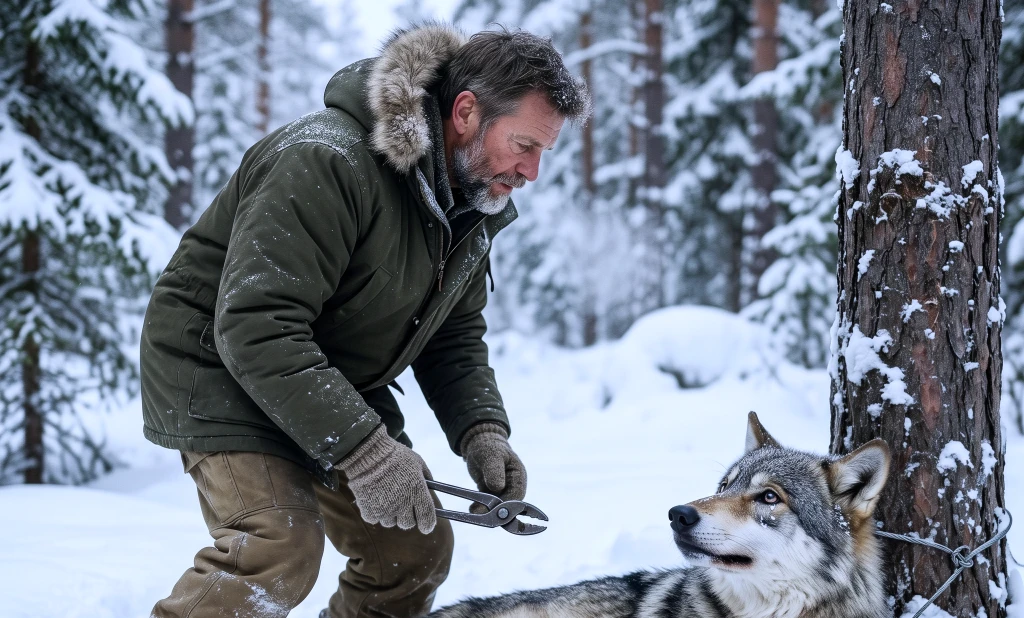
The wolf had twisted herself half around the trunk, not hanging the way a dead animal might hang, but caught low by the neck and shoulder, one front leg folded wrong beneath her. She was large, though hunger had sharpened the lines of her ribs. Frost clung to the guard hairs along her back. Her eyes followed him as he came closer, and they did not soften. They were yellow, wild, full of pain, and ready to spend the last of her strength on one bite if he gave her no other choice.
“Easy,” Hank said.
His voice sounded strange out there. He had not spoken to another living thing since the previous afternoon, when he had told the old woodstove to quit sulking and burn right. People in town had once known him for a dry laugh and a patience that held through blizzards, drunk hunters, lost hikers, and men who lied with blood on their boots. These days they mostly knew his mailbox, his tire tracks, and the way he left before anyone could ask how he was doing.
The wolf lunged when he took another step. The cable bit tighter. A ragged sound tore out of her, and Hank backed up fast, one hand raised though he knew she would not understand the gesture.
“I know,” he said, lower this time. “I’d hate me too.”
He crouched several feet away and studied the snare. It was illegal in at least three ways he could see without touching it. Wrong height. Wrong placement. No tag. Set along a ridge line where deer, elk, coyotes, and anything else with a beating heart might pass through. A man who set a snare like that was not making a mistake. He was counting on the woods to hide what he had done.
Hank looked past the wolf to the broken trail behind her. She had fought hard. Long enough to melt the snow beneath her. Long enough to wrap the cable twice around the pine. Long enough that any decent person would have been ashamed to see it.
Then he noticed her belly.
It was not the roundness of a full meal. He had seen enough pregnant animals in his life to recognize the weight, the shape, the way she tried to protect herself even as the cable pulled at her throat. Somewhere under that matted fur, under the fear and the blood and the ice, small lives were still waiting for a chance.
Hank closed his eyes for one second.
He saw Ruth as clearly as if she were standing beside him in her green parka, her braid tucked under a wool cap, her face serious in the way it got whenever people confused wild with worthless. She had been the one who stopped for foxes on the highway, who carried towels and syringes in the back of their truck, who could make a frightened hawk settle just by lowering her voice. She had also been the one who went out on a search near Black Creek eleven years earlier and never came home.
Hank had not gone with her that night. They had argued about something so small he could no longer remember the words, only the tone. She left anyway because a child was missing, and Ruth Walker did not measure mercy against weather. The boy survived. Ruth’s truck slid off the service road after midnight and dropped nose-first into the black water where the creek narrowed between the rocks.
People said she died doing what she believed in. Hank had never found much comfort in that.
Now the wolf strained against the cable and made a sound that was not a howl, not a growl, but a raw breath forced through pain. Hank opened his eyes.
“All right,” he said. “I hear you.”
He had a folding knife in his coat and wire cutters in the canvas pack he carried on winter rounds. The cutters were old, their handles wrapped with electrical tape Ruth had put there one summer when the rubber split. He took them out carefully, watching the wolf’s head. She watched the cutters.
The first time he reached for the cable, she snapped. Her teeth caught the outer layer of his glove, close enough for him to feel the pressure without losing skin. He pulled back, waited, and tried again from a different angle. The cable had cut into the fur at the side of her neck. If he pulled wrong, she could choke before he freed her.
“Not asking you to trust me,” Hank said. “Just asking you to keep breathing.”
The cold worked its way into his knees. His fingers numbed inside the gloves. Twice he had to stop because the wolf thrashed so hard the cable tightened, and each time he waited until she exhausted herself before he moved again. He spoke because Ruth had always spoken to animals, not because the words mattered. Maybe tone did. Maybe breath did. Maybe nothing did, and he was only trying to remind himself he was still human.
When the cutters finally bit through the cable, the release came too suddenly. The wolf collapsed sideways, nearly striking his arm with her head. Hank scrambled back as she tried to rise. Her injured leg failed. She dragged herself two feet, bared her teeth, and then sank into the snow with a shudder that traveled through her whole body.
He could have left her there. A state biologist might have told him to mark the location, back away, make a call, and let procedure handle what procedure could. But there was no cell signal in the draw, the road was drifted in, and procedure had never warmed a dying animal through a mountain night.
Hank looked toward the ridge. His cabin was almost three miles away if he followed the old logging road and cut across the meadow. He had a small rescue sled strapped behind the tool cache near the road, meant for firewood or an injured hiker. He had used it twice in the past ten years, once for a neighbor’s boy with a broken ankle and once for the body of a mule deer some out-of-county men had shot and left.
“Ruth,” he muttered, because sometimes her name was the only prayer he had left.
The wolf did not make it easy. He expected nothing else. Getting the old quilt around her took nearly half an hour, and by the time he managed to shift her onto the sled, sweat had frozen under his collar. She struck once, weakly, catching the edge of his sleeve. He did not blame her. Pain had a language of its own.
The pull home was worse than he expected.
The sled bogged down in powder. The wind came up from the west and shoved snow into his tracks as fast as he made them. Twice he fell. Once, on the slope above the meadow, he went down hard enough that his shoulder rang with white heat and he lay there staring at the colorless sky, wondering if this was the kind of foolishness that got old men found in April. Behind him, the wolf’s breath steamed through the quilt. It came unevenly, but it came.
He got up.
By the time his cabin appeared through the trees, the world had narrowed to the rope in his hands and the dull fire in his lungs. The place looked smaller than it used to, a cedar-sided cabin with a low porch, a woodshed, and a barn Ruth had once painted red because, she said, every lonely ridge needed one cheerful thing. The paint had faded to the color of old blood. Hank had meant to repaint it for six summers.
He dragged the sled to the barn first, then changed his mind. The barn was too cold. The wolf needed warmth before distance. He hauled her through the mudroom and into the cabin, leaving snow and pine needles across the floor Ruth had scrubbed every Friday whether it needed it or not.
Inside, the air smelled of woodsmoke, coffee grounds, and the cedar kindling stacked by the stove. The wolf lifted her head when the door shut. Her lips peeled back, but the sound she made was thin now. Hank spread the quilt in the far corner near the kitchen, away from the stove but close enough for heat, and eased her down onto it. He kept the table between them while he built the fire higher.
“Don’t get comfortable,” he said, though his voice had lost its edge. “You’re not staying. Soon as the road clears, I’m calling Claire.”
The name put a small ache in the room. Dr. Claire Bennett had been Ruth’s friend before she became Hank’s emergency number, the kind of woman who still sent a Christmas card even though he had not answered one in years. She ran the veterinary clinic in town, treated ranch dogs and calving cows, and quietly helped the state when injured wildlife needed hands before paperwork. Ruth had trusted her. That still counted for something.
Hank cleaned the wound as best he could with warm water, antiseptic, and a towel wrapped around his left forearm in case the wolf found strength enough to punish him. She growled through most of it. Once she pressed her head into the quilt and made a low, shaking sound that went through him more sharply than the cold had.
The leg worried him. It did not look shattered, but it was swollen and tender. He could not do much without Claire. He could only stop the bleeding, warm the animal slowly, and place a shallow pan of water near enough for her to reach if she chose. He set strips of venison on an old plate and pushed it halfway across the floor with the broom.
The wolf stared at him until he retreated to the rocking chair by the stove.
Only then did she eat.
Hank watched without meaning to. Her movements were careful, efficient, still dangerous. She was not a dog. She was not grateful. She did not belong to him because he had cut a cable. That was the first thing Ruth would have reminded him, probably with one eyebrow raised and the tone she used when he mistook silence for agreement.
On the table by the window lay one of Ruth’s old field notebooks. Hank had taken it out the week before to press a loose photograph back between the pages, then left it there because putting it away felt like another small burial. Now, while the wolf drank and the fire snapped, Hank opened it.
Ruth’s handwriting leaned forward, quick and dark. Most of the notes were practical: dates, weights, wound descriptions, feeding schedules. In the margin of one page, beneath a sketch of a fox kit with oversized ears, she had written a line Hank had avoided reading for years.
Wild things don’t owe us love. We owe them mercy anyway.
Hank shut the notebook.
In the corner, the wolf lowered her head over her front paws. Her eyes stayed open. Every few minutes, her belly tightened and shifted. Hank pretended not to see how badly that unsettled him.
Outside, dusk folded itself into the pines. The wind pushed snow against the windows. Hank tried the landline twice, but the storm had taken it down, leaving only a dead hum that came and went like a tired insect. He checked the wolf’s water, added another log to the stove, and told himself he would rest for ten minutes before trying the radio in the mudroom.
He sat in the rocking chair with Ruth’s quilt over his knees.
The cabin had trained him in loneliness. It creaked in certain places when the temperature fell. It breathed through gaps he had never gotten around to fixing. At night, the emptiness had a shape, and Hank knew every inch of it. But that night there was another sound in the room: the rough, stubborn breathing of a creature that had every reason to hate his kind and no strength left to show it.
He must have slept harder than he meant to.
The next sound did not come from the wind. It came from the floor.
A scraping. A thud. Then a harsh, broken bark that jerked him out of a dream so old he could still see Ruth’s headlights sliding across wet gravel. Hank opened his eyes to darkness and orange light, confused by the smell before he understood it.
Smoke.
The wolf was out of her corner. She had dragged herself across the floor, one useless leg twisted beneath her, leaving the quilt behind in a dark, rumpled heap. Her head was low, her teeth bared, and for one stunned second Hank thought she had finally gathered enough strength to come for him.
Then a coal popped from the warped stove door and rolled onto the rag rug at his feet.
The wolf barked again, ragged and furious, and Hank saw the black circle spreading through the wool. She was not trying to attack him. She was trying to wake him before the cabin filled with smoke…
To read the rest of the story – CLICK the NEXT button 👇👇👇