


The room was supposed to be empty by Wednesday. Instead, when Marjorie Price pushed open the basement door, twenty-three years of our lives stared back at us. Photographs covered all four walls of the cramped caretaker’s room, rising from the baseboards to the low concrete ceiling. There were babies in strollers, teenagers racing bicycles across the courtyard, old men playing chess on overturned milk crates, women carrying groceries through the snow. Beneath every picture, someone had written a name and date in careful black ink.
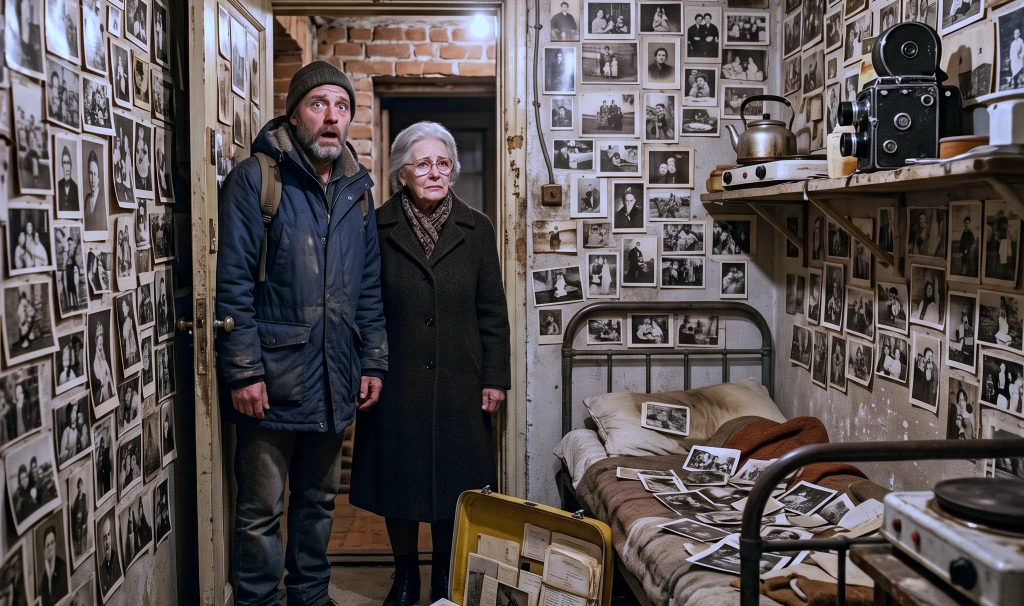
I stepped closer to the wall beside the door and found myself.
“Martin Hale. September 3, 2003. Walking Megan to fifth grade.”
My daughter was ten in the picture. Her purple backpack looked almost as large as she was, and I had one hand resting on her shoulder as we crossed the courtyard. Megan was looking up at me, laughing at something I no longer remembered.
I remembered the backpack. I remembered that she had been nervous about her new teacher. I even remembered the cereal she had spilled that morning.
I did not remember Samuel Mercer standing nearby with a camera.
Marjorie leaned around my shoulder. At seventy-two, she still carried herself like the principal of a school everyone else had forgotten to leave. Her silver hair was pinned into a firm twist, and her glasses hung from a chain against a blouse buttoned to the throat.
“Did he take these without telling us?” she asked.
“I guess he did.”
“That’s unsettling.”
Her words were sharp, but she did not move away from the wall. Her eyes had caught on a photograph of two children building a crooked snowman beside Building Three.
The room lay beneath Cedar Court, a group of six aging brick apartment buildings arranged around a common courtyard in Buffalo. It had once been intended for a live-in superintendent. By the time Sam arrived, it was little more than a nine-by-ten-foot space with a cot, a sink, a hot plate, and one barred window at sidewalk level.
The management company let him sleep there as part of his pay. None of us had questioned the arrangement. We barely questioned anything about Sam.
Now Northline Residential wanted the room cleared so an electrical contractor could install a new breaker bank. Marjorie chaired our tenant council, and I had made the mistake of volunteering for that council years earlier. That was why we were standing there with contractor bags, work gloves, and a folding hand truck.
It was also why I was among the first residents to see what Samuel Mercer had left behind.
He came to Cedar Court in the summer of 2003. I was forty-one then, Megan had just finished fourth grade, and my wife, Laura, was still working evening shifts at the county hospital.
Sam looked older than the fifty years listed on his employment papers. His shoulders curved forward, and his long arms seemed to hang from his work coat rather than fit inside it. In winter he wore the same faded green parka, repaired across one shoulder with silver duct tape. In summer he worked in gray T-shirts washed thin enough to show the outline of his collarbones.
Every morning, while I stood at our kitchen window drinking coffee, his cart rattled across the courtyard below. Every evening, before Laura and I sat down to dinner, he made one last circuit of the dumpsters.
Between those two sounds, my entire day happened. I went to work, stopped at the grocery store, helped Megan with homework, argued with Laura about money, watched the news, and fell asleep.
Sam swept leaves, cleared snow, changed trash bags, trimmed hedges, and disappeared into the basement.
We exchanged the same words for more than two decades.
“Morning, Sam.”
“Morning.”
“Cold one.”
“Sure is.”
Once, during his first year, Megan asked why the new groundskeeper never talked.
“He’s working,” I told her. “Not everybody wants to chat.”
It was the sort of answer a busy father gives when he assumes there will be another morning, another question, another chance to pay attention.
Sam died near the end of March.
A lake-effect storm had dropped several inches of wet snow overnight. On the first morning, I noticed the walkways had not been cleared. On the second, I complained to Laura that the management company was cutting corners again. By the fourth, trash bags had begun piling beside the dumpsters, and someone called Northline’s emergency number.
A maintenance supervisor found Sam on his cot in the basement room. The county medical examiner said his heart had stopped sometime during the night.
We noticed the snow before we noticed the man.
No relative came forward. The county arranged a simple burial, and eight people stood beside the grave: a Northline representative, two maintenance workers from other properties, a county employee, Marjorie, Mrs. Alvarez from Building One, another tenant whose name I did not know, and me.
The wind cut through my coat while a funeral-home employee read a few sentences from a card. There was no photograph beside the casket and no story about the person inside it. The temporary marker said only:
SAMUEL MERCER
1953–2026
I stood there thinking about the hundreds of mornings Sam had crossed the courtyard before any of us were awake. He had salted the steps where our children ran, carried broken furniture to the dumpsters, found lost keys, jump-started dead cars, and shoveled paths through storms that closed schools.
Until that funeral, I had never wondered where he was born.
Three weeks later, Marjorie and I entered his room to throw away what remained.
A narrow cot stood beneath the window, covered with a brown plaid blanket. Beside it was a particleboard nightstand, one corner swollen from an old leak. A single-burner hot plate sat on a metal cabinet next to a chipped mug.
On the shelf above the bed rested a battered Pentax camera. Its black casing had been worn smooth at the edges, and a fine crack ran across the plastic around the lens. Under the cot, I found developing trays, empty chemical bottles, and a lightproof film tank.
“He printed them here,” I said.
Marjorie looked around the room again. “All of them?”
A yellow suitcase sat in the corner with a rusted weight placed on its lid. Inside were bundles of photographs tied with string, rubber bands, shoelaces, and strips of cloth. Some had fused together at the edges, but most were remarkably well preserved.
I lifted one bundle. Every photograph had been labeled.
“Rosa Alvarez. January 11, 2004. Feeding the sparrows.”
“Daniel Reeves. June 6, 2008. Teaching his son to patch a bicycle tire.”
“Evan Brooks, age eight. First day of school.”
There were 1,237 photographs. I learned the exact number later, after counting them twice at my kitchen table.
None appeared staged. People bent to tie children’s shoes, brushed snow from windshields, carried birthday cakes, sat alone after bad news, and laughed at jokes that had vanished years earlier. Sam had not photographed private windows or embarrassing moments. He had recorded ordinary life in public places, always from a respectful distance.
That somehow made the pictures harder to look at.
He had seen dignity in moments the rest of us had considered too small to remember.
Marjorie glanced at her watch. “The contractor arrives Wednesday.”
“Give me two days.”
“For what?”
“I don’t know yet.”
She studied me over the top of her glasses. Then she looked at the photographs covering the walls and at the unopened contractor bags near the door.
“Forty-eight hours,” she said. “After that, the room has to be cleared.”
That night, I spread Sam’s photographs across our kitchen table and the living-room floor. Laura went to bed shortly after midnight, but I kept sorting them into piles by year.
Cedar Court changed one picture at a time. The old wooden playground disappeared. A maple near Building Two grew from a sapling into a broad, shading tree. Cars became larger, clothes changed, children lengthened into adults, and familiar older faces quietly stopped appearing.
Sam remained absent from every frame.
Near the bottom of the suitcase, I found a sealed envelope made from thick cream-colored paper. Inside was a glossy photograph unlike the matte black-and-white prints from Cedar Court.
A girl of about eleven stood in rubber boots beneath a tree. She had a gap between her front teeth and was smiling at something above the camera. Sunlight caught in her hair.
On the back, Sam had written:
“Maggie. Her last summer.”
I knew every child who had grown up at Cedar Court during Sam’s years there. This girl had never lived among us.
The next morning, I returned to the basement alone. Beneath the cot mattress, I found a brown composition notebook with a cracked vinyl cover. Three-quarters of its pages had been filled in the same precise handwriting as the photograph captions.
The first entry was dated July 2003.
“Cedar Court. New city, new work. I could not keep my own safe. Maybe I can keep a record of other lives. Names, dates, ordinary days. Proof they were here.”
Two official documents had been folded between the first pages.
The first was a death certificate for Margaret Anne Mercer, age eleven. The second belonged to Claire Louise Mercer, age forty-six, and was dated seven months later. In the space marked relationship to the deceased, the same man had signed both forms. Samuel Thomas Mercer. Father on one. Husband on the other…
To read the rest of the story – CLICK the NEXT button 👇👇👇