


The cat came in during the prayers for the sick. Father Matthew Reed noticed her because old Mrs. Bellamy stopped whispering the response and lifted one hand to her mouth. At first, he thought a child had slipped through the side door of St. Luke’s, the old Episcopal church that sat at the corner of Maple and Third in Hawthorne, Pennsylvania. Then he saw the small gray shape moving down the center aisle with the steady confidence of someone who had been there before.
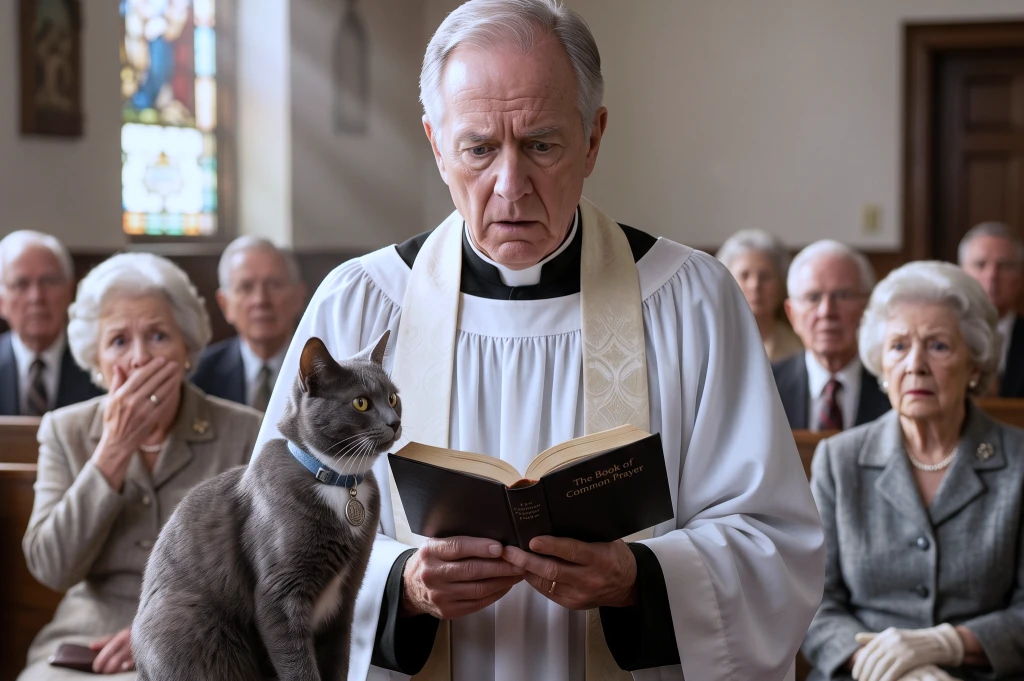
She did not look frightened. That was the first thing that unsettled him. Lost animals usually bolted under pews or froze near the entrance, waiting for someone to chase them back into the weather. This cat walked past the brass offering plates, past the worn kneelers, past the row where Eleanor Whitaker always sat with her folded gloves in her lap.
Then she stopped at the communion rail and looked straight at him.
Father Matthew forgot the next line of the prayer.
The book was open in his hands. The words were familiar enough that he could have said them half-asleep, and some mornings, after twenty-seven years in parish ministry, he nearly did. But the sight of that gray cat sitting beneath the carved wooden cross reached into some quiet room inside him and opened a door he had been trying not to notice.
The cat’s fur was thick and storm-colored. A white patch rested on her chest like a tiny bib, and around her neck hung a faded blue collar with a small St. Francis medal. Father Matthew knew that collar. He knew the crooked little bell Eleanor had tied to it with blue thread after the clasp broke. He knew the way the cat’s left ear tipped slightly forward, giving her the permanent expression of someone listening for a secret.
“Mabel,” he said under his breath.
A few people shifted in the pews. Mr. Carver, who came every Wednesday and slept through half of morning prayer, opened both eyes for once. Mrs. Bellamy crossed herself twice even though she had once told Father Matthew that Episcopalians were not required to do anything that dramatic unless they truly meant it.
Mabel did not move. She sat at the rail and watched him with yellow eyes, unblinking.
Father Matthew forced himself to look back down at the prayer book. His thumb trembled against the thin page. He found the line he had lost, but the words came out softer than before, and each sentence had to push its way past the cold weight gathering under his ribs.
Eleanor had not been in church for two Sundays.
He had noticed. Of course he had noticed. In a small parish like St. Luke’s, an empty seat was not really empty. It carried the shape of the person who belonged there. Eleanor’s pew still held the memory of her neat black purse, her gloves, her cane propped against the end, her quiet voice singing half a beat behind everyone else.
He had meant to call.
That was the sentence that kept finding him now, sharp and useless.
He had meant to call after the first Sunday, but the boiler had gone out in the parish hall, and the youth group had needed rides to the service project, and a man from the food pantry had come in crying because his wife had left with the kids. He had meant to call after the second Sunday, but there had been a funeral in the morning, an emergency vestry meeting at lunch, and three hospital visits before dinner.
There was also the blinking red light on the church office phone. Eleanor had called late Friday afternoon, just as he was carrying boxes of canned soup into the pantry. He remembered seeing her name on caller ID and thinking he would return it when his hands were free.
He had not returned it.
Now Mabel was sitting at the communion rail as if she had carried that missed call in her mouth all the way from Eleanor’s apartment.
Father Matthew finished the prayers. He did it because people were watching him and because ritual had taught him how to keep moving when his heart did not want to. He prayed for the sick, for the lonely, for those who had no one to pray for them by name. At that last line, Mabel’s ears twitched.
The service ended in the usual way, but nothing about the room felt usual. People stood slowly, gathering purses and hymnals, all of them looking toward the front as if the cat might vanish if they turned away. Mabel stayed where she was until Father Matthew closed the prayer book.
Then she stood.
“Father?” Mrs. Bellamy whispered from the front pew. “Do you know whose cat that is?”
“Yes,” he said.
His own voice sounded too flat. He cleared his throat and tried again. “She belongs to Eleanor Whitaker.”
Mrs. Bellamy’s face changed. “Eleanor hasn’t been here.”
“I know.”
That was all he could manage. He stepped away from the altar, removed his stole with hands that felt clumsy, and laid it across the back of the chair. In the sacristy, he took off his vestments and hung them carefully because some old part of him still believed that doing small things carefully might keep larger things from falling apart.
When he came back out, Mabel had moved to Eleanor’s pew.
She had climbed onto the cushion and settled beside the empty space where Eleanor’s purse used to rest. The sight hurt more than Father Matthew expected. It was not theatrical. It was not strange enough to be comforting. It was simply an animal sitting in the place where her person should have been.
He walked down the aisle and stopped beside the pew. “Mabel.”
The cat looked up.
“How did you get here, sweetheart?”
Mabel blinked once, then stepped down to the floor. She brushed against his pant leg, crossed the aisle, and went toward the red side door that opened into the parish garden. At the threshold, she stopped and looked back.
Mrs. Bellamy made a small sound. “I don’t like that.”
Neither did Father Matthew.
He took his coat from the hook near the office and reached for his phone. Through the open office door, he saw the old desk phone with its red voicemail light still blinking. He stared at it for two seconds too long, then looked away. Whatever Eleanor had said on Friday was still inside that machine, and he suddenly understood that he was afraid to hear it.
“Father, should I call someone?” Mrs. Bellamy asked.
“Lock up after me,” he said. “Please. And if anyone asks, tell them I had to make a visit.”
Mabel waited on the front steps under a low gray sky. It was late October, cold enough for breath to show but not cold enough for snow. Leaves skittered along the sidewalk, collecting against curbs and storm drains. The cat did not hesitate. She trotted down the church steps, crossed the garden path, and turned toward the older part of Hawthorne where the brick storefronts thinned into apartment buildings and senior housing.
Father Matthew followed.
At first he felt foolish. He was a sixty-one-year-old priest in a black coat, walking quickly behind a cat along Maple Avenue while morning traffic slowed and drivers turned their heads. But the feeling lasted only half a block. Mabel was not wandering. She kept to the sidewalk, paused at curbs, and waited for him before crossing. Twice she looked back, not impatiently, but with a kind of grave certainty that made his throat tighten.
Eleanor had brought her to St. Luke’s twice before, both times for the Blessing of the Animals in early October. The first time, Mabel had been a skinny kitten wrapped in a towel, too weak to complain. Eleanor had found her behind the laundromat during a rainstorm, half-starved and shaking. She had carried that kitten into church like a newborn and asked Father Matthew to bless “the little fool who decided to keep living.”
The second time, Mabel had arrived in a blue harness, plump and regal, glaring at the dogs as if they had entered her private cathedral.
“She remembers this place,” Eleanor had said proudly. “Don’t you, Mabel? This is where we got you officially approved by heaven.”
Father Matthew had laughed then. He could still see Eleanor’s face that day, her eyes brighter than usual, her white hair pinned neatly under a navy hat. She had been seventy-nine, maybe eighty, though she never liked to say. A retired school librarian, a widow, a woman who wrote thank-you notes on heavy stationery and brought homemade banana bread to the church office every December. She was the sort of person everyone described as sweet because sweet was easier than saying lonely.
Three weeks ago, he had taken communion to her apartment at Linden Court Senior Living. She had been sitting in her recliner by the window, wrapped in a blue cardigan, Mabel on the sill beside her. The apartment had smelled of tea, lemon furniture polish, and the salmon cat food Eleanor pretended not to buy in bulk.
“You’re thinner,” he had told her.
“So are half the saints in the stained glass,” she had said. “Nobody complains about them.”
He had smiled because she wanted him to. Then he had offered communion, prayed with her, and listened while she talked about the squirrels outside her patio door, the price of eggs, and Claire, her daughter in Columbus, who was “very busy, but good at heart.” Eleanor had said that phrase twice.
Very busy, but good at heart.
Just before he left, she had caught his sleeve.
“Father Matthew,” she said, “promise me something silly.”
“Most of my promises are silly before lunch.”
She did not smile. “If anything ever happens to me, don’t let Mabel end up in a cage somewhere. She wouldn’t understand.”
He had covered her hand with his. Her fingers were cold and dry, the skin thin as paper. “Nothing is happening to you today, Eleanor.”
“You don’t know that.”
“No,” he said gently. “I suppose I don’t.”
“Then promise.”
So he had promised. He had said the words because they were easy and because he believed there would be time to make good on them later.
Mabel turned off Maple and crossed the small parking lot behind Linden Court. The building was three stories, brown brick, with plastic pumpkins lined along the front walk and a sign reminding residents that flu shots would be available in the community room on Thursday. Father Matthew had been here dozens of times. He knew the smell of the lobby, the faded carpet, the bulletin board crowded with notices for bingo, blood pressure checks, and Bible study.
Mabel did not go to the main entrance. She slipped around the side of the building toward the ground-floor patios.
That was when Father Matthew saw the torn screen.
Eleanor’s patio door was closed, but the screen beside it had been pushed loose at the bottom. The tear was small, just wide enough for a determined cat. A plastic bowl sat overturned on the concrete patio. Beside it, a dry brown leaf had blown into the empty water dish.
Father Matthew stopped breathing for a moment.
Mabel climbed onto the patio, sat in front of the glass door, and looked through it. The blinds inside were half-open. The apartment beyond them seemed dim, though it was almost noon.
He stepped up carefully and knocked on the glass.
“Eleanor?”
No answer.
He knocked harder. “Eleanor, it’s Father Matthew.”
The only movement inside came from the blinds swaying slightly where the heating vent stirred them.
Mabel gave a low cry.
Father Matthew moved around to the hallway entrance, pressing the call button until the old lock buzzed. A resident leaving with a wheeled grocery cart held the door for him, and Mabel slipped in ahead of both of them. The woman frowned at the cat, then at the priest.
“Is that allowed?”
“I hope so,” Father Matthew said.
Eleanor’s apartment was 1B, first door past the mailboxes. A small wreath of artificial autumn leaves hung from the knob. Under it, someone had tucked a grocery flyer that had begun to curl at the corners.
Mabel sat on the mat.
Father Matthew knocked. He waited, listening for the slow shuffle of Eleanor’s slippers, the creak of her cane, the familiar call of “Just a minute, Father.” Nothing came.
He knocked again, harder this time.
“Eleanor? It’s Matthew.”
The hallway lights hummed. Somewhere upstairs, a television laughed with canned brightness. Mabel lowered herself to the carpet and pressed one paw under the door.
Father Matthew took out his phone and found Eleanor’s number. His thumb hovered over the screen. He did not want to call. That was the truth. He did not want to hear the phone ring inside that apartment. But he pressed the button. For one second, nothing happened. Then, from the other side of Eleanor’s door, a phone began to ring…
To read the rest of the story – CLICK the NEXT button 👇👇👇