


The man in the wheelchair stopped just inside the cemetery gates, as if the path itself had remembered him before anyone else did. Margaret Whitaker noticed him because the wheels made a rough, uneven sound over the pea gravel. It was a cold Sunday morning outside Pittsburgh, the kind of late-fall morning that turned every breath pale, and Allegheny Memorial Gardens was so quiet that even a broken wheel could seem loud. She had a dozen white roses in her arms. Her husband, Daniel, carried nothing, the way he always carried nothing when they came to visit their son’s grave, because holding flowers made his hands shake.
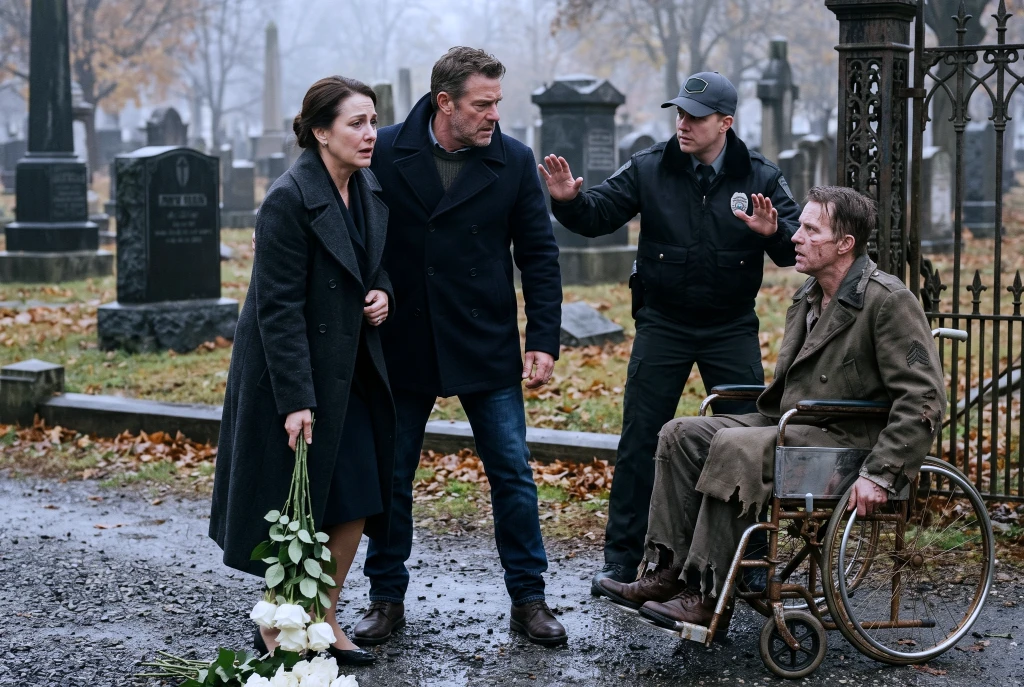
The man by the gate was thin enough that his coat hung from him like it belonged to somebody larger. One side of his face was badly scarred. His beard was untrimmed, his hair tangled beneath a knit cap, and his left hand gripped the rim of the wheelchair as if every push cost him. A cemetery security guard had already turned toward him with that careful, polite expression people used when they wanted a stranger to leave without making a scene.
Then the man looked past the guard and saw Margaret.
“Mom,” he called.
Daniel stepped in front of her before she could answer. He was sixty-two, broad-shouldered, still the kind of man who made contractors lower their voices and bankers return calls, but his body changed at that one word. He went rigid from his neck down, as if something cold had moved through his spine.
The man pushed closer. “Dad. Please. Don’t let him send me away.”
Margaret dropped the roses.
They landed face-down on the walkway, white petals crushed against wet gravel. For one terrible second she was not standing in a cemetery. She was standing in a county medical examiner’s office five years earlier, staring at a sealed casket she had begged them to open even after everyone told her not to. She was twenty-three years younger and twenty years older at the same time. She was hearing a detective say, “We’re very sorry, Mrs. Whitaker.”
Daniel’s voice came out low. “Get back.”
The guard, a heavyset man named Carl who had watched the Whitakers arrive every Sunday for five years, lifted one hand. “Sir, I’m going to need you to stop right there.”
The man stopped. His chest rose and fell under the dirty coat. Up close, the damage to his face was harder to look at. The scars pulled at his mouth and cheek. One ear had been partly rebuilt or partly lost; Margaret couldn’t tell which. But his eyes were clear brown, wide-set, with a small gold fleck near the left pupil.
Noah had that fleck.
Margaret made a sound she didn’t recognize.
Daniel turned sharply. “Margaret, don’t.”
The man in the wheelchair swallowed. “My name is Noah Daniel Whitaker. I was born on March 15 at St. Catherine’s. My first word was truck. I broke my left arm when I was seven because I climbed the maple by the back patio after Mom told me not to.” He breathed in, and his ruined mouth trembled. “Dad cut the branch down the next morning and told everybody it was diseased.”
Daniel’s face drained of color, but he did not move. “Anyone could find out pieces of a life.”
“Not that piece,” Margaret whispered.
The man heard her. His eyes shifted to hers, and for a moment the years fell away so violently that she almost reached for him. Noah at eight, barefoot and sunburned. Noah at fourteen, sulking over braces. Noah at twenty-three, kissing her cheek on his way out the door and promising he wouldn’t stay out late.
The man lowered his voice. “On my fifteenth birthday, you gave me a tungsten pendant because you said tungsten was almost impossible to break. You had the inside engraved where nobody else could see it.”
Daniel’s jaw tightened. “Stop.”
“It said, ‘Always my brave boy.’” The man’s hands clenched on the wheels. “Mom cried when I opened it, and Dad pretended he had something in his eye. Ruth made carrot cake because I hated regular birthday cake. She put orange zest in the frosting even though I told her it tasted like soap.”
Margaret covered her mouth.
Carl looked from the man to the Whitakers. His hand lowered by an inch. “Mr. Whitaker?”
Daniel didn’t answer. He was staring at the stranger with the helpless anger of a man who had spent five years nailing a door shut from the inside, only to hear someone knock from the other side.
“Noah died,” he said. “My son died in a fire.”
The man flinched, but he did not look away. “I know that’s what they told you.”
“They identified him.”
“They identified the pendant.”
Margaret bent slowly and picked up one rose from the ground. It was bruised along the edges. She held it by the stem because her hands needed something to do, and because if she did not hold something, she might reach for the man and never let go.
Daniel looked toward Carl. “Call the police.”
“No,” Margaret said.
Her husband turned. “Margaret.”
“No.” She stepped around him, though her knees were unsteady. “Let him speak.”
Daniel caught her wrist, not hard, but desperate. “You don’t know who he is.”
“I know what he said.” Her voice shook badly, but it held. “I know nobody outside our family knew about that engraving.”
The man in the wheelchair looked down then, as if her belief hurt more than Daniel’s doubt. “I don’t blame you for not recognizing me. Most mornings I don’t recognize myself.”
Margaret took one step closer. The guard stayed near, uncertain, but Daniel did not pull her back this time.
“What happened to you?” she asked.
The man closed his eyes. “I don’t remember all of it. Not yet.”
Daniel gave a bitter, broken laugh. “Convenient.”
“Dan,” Margaret said.
“No. Don’t Dan me.” He pointed toward the polished black headstone twenty yards away. NOAH DANIEL WHITAKER, BELOVED SON. Underneath it, Margaret had insisted on the words COME HOME TO US IN DREAMS. “I buried my son. I stood here every Sunday for five years. I watched my wife talk to a stone because there was nothing else left of him. And now some man rolls in here with a handful of stories and expects us to—”
“I remember the lake house,” the man cut in.
Daniel stopped.
The man’s voice dropped to almost nothing. “The one in Erie you sold after the accident. The downstairs bathroom had blue tile. I hated it. Dad said it looked like a swimming pool threw up. I remember hiding in the linen closet because Mom and Dad were fighting about Uncle Grant. Dad said he’d never bring him into the company. Mom said family was still family.”
Margaret stared at Daniel. That fight had happened behind a closed door when Noah was ten. They had never known he heard it.
A crow called somewhere among the trees. Carl shifted his weight and said softly, “Mr. Whitaker, do you want me to call anyone?”
Daniel’s mouth opened. Closed. Opened again.
Margaret moved before either man could decide. She crossed the last few feet and crouched in front of the wheelchair, careless of the wet hem of her coat, careless of the mud soaking through one knee of her slacks. The smell of cold air, unwashed wool, and old smoke clung to the man. Beneath it, something medicinal, sharp and faint.
She lifted her hand but stopped before touching his face.
The man leaned into her palm anyway.
That one small surrender broke something in her. Margaret had imagined Noah’s body a thousand ways after the funeral. She had imagined him whole in heaven because that was what mothers were told to do when the earthly facts were unbearable. She had not imagined him hungry. She had not imagined him scarred. She had not imagined him waiting at a cemetery gate, asking permission to exist.
“Oh, God,” she whispered. “Oh, my baby.”
Daniel stood behind her, breathing hard. He was not crying. Daniel Whitaker did not cry in public. Daniel had built Whitaker Development from a two-truck contracting business into one of the largest construction firms in Pennsylvania by controlling rooms, timelines, bids, emergencies, and people. He had not controlled grief. He had only outworked it.
“Margaret,” he said, but the warning had gone out of his voice.
The man looked past her. “I’ll take a test. DNA, fingerprints, whatever you want. I know I look like somebody dragged me out of a ditch because that’s exactly what happened. But I’m not here for money. I’m not here to hurt you.” His eyes returned to the black headstone. “I came because I remembered my name.”
The guard rubbed a hand over his jaw. “Do you still want police?”
Daniel looked at the grave, then at the man, then at Margaret kneeling in the gravel as if she had forgotten she was rich enough to have people kneel for her.
“No,” Daniel said at last. “Not yet.”
The drive back to Fox Chapel took forty minutes and felt much longer. Margaret sat in the back seat of the SUV beside the man who might be her son, one hand wrapped around his wrist because she needed to feel a pulse. Daniel sat in front beside the driver, silent, making calls in a voice so controlled it frightened her. Private lab. Emergency parentage test. Doctor on standby. Security told to keep reporters away, though no reporters knew anything yet.
The man watched Pittsburgh pass outside the window like he recognized it through water.
At the house, Ruth Donnelly opened the front door before the driver could ring. Ruth had worked for the Whitakers since Noah was in preschool. She was sixty-eight now, soft around the middle, silver-haired, and stern with everyone except Margaret. She saw the wheelchair first, then the scarred face, and her expression tightened with practiced household composure.
“Mrs. Whitaker?” she asked. “What’s happened?”
Margaret could barely speak. “Ruth. Make up Noah’s room.”
Ruth’s hand went to the doorframe. “I’m sorry?”
“Please.”
Ruth looked at Daniel, waiting for the correction that always came when grief made Margaret unreasonable. Daniel did not correct her. He only stood on the porch beside the wheelchair, pale and hollow-eyed.
The man looked up at Ruth. His voice was rough. “Do you still keep the good cinnamon in the coffee tin because Mr. Whitaker says he can’t tell the difference?”
Ruth stared at him.
“And do you still make that awful carrot cake with the orange frosting?” he asked. “I used to complain, but I always ate two pieces.”
Ruth made a small choking sound. “Noah?”
The man smiled, and the scarred side of his mouth struggled to follow the other. “Hi, Ruth.”
She crossed the porch and bent over him with both arms. She did not hesitate because of the smell or the dirt or the scars. She held him the way she had held him when he came home from camp, when he failed his first driving test, when he left muddy cleats on her clean kitchen floor and grinned his way out of trouble.
Daniel turned away.
By evening, the man had showered, shaved as much as his scars allowed, and changed into soft clothes Ruth found in a guest-room drawer. He looked less like a stranger and more like a wound that had learned to speak. Margaret sat beside him on the family room couch, holding one hand. Daniel stood near the fireplace, waiting for the lab call as if his body were made of wire.
The call came at 9:17 p.m.
Daniel answered on speaker because Margaret asked him to. The lab director’s voice was careful, professional, and far too calm for what he was about to say.
“Mr. Whitaker, the preliminary parentage results are complete. The probability of paternity is greater than 99.99 percent. The sample belongs to your biological son.”
Margaret folded forward over Noah’s hand.
Daniel did not move at first. He looked at the phone in his palm, then at the man on the couch, then at the framed photograph on the mantel: Noah at twenty-two, tan and laughing, one arm around Margaret, the old tungsten pendant glinting against his T-shirt.
When Daniel finally crossed the room, he did not walk like a powerful man. He walked like someone learning to stand after an accident. He dropped to his knees in front of the couch and gripped Noah’s shoulders with both hands, staring into his face as if he could put the old one back by force of wanting.
“My son,” Daniel said.
Noah leaned forward and rested his scarred cheek against his father’s temple. For a few seconds no one spoke. Ruth stood in the hallway with her apron pressed to her mouth, and Margaret held both of them, one hand on her husband’s back, the other on Noah’s arm.
Then Daniel pulled away just enough to look at him.
“Where have you been?” he asked. “How did this happen? Why didn’t you come home?”
Noah looked toward the mantel photograph, and his fingers moved to the hollow place at his throat where the pendant should have been.
“Before I tell you where I was,” he said quietly, “you need to ask me about the necklace.”
Daniel frowned. “What about it?” – “The one you buried me with,” Noah said. “It was never on my body…”
To read the rest of the story – CLICK the NEXT button 👇👇👇