


The first thing my daughter said at 2:47 in the morning was not “Help me.”
She said, “Dad, Evan hits me every day. I think I’m used to it.”
People imagine terror as screaming. Sometimes it sounds like a woman reading a grocery list because feeling anything has become too expensive. I sat up in the dark and listened to Claire breathe through her mouth, each breath shallow and careful.
“Where is he?” I asked.
“At the market. There was an alarm at one of the stores.”
“Are you bleeding?”
“No.”
“Can you take a full breath?”
A pause. “Not really.”
I swung my feet to the floor. At sixty-three, my left knee needed a second before it remembered its job, but the rest of me was already moving. Twenty-two years with Army Criminal Investigation had trained me to separate fear from the next useful action.
“Lock the door,” I said. “Put on shoes. If it’s safe, gather your ID, medication, and one change of clothes. Don’t call him. Don’t erase anything. I’m leaving now.”
“Dad, I’m not asking you to—”
“I know.” I kept my voice level. “I’m coming anyway. You can decide what happens after I get there.”
In the hall, I opened the small gun safe out of habit. My hand rested on the case for half a second, then I shut the door again. Claire had spent three years in a home where an angry man believed force gave him the final word. She did not need another angry man arriving with a weapon and calling it protection.
I took my coat, keys, phone charger, and the old leather notebook I had carried through half my career. Before I backed my Ford out of the driveway, I called Ray Alvarez, my former partner. He now supervised investigators for a state criminal bureau two counties north of Claire’s city.
Ray answered on the fourth ring. “Tom?”
“My daughter says her husband has been beating her. He’s Evan Whitaker.”
The sleep left Ray’s voice. Everyone in Riverton knew the name. Whitaker owned seven grocery stores, chaired the city council, funded youth leagues, and appeared in campaign photographs with his hand on somebody’s shoulder.
“Is she in immediate danger?” Ray asked.
“He’s away from the apartment for now. She may have broken ribs. She says local police didn’t help.”
“Get her medical care. Don’t confront him if you can avoid it. I’ll connect you with an advocate outside Riverton and make sure any complaint involving an officer gets routed beyond the city department.” He hesitated. “Tom, let her lead.”
“I know.”
I said it too quickly.
Rain found me forty miles from home and stayed with me all the way north. The wipers pushed gray water across the windshield while I replayed every explanation I had accepted because accepting it had been easier than asking another question. Claire had walked into Thanksgiving with makeup too thick under one eye. She had canceled Christmas because Evan was “sick.” Once, when she reached for a serving bowl, her sleeve slid back and showed four bruises shaped like fingertips.
She told me she had bruised herself moving furniture. I had looked at Evan. He had met my eyes and smiled.
I had told myself my daughter was thirty-four. I had told myself that pushing would drive her away. Some of that was wisdom. Some of it was cowardice dressed in respectful language.
Riverton sat along the Ohio River, all restored brick downtown and rusted mill buildings beyond the postcard streets. Evan and Claire lived in a glass condominium tower overlooking the water, the kind of place where the lobby smelled like cedar and no one admitted to hearing arguments through the walls.
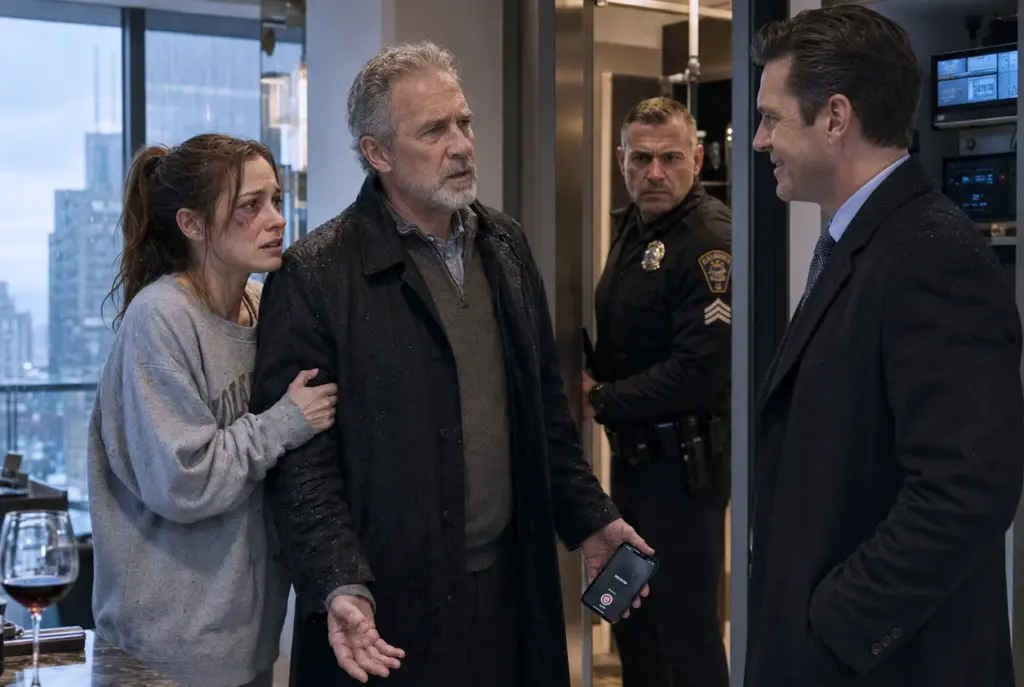
Claire opened the apartment door before I knocked. She wore gray sweatpants, an old college sweatshirt, and no shoes despite what I had told her. A purple mark curved beneath her left eye. One arm was folded across her ribs as if she were holding herself together.
“Hi, Dad,” she said.
I had prepared a dozen questions during the drive. None of them mattered when I saw her. I stepped inside and said the one thing she should not have had to earn.
“I believe you.”
Her face changed. Not dramatically. Her mouth opened, then closed, and the muscles around her eyes loosened as if she had been bracing for an argument. I hugged her carefully, keeping my arms high so I would not touch her ribs.
When she let go, I asked, “What do you want to happen today?”
“I want to leave.” She looked past me toward the elevator. “But he always finds me.”
“Then we figure out how.”
The apartment was large, expensive, and nearly silent. There were no family photographs except two wedding portraits chosen by a decorator. A camera sat above the entry, another faced the kitchen, and a third watched the living room from a shelf beside a white ceramic vase.
Claire saw me looking. “He says they’re for security.”
“Do they record inside all the time?”
“He checks them from work. If I leave the apartment, he asks why. If I sit somewhere the camera can’t see me, he calls.” She gave a small, embarrassed shrug. “Sometimes he rewinds them and tells me what my face meant.”
I wanted to rip every camera from the wall. Instead, I pulled out a chair and waited until she sat across from me.
The first assault had happened six weeks after the wedding. She answered a business call too casually while Evan was entertaining a supplier, and he slapped her in the pantry. For three days afterward, he brought flowers, cooked dinner, and cried into her lap. He said stress had turned him into someone he did not recognize.
The second time, he did not cry as long. By the end of the first year, apologies had become accusations. She was disrespectful. She embarrassed him. She made him lose control. He stopped her from working at the nonprofit where they had met, then placed her on a household allowance and demanded receipts. He changed the passwords on their accounts and added tracking to her phone “for safety.”
“I tried to leave twice,” she said. “The first time I stayed with Brooke in Dayton. Evan showed up before dinner. The second time I drove to a motel outside Columbus, and Sergeant Delling was waiting in the parking lot.”
“Paul Delling?”
She nodded. Delling was a Riverton police sergeant who often stood beside Evan at charity events.
“He said Evan was worried I might hurt myself. He put me in the back of his cruiser and drove me home. I kept telling him I wasn’t suicidal. He said I was making things difficult.”
“Did you file a report?”
“Two months ago. A patrol officer took pictures and brought me to the station. Delling came into the interview room and said he’d handle it. Then Evan’s lawyer arrived with a statement saying I didn’t want charges. I refused to sign it.” She stared at her hands. “The next day, the report was gone. The officer who took the pictures wouldn’t return my calls.”
I wrote down names and dates, but I did not tell her what we would do. Ray’s warning remained in my ear: let her lead.
“Claire, I think you need an ER,” I said. “I also think we should call the advocate Ray gave me. But neither happens unless you say yes.”
She looked toward the kitchen camera. “Can we make sure he can’t watch us first?”
The control hub was mounted inside a hall closet. Claire’s name appeared as an authorized user, though Evan had limited what she could change. With her beside me, I photographed the screen and called Ray. He gave us a secure upload address and told us not to delete, unplug, or alter the system.
“There’s an export button,” Claire said.
“Your account?”
“Yes.”
“Then you choose.”
She pressed it.
The archive opened by date. Most clips showed ordinary pieces of a life under observation: Claire making coffee, folding towels, standing alone at the window. Then we reached the previous night.
Evan came into the kitchen at 11:08 p.m. He was still wearing the blue suit from a council meeting. The video had no blind corner and no mercy. He accused Claire of ignoring a text. She showed him her dead phone. He struck her once, then again when she bent over, and shoved her into the counter hard enough to send a glass across the floor.
Beside me, Claire made a sound I had never heard from her. “I thought maybe I remembered it worse than it was.”
“You didn’t.”
We kept looking. Three weeks earlier, the kitchen camera had recorded Evan drinking with Sergeant Delling after midnight. Claire had been locked in the bedroom that night. On the video, Delling slid a paper across the island and said, “I cleaned up the complaint, but you need to keep her away from the hospital next time. Pictures make everybody’s life harder.”
Evan laughed. “She won’t try that again.”
Claire leaned closer to the screen. Her bruised face went still.
“He told me the report never existed,” she whispered.
Before I could answer, the control panel chimed. A notification appeared across the video: GARAGE ENTRY—EVAN WHITAKER.
The live feed replaced the archive. Evan stepped from the private elevator in the underground garage, rain shining on the shoulders of his coat. Sergeant Delling came out behind him, his badge clipped to his belt. Claire closed her hand around my sleeve. “That’s him,” she said. “That’s the officer who tore up my statement…”
To read the rest of the story – CLICK the NEXT button 👇👇👇